Mood shifts after replaying past events

 It explains why the brain automatically replays past moments and how that replay reactivates emotions in the body, often triggering regret, shame, or anger.
- Why the brain replays past moments automatically
- How memory replay reactivates emotions in the body
- Regret, shame, anger: common moods after replay
- Why “mental time travel” happens more under stress
- How to separate learning from self-punishment
- Techniques to stop replaying and calm the nervous system
- Using closure rituals to reduce emotional replays
- When intrusive replay may need professional help
Replaying an old moment in your mind can shift your emotions fast. One small detail might bring warmth, then flip to shame or anger, and later fade again. Noticing this pattern helps you understand what your mind is doing, steady your reactions, and decide what lessons to keep and what to let go.
Why the brain replays past moments automatically
Mental replay often shows up without invitation: a conversation loops on the commute, an awkward moment resurfaces in the shower, or a happy scene pops up while doing chores. This isn’t just “overthinking.” It’s a common way the mind sorts information, predicts what might happen next, and keeps important lessons easy to reach.
Everyday life gives the brain more input than it can fully process in real time. Replaying a memory is one shortcut for finishing the job later, especially when something felt emotional, surprising, or unresolved. The same mechanism can lift mood (by revisiting comfort or pride) or pull it down (by reactivating shame, anger, or loss), which is why mood shifts after replaying past events can feel sudden.
- To learn from outcomes: Re-running a scene helps the mind compare “what happened” with “what I expected,” so it can adjust future choices. This is why mistakes and near-misses tend to replay more than routine successes.
- To solve unfinished problems: When there’s no clear conclusion (an unclear text, a conflict that ended abruptly), the brain keeps the file open. The replay acts like a background attempt to reach closure or decide what to do next.
- To protect you from repeating danger: Threat-related memories are easier to trigger because they carry “don’t let this happen again” value. Even mild social threats, like embarrassment, can be treated as important because belonging matters.
- To maintain identity: People naturally revisit moments that support a self-story: “I’m capable,” “I’m careful,” “I’m not safe,” or “I’m not respected.” Those replays can stabilize a sense of self, even when the story is harsh.
- To regulate emotion: Sometimes replay is soothing (nostalgia, gratitude, connection). Other times it’s activating (rehearsing arguments, reliving rejection). The same memory can shift mood differently depending on current stress, fatigue, or context.
- To rehearse social situations: The mind practices what to say next time, how to set a boundary, or how to avoid a repeat. This can be useful preparation, but it can also turn into repetitive rumination when it stops producing new options.
What gets replayed most is usually what feels important rather than what is objectively big. A small comment can loop for days if it touched a sensitive spot, while a major event might stay quiet until something reminds you of it.
Triggers are often ordinary: a smell, a song, a location, a tone of voice, or even a similar facial expression. Once the memory is active, the body may respond as if the event is happening again, which helps explain why mood shifts after replaying past events can feel physical as well as mental.
How memory replay reactivates emotions in the body

Replaying a past moment can set off the same body signals that showed up the first time. The brain doesn’t store experiences as a single “file”; it keeps connected pieces like images, sounds, meanings, and physical sensations. When you mentally run the scene again, those linked pieces can switch on together, so your body reacts as if something important is happening now.
This is why a quick flashback to an argument can tighten your jaw, or remembering an embarrassing moment can make your face feel warm. The memory itself is not dangerous, but your nervous system may still treat it as a cue to prepare for action.
- Sensory details act like triggers. A remembered tone of voice, a smell, or a specific place can “pull up” the emotional layer attached to it, not just the facts.
- Your body prepares before you finish the thought. Heart rate, breathing, and muscle tension can change quickly, because the brain is built to respond fast to anything that resembles past threat or reward.
- Meaning drives intensity. If the replayed event is interpreted as rejection, failure, or danger, the reaction tends to be stronger than if it’s framed as a misunderstanding or a one-off mistake.
- Attention keeps the loop going. The more you focus on “what I should have said” or “what might happen next,” the longer the body stays activated.
- Safety cues calm the system. Noticing you’re currently safe (where you are, who you’re with, what you can control) can reduce the physical surge, even if the memory remains unpleasant.
| What the mind replays | Common body response | How it can shift mood afterward |
|---|---|---|
| A conflict or criticism | Tight chest, clenched stomach, shallow breathing | Irritability, defensiveness, feeling on edge |
| An embarrassing moment | Face warmth, urge to look away, restless energy | Self-consciousness, withdrawal, low confidence |
| A loss or painful goodbye | Heaviness, slower movement, lump in throat | Sadness, fatigue, reduced motivation |
| A success or warm connection | Looser muscles, deeper breathing, lightness | Optimism, calm focus, more patience |
| An unresolved “what if” scenario | Racing heart, scanning thoughts, tension headaches | Anxiety, indecision, trouble settling |
These reactions often happen during ordinary routines: commuting, showering, lying in bed, or scrolling on a phone. A small cue starts the replay, the body ramps up, and the mood shift can linger because hormones and muscle tension don’t always drop instantly when the thought changes.
Over time, repeated mental reruns can make certain emotional patterns feel automatic. If the same event is revisited with blame or danger-focused interpretations, the body learns to respond faster. If it’s revisited with context, self-compassion, or a clearer ending, the physical response is more likely to soften, and the mood swing tends to pass sooner.
Regret, shame, anger: common moods after replay
When people mentally replay a past conversation, mistake, or missed chance, the emotional tone often shifts quickly from “just thinking” to a heavy, sticky feeling. The mind tends to zoom in on what should have happened, what was said “wrong,” or what felt unfair. That narrow focus can make certain emotions show up more strongly than they did in the moment.
Three reactions come up often because they match three different ways the brain explains the event: regret focuses on choices, shame focuses on the self, and anger focuses on blame or boundary violations. These moods can overlap, and the same memory can trigger different feelings on different days depending on stress, sleep, or what the replay reminds you of.
- Regret tends to sound like “If only I had…” or “I should have known.” It’s usually tied to decision points: not speaking up, choosing the wrong words, waiting too long, or taking a risk that didn’t pay off. In everyday behavior, regret often leads to mental time-traveling (rewriting the scene), repeated checking of what could have been done, and a push to “fix it” even when the moment has passed.
- Shame is more global and personal: “What’s wrong with me?” rather than “That choice didn’t work.” It can show up after replaying moments of embarrassment, conflict, or perceived rejection. Common patterns include replaying facial expressions and tone of voice, assuming others judged you more harshly than they did, and avoiding similar situations later to prevent a repeat.
- Anger often appears when the replay centers on unfairness, disrespect, or crossed boundaries. The mind re-runs the scene looking for proof of intent: “They knew what they were doing.” Typical behaviors include drafting imaginary comebacks, rehearsing future confrontations, and feeling physically keyed up (tight jaw, clenched hands) while the memory loops.
These moods also have different “targets,” which can change what someone does next. Regret usually targets the past choice, shame targets identity and social standing, and anger targets another person or situation. Noticing the target can explain why one replay ends in problem-solving while another ends in withdrawal or a desire to argue.
| Mood after replay | What the mind fixates on | Common inner phrasing | Typical behavior pattern |
|---|---|---|---|
| Regret | Missed options and alternative outcomes | “I should have done X.” | Rewriting the scenario, searching for the “right” move, trying to undo or compensate |
| Shame | How you appeared to others; perceived flaws | “I’m so embarrassing.” | Avoidance, over-apologizing, people-pleasing, hiding details of the event |
| Anger | Unfairness, disrespect, or boundary violations | “They had no right.” | Rehearsing arguments, seeking validation, scanning for similar threats |
| Mixed (regret + shame + anger) | Both the choice and what it “says” about you and others | “I messed up, and they took advantage.” | Rapid mood swings, rumination loops, difficulty deciding whether to repair, confront, or withdraw |
A useful everyday distinction is that regret often comes with a desire to learn, shame comes with a desire to disappear, and anger comes with a desire to push back. During replay, the mind can treat feelings as evidence, so the stronger the emotion, the more “true” the story can seem. That’s why a small moment can start to feel like a defining one when it’s revisited repeatedly.
Why “mental time travel” happens more under stress
When pressure is high, the mind often shifts into a “scan for danger” mode. In that state, replaying old moments can feel less like daydreaming and more like problem-solving: the brain searches the past for clues about what went wrong, what to avoid, or what to fix. That’s why stressful days can make yesterday’s argument or last year’s mistake pop back up with surprising intensity.
Stress also narrows attention. Instead of taking in the full context of the present, people tend to focus on whatever seems most urgent or threatening. Memories linked to similar emotions or situations become easier to access, so a small trigger (a tone of voice, an email subject line, a place you pass) can pull you into a vivid replay of an earlier event.
- Threat detection gets priority. Under strain, the brain treats uncertainty like risk. Revisiting past outcomes becomes a quick way to predict what might happen next.
- Unfinished business feels louder. Stress makes unresolved situations stand out. If something ended without closure, the mind keeps “reopening the file” to look for a better ending or explanation.
- Emotional memory becomes more accessible. Strong feelings act like bookmarks. When you’re tense, memories tagged with fear, shame, anger, or regret are easier to retrieve than neutral ones.
- Sleep and recovery are often reduced. Stress commonly disrupts rest. With less mental recovery, intrusive recollections and repetitive thinking tend to increase, especially in quiet moments.
- Control-seeking increases. Replaying scenes can create the sense that you’re preparing or preventing mistakes, even if it mostly fuels rumination.
A key reason mood shifts after replaying past events is that the body reacts as if the memory is happening now. Heart rate can rise, muscles tighten, and the mind starts interpreting the present through the emotional lens of the recalled moment. That can turn a neutral afternoon into irritability, sadness, or anxiety within minutes.
| Stress-related trigger | Typical “time travel” pattern | Common mood effect |
|---|---|---|
| Conflict or criticism | Replaying conversations, imagining better comebacks, re-checking what was said | Anger, shame, defensiveness |
| Uncertainty (waiting, ambiguous messages) | Searching memory for similar situations and how they ended | Anxiety, restlessness |
| Overload and time pressure | Reviewing past mistakes to avoid repeating them, “what if I mess up again?” loops | Tension, self-doubt |
| Loneliness or social comparison | Revisiting old relationships, missed chances, “why did that happen?” stories | Sadness, longing |
In everyday life, this mental back-and-forth is often strongest during transitions: right before sleep, in the shower, on a commute, or while doing routine tasks. The mind has spare bandwidth, and stress fills it with reviews and forecasts. The result is that a memory isn’t just remembered; it’s re-experienced, and the mood follows.
How to separate learning from self-punishment
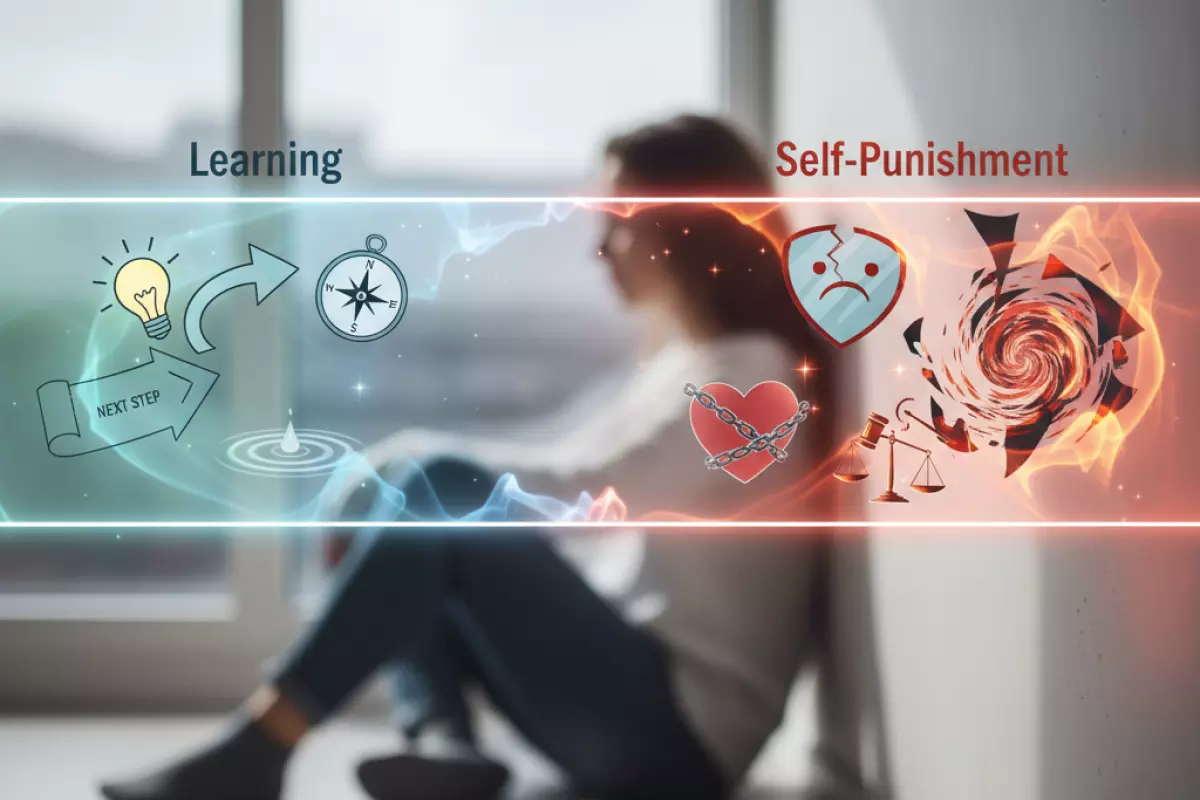
When you replay a past event, the mind often mixes two different activities: extracting a useful lesson and delivering a verdict about your worth. The first tends to calm things down over time because it creates clarity and a next step. The second usually intensifies mood shifts because it keeps the scene emotionally “live,” as if it is still happening.
A practical way to tell them apart is to look at the output. Learning produces a specific adjustment you could try in the future. Self-punishment produces a global conclusion, like “I always ruin things,” and leaves you stuck in the same loop.
| What it sounds like in your head | What it leads to |
|---|---|
| “Next time I’ll pause before replying and ask one clarifying question.” | A concrete plan; the memory loses intensity because it has been processed. |
| “I shouldn’t have said that, I’m so embarrassing.” | Shame and rumination; the same moment keeps replaying without resolution. |
| “I missed the cue; I can watch for that earlier.” | Skill-building; more realistic confidence and fewer mood swings afterward. |
| “If they saw the real me, they’d reject me.” | Threat response; more avoidance, more scanning for signs you did something wrong. |
- Limit the review to one question: “What is one thing I can do differently next time?” If you can’t answer in one sentence, the mind is often drifting back into self-attack.
- Separate facts from interpretations: Facts are observable (“I raised my voice”). Interpretations are judgments (“I’m a terrible person”). Keeping them distinct reduces the emotional charge of the replay.
- Use “behavior” language, not “identity” language: “That comment was unhelpful” supports change; “I’m unhelpful” invites punishment and makes the memory stickier.
- Stop at the first workable takeaway: Once there is a clear lesson, continuing to rewind the scene usually becomes a search for pain, not insight.
- Check for a repair step: If the event involved someone else, learning often includes a small action (clarify, apologize, set a boundary). Punishment focuses on replaying the moment instead of improving the outcome.
- Notice the body signal: Useful reflection tends to feel steady or neutral. Self-punishment often comes with tightness, heat, or a sinking feeling, which can trigger sharper mood shifts.
If the replay keeps escalating, it can help to “close the file” with a brief summary: what happened (one sentence), what you learned (one sentence), and what you’ll do (one sentence). That structure turns the memory into information rather than a recurring sentence you have to serve.
Techniques to stop replaying and calm the nervous system
When the mind keeps looping a past conversation or mistake, the body often reacts as if the event is happening again: tighter muscles, faster heart rate, shallow breathing, and a narrower focus. The goal is to interrupt the loop and send clear “safe enough right now” signals to the brain and body, so emotions can settle and thinking becomes more flexible.
- Name the loop, then label the feeling. A quick, neutral statement such as “This is replaying” plus “I’m feeling embarrassed/angry/anxious” helps separate the memory from the present moment. This reduces the sense that the thought is an emergency that must be solved immediately.
- Use a short grounding scan (30–60 seconds). Look for 5 things you can see, 4 you can feel (feet on the floor, fabric on skin), 3 you can hear, 2 you can smell, and 1 you can taste. This shifts attention from mental images to current sensory input, which can lower the intensity of the emotional surge.
- Lengthen the exhale to downshift. Try inhaling gently for 4 counts and exhaling for 6–8 counts for a few rounds. A longer exhale tends to reduce physiological arousal, which makes it easier to stop “arguing with the memory” in your head.
- Do a “completion cue” for the brain. Replaying often continues because the mind wants closure. Write one sentence that captures the lesson (for example, “Next time I’ll pause before responding”) and one sentence that closes the file (“I can’t redo it; I can repair what’s possible”). Keep it brief so it doesn’t become another rumination ritual.
- Schedule a contained worry window. If the loop keeps returning, set a specific time later (10–15 minutes) to think it through on purpose. When it pops up earlier, redirect with “Not now, at 7:00.” This trains the brain to stop treating the thought as urgent all day.
- Switch from replaying to problem-solving. Ask: “Is there a real action I can take?” If yes, choose one small step (send a clarifying message, plan what to say, make a note for next time). If no, shift to soothing rather than analysis, because more reviewing won’t create new information.
- Move the body to discharge stress. A brisk 5–10 minute walk, shaking out arms, stretching hips/shoulders, or a few slow squats can help metabolize the stress response. Physical movement often reduces the “stuck” feeling that keeps mental loops going.
- Try a compassionate reframe without excusing. Replace harsh conclusions (“I’m terrible”) with a more accurate statement (“I handled that imperfectly while stressed”). This lowers shame and defensiveness, two emotions that commonly fuel repeated mental playback.
- Reduce triggers that keep the memory active. If certain cues restart the loop (scrolling, alcohol, specific chats, late-night silence), adjust the environment: limit exposure, add background sound, or choose a different activity during vulnerable times like bedtime.
| If you notice… | What it usually means | Try this in the moment |
|---|---|---|
| The same scene plays with sharper details | Your brain is scanning for threat or “what went wrong” | Grounding scan + label the emotion |
| Urge to mentally rewrite what you said | Seeking control and closure | Write one lesson + one closing sentence |
| Body feels keyed up (tight chest, restless, tense jaw) | Nervous system is activated | Longer exhale breathing + brief movement |
| Loop returns most at night or when alone | Less distraction, more internal focus | Set a worry window earlier + calming routine before bed |
These tools work best when they’re repeated consistently rather than used once in a crisis. Over time, the mind learns that remembering is allowed, but replaying is optional, and the body learns to come back to baseline more quickly after a memory spike.
If replaying is frequent, tied to trauma, or causes major sleep or functioning problems, it can help to talk with a qualified professional. Persistent loops can be a sign that the nervous system is stuck in protection mode and needs more structured support.
Using closure rituals to reduce emotional replays
When a past moment keeps looping in the mind, it often feels unfinished. A closure ritual is a small, intentional action that signals to the brain, “this is complete for now,” so the memory is less likely to keep re-triggering mood shifts. The goal is not to erase what happened, but to give the mind a clear stopping point instead of leaving the event open-ended.
These rituals work best when they match typical replay patterns. People often rehash events at predictable times (late at night, in the shower, during commutes) and in predictable ways (re-reading messages, imagining alternative outcomes, replaying a conversation). Adding a brief closing step at the end of the replay can reduce the emotional “aftertaste” that lingers and spills into the rest of the day.
- Name the loop, then label the need. A simple line like “I’m replaying that meeting because I want reassurance” turns a vague swirl into a specific need, which lowers intensity and makes the next step clearer.
- Write a two-minute ending. Jot down what happened, what you wish had happened, and what you choose to do next. Keeping it short matters; long journaling can turn into more rumination.
- Use a physical “done” cue. Close the notebook, wash your hands, put the phone in a drawer, or step outside for three breaths. The body action becomes a marker that the review is over.
- Send a message you do not send. Draft the text or email you wish you could send, then save it as a note or delete it. This can satisfy the urge to respond without reopening the situation.
- Do a quick values reset. Choose one value the event challenged (respect, fairness, belonging) and one small action that reflects it today. This shifts attention from “what should have happened” to “what I can stand for now.”
- Schedule the next review. If the mind insists it is not finished, set a specific time to revisit it (for example, 15 minutes tomorrow). This containment often reduces spontaneous emotional replays in the meantime.
| Common replay trigger | What it tends to do to mood | Closure ritual that fits |
|---|---|---|
| Re-reading a chat or email thread | Reactivates anger or embarrassment; keeps the body keyed up | Archive the thread, write one sentence of “what I know now,” then put the phone out of reach for 10 minutes |
| Imagining a better comeback in a conversation | Creates agitation and a sense of unfinished business | Speak the “ideal line” once out loud, then end with a closing phrase like “That’s the end of that scene” |
| Nighttime replay in bed | Shifts mood downward and makes sleep harder | Two-minute note: “What happened / what I’m worried it means / the most likely explanation,” then lights out |
| Post-event scanning for mistakes (after a date, interview, presentation) | Turns normal uncertainty into self-criticism | List one thing that went fine, one thing to adjust next time, then do a brief grounding action (feet on floor, slow exhale) |
For closure rituals to stick, they need to be repeatable and specific. Vague intentions like “stop thinking about it” usually backfire, while concrete steps create a predictable endpoint. Over time, the mind learns that the replay has a boundary, which can reduce how often the same memory pulls mood around.
If a memory keeps returning with high intensity, the ritual can still help, but it may also be a sign that something practical needs attention (a conversation to have, a boundary to set, an apology to make, or support to seek). In those cases, the closing step works best when paired with one small, realistic next action.
When intrusive replay may need professional help
It can be normal to revisit a mistake, a conflict, or an embarrassing moment and feel your mood shift. Support becomes important when the replay starts to feel less like reflection and more like something that “happens to you,” pulling attention away from daily life or triggering intense distress.
Patterns that often signal it’s time to talk with a qualified professional include:
- The replay feels uncontrollable, showing up repeatedly even when you try to redirect your attention.
- Strong physical stress reactions occur during the memory loop, such as racing heart, nausea, shaking, sweating, or feeling panicky.
- Your mood drops sharply or stays low for hours or days after revisiting the event, rather than easing with time.
- Sleep is disrupted by recurring scenes, nightmares, or a mind that won’t “shut off” at night.
- Avoidance grows, such as steering clear of places, people, conversations, or tasks that remind you of what happened.
- Everyday functioning changes, including trouble concentrating at work or school, increased irritability, or withdrawing from relationships.
- Reassurance-seeking becomes a loop, like repeatedly asking others if you did something wrong, rereading messages, or mentally “checking” what you said.
- Substances or compulsive habits increase as a way to numb the feelings that follow the memory replay.
Some experiences are more likely to produce intrusive reliving, especially after events that felt threatening, violating, or deeply shaming. In those cases, the mind may replay details in a way that resembles being back in the moment, rather than remembering it from a distance.
| What it can look like | Why it may matter |
|---|---|
| Replaying the scene many times a day and feeling “stuck” on one detail | Can reinforce anxiety and keep the nervous system on alert, making mood swings more frequent |
| Feeling detached, unreal, or “not present” during or after the memory | May be a dissociative response that deserves assessment, especially if it interferes with safety or work |
| Flashback-like moments triggered by sounds, smells, or locations | Can indicate the memory is being processed as a threat cue rather than a past event |
| Persistent guilt, shame, or self-blame that doesn’t shift with new information | May point to depression, trauma-related distress, or rigid thinking patterns that respond well to treatment |
Immediate support is especially important if the replay is paired with thoughts of self-harm, feeling unable to stay safe, or a sense that life isn’t worth living. In those situations, reaching out for urgent professional care can help stabilize the moment and create a plan for next steps.
In many cases, therapy focuses on reducing the intensity and frequency of intrusive replay, building skills to settle the body after a trigger, and changing the meaning the mind attaches to the event. The goal is not to erase memory, but to make it feel like something that happened in the past rather than something that keeps re-happening in the present.