Emotional fluctuations that feel random

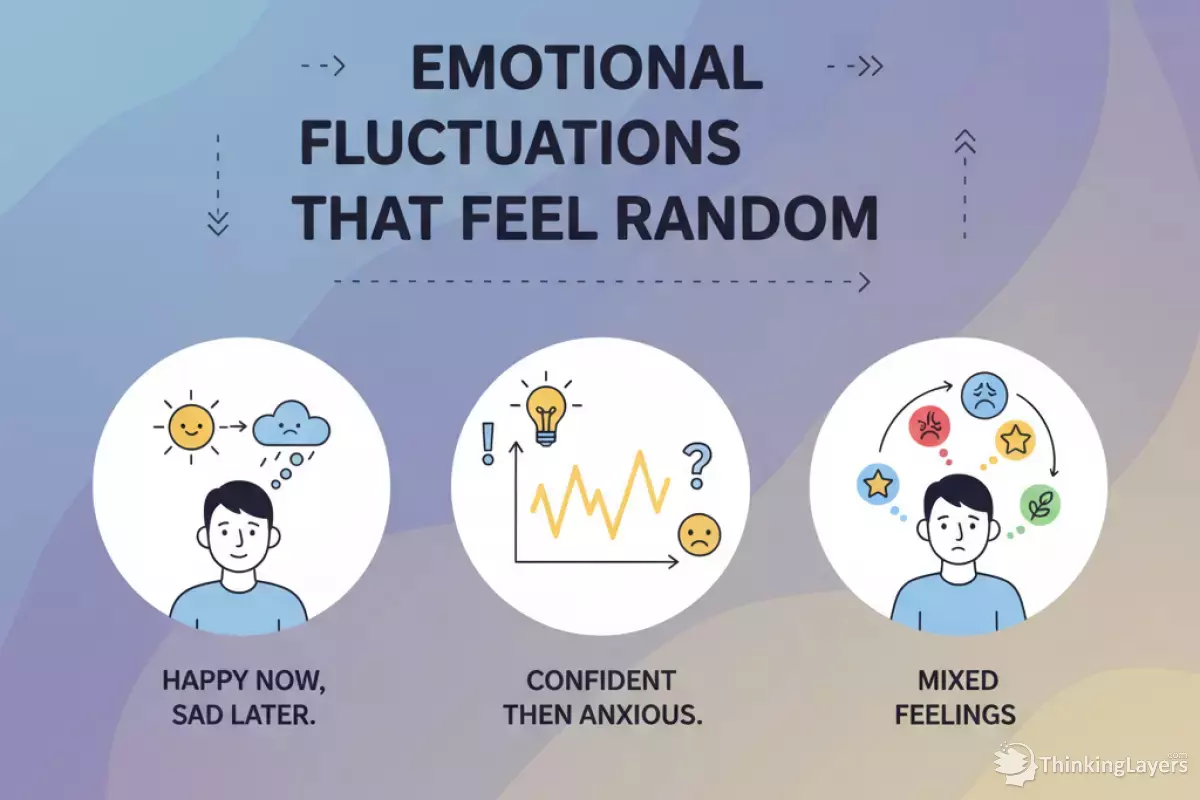 The article explains why emotions can shift without a clear trigger, how stress buildup can hit later, and how mental overload and decision fatigue affect mood. It also covers sleep, hunger, low energy, overstimulation, and why feelings surface after being ignored, plus simple routines to steady them.
- Why emotions can change without obvious reasons
- How stress buildup shows up later as mood shifts
- The impact of mental overload and decision fatigue
- Sleep, hunger, and low energy as hidden mood drivers
- How overstimulation affects patience and mood
- Why emotions surface after pushing them aside
- Simple routines that make emotions feel steadier
Sudden mood swings can make you question your own stability, but they’re often your mind and body responding to small stresses, changes in sleep, hormones, or needs you haven’t identified yet. Try tracking when they happen and what was going on beforehand, without judging yourself. Look for patterns in rest, food, workload, and social pressure, and consider reaching out for support if the swings feel intense or persistent.
Why emotions can change without obvious reasons
Mood shifts can seem to come out of nowhere because the brain is constantly integrating small signals from the body, the environment, and recent experiences. Many of these inputs are subtle enough that they do not register as a clear “cause,” yet they still influence how calm, motivated, irritable, or low someone feels in the moment.
Everyday emotional swings often reflect accumulated micro-stress rather than one big trigger. A slightly shorter night of sleep, a tense commute, background noise, or a busy schedule can stack up. When the mind finally notices the change, it may feel random simply because the buildup happened gradually.
- Body state changes: Hunger, dehydration, caffeine, alcohol, hormonal shifts, and illness can all alter energy and patience. Even mild physical discomfort can tilt emotions toward frustration or sadness without an obvious narrative reason.
- Sleep and circadian rhythm: A small sleep debt or an off-timed nap can affect emotional regulation, making reactions sharper or motivation lower than usual.
- Unprocessed thoughts in the background: The mind can keep working on worries, decisions, or social concerns outside of focused awareness. The emotional “output” shows up first, while the thought process stays faint.
- Context cues you barely notice: Lighting, temperature, clutter, loud spaces, or too much screen time can increase tension. Likewise, a familiar song, smell, or place can bring up feelings linked to past experiences.
- Social ripple effects: A brief awkward interaction, delayed reply, or subtle tone shift can create uncertainty. People often feel the emotional impact before they can identify the social cue that started it.
- Decision fatigue: After many small choices, self-control and patience can drop. The result can look like a sudden mood dip, even though it is tied to mental load.
- Expectation gaps: Feeling “off” can come from the difference between how the day is going and how it was supposed to go. Disappointment or restlessness may appear without a single clear event.
| Hidden driver | How it can feel | Common everyday clue |
|---|---|---|
| Low blood sugar or dehydration | Sudden irritability, low mood, “thin patience” | Skipped meal, long gap between snacks, dry mouth, headache |
| Sleep debt | More sensitivity, pessimism, emotional “heaviness” | Waking up unrefreshed, afternoon slump, relying on caffeine |
| Overstimulation | Restlessness, agitation, feeling overwhelmed | Too many notifications, noisy environment, multitasking |
| Background worry | Unease, dread, difficulty relaxing | Upcoming deadline, unresolved conflict, waiting for news |
| Social uncertainty | Self-doubt, embarrassment, sudden sadness | Short reply, ambiguous comment, being left out of a plan |
| Hormonal cycle or health fluctuations | Tearfulness, irritability, low motivation | Timing patterns across weeks, new medication, getting sick |
Because these influences are ordinary and often overlapping, it is common for feelings to change without a clear storyline. Noticing patterns over time can make the shifts feel less mysterious, even when there is no single “obvious reason” to point to in the moment.
How stress buildup shows up later as mood shifts
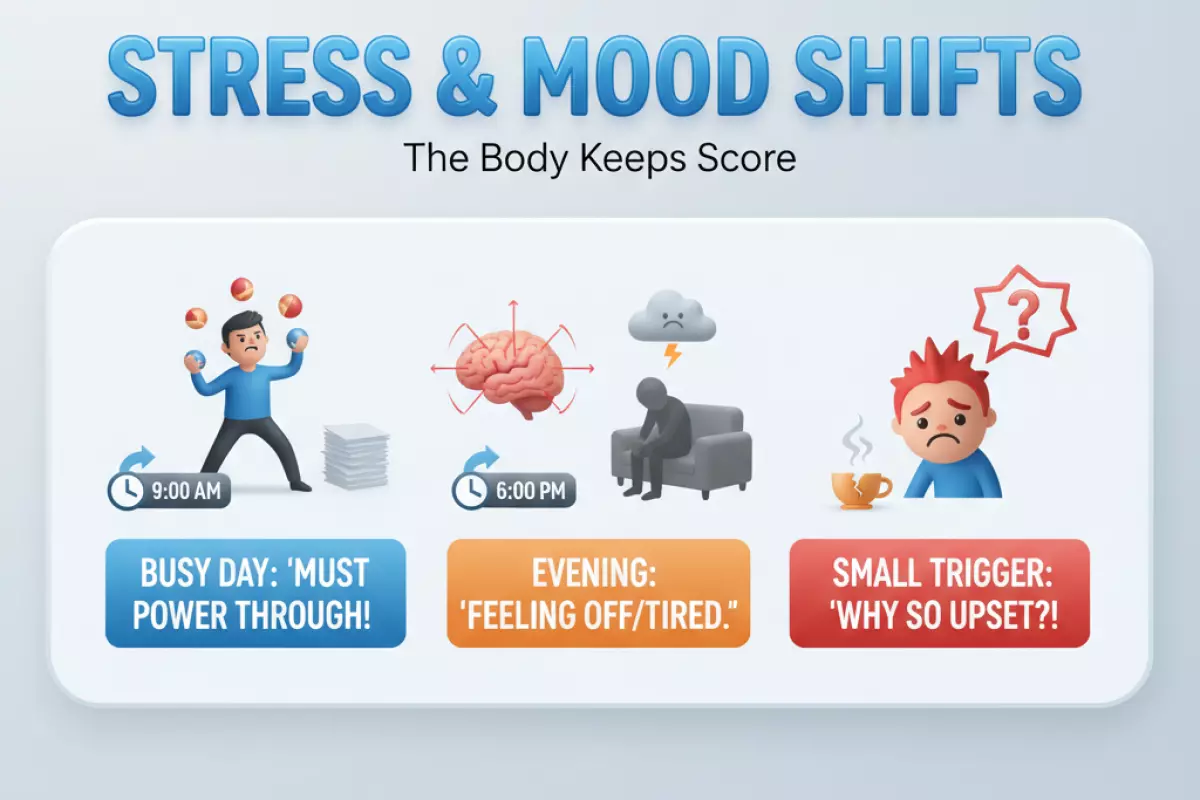
Stress often doesn’t land emotionally in the moment it happens. When the day is busy or demanding, the mind can stay in “get through it” mode, and feelings get postponed. Later, when things finally quiet down, that stored tension can surface as irritability, sadness, restlessness, or sudden sensitivity that seems out of proportion to what’s happening.
This delayed reaction is common because the body keeps score. Elevated adrenaline and cortisol can help with short-term performance, but when they stay high, sleep quality drops, patience thins, and small problems start to feel bigger. Mood changes can then show up hours or even days after the original strain, making the shift feel random.
- After-work emotional drop: Holding it together all day can lead to a crash at home, where frustration or tearfulness appears once the pressure is off.
- Short fuse over minor issues: A small inconvenience (traffic, a slow website, a misplaced item) triggers a bigger reaction because the stress “bucket” is already full.
- Numbness followed by overwhelm: Feeling detached during a stressful stretch, then suddenly feeling everything at once when there’s a pause.
- Low motivation and withdrawal: Ongoing demands can drain energy, leading to canceling plans, procrastination, or wanting to be left alone.
- Sleep-related mood swings: Stress disrupts falling asleep or staying asleep, and the next day can bring irritability, anxiety, or gloominess without a clear cause.
- Body signals that steer mood: Headaches, stomach upset, jaw tension, or muscle aches can make people more reactive and less resilient.
| Where the stress builds up | How it may show up later | Why it can feel “out of nowhere” |
|---|---|---|
| Work or school deadlines | Snappiness, impatience, difficulty concentrating | The pressure was managed in the moment, but the nervous system stays activated afterward |
| Conflict avoidance (not saying what you need) | Resentment, sudden anger, passive withdrawal | The trigger is old, but it surfaces during a new, smaller interaction |
| Too many small tasks and decisions | Feeling fragile, easily overwhelmed, crying spells | Decision fatigue accumulates gradually, so the tipping point isn’t obvious |
| Caregiving or constant responsibility | Emotional flatness, guilt, then bursts of frustration | There’s little recovery time, so emotions rebound when a brief gap appears |
| Social overload or people-pleasing | Sudden need to isolate, irritability, sensitivity to criticism | Energy is spent “performing okay,” leaving fewer resources for regulation later |
These patterns are also shaped by timing. Mood often shifts when a person transitions: commuting home, getting into bed, finishing a project, or arriving at the weekend. The change in pace removes distractions, and the body finally registers what it has been carrying.
Noticing the lag can make the experience feel less mysterious. When a strong reaction shows up, it can help to scan the previous day or two for accumulated strain, skipped meals, poor sleep, unresolved conversations, or nonstop problem-solving. The “cause” is frequently the buildup, not the last small event.
The impact of mental overload and decision fatigue
When the brain is juggling too many inputs and choices, emotions can start to swing in ways that seem disconnected from what’s happening. Small frustrations feel bigger, patience runs thinner, and mood can shift quickly because the mind is spending its remaining energy just to keep up.
Mental overload often builds quietly: constant notifications, back-to-back tasks, unfinished errands, and background worries all compete for attention. As the day goes on, decision fatigue can kick in, meaning the ability to evaluate options calmly gets weaker. The result is not only slower thinking, but also more reactive feelings.
- Lower tolerance for minor stressors: everyday inconveniences (traffic, a slow website, a messy room) can trigger disproportionate irritation.
- More “snap” responses: replies become shorter, tone gets sharper, and misunderstandings happen more easily.
- Indecision followed by impulsivity: after struggling to choose, people may suddenly pick the quickest option just to end the mental effort.
- Emotional numbness or detachment: instead of feeling “too much,” some people feel flat because the system is conserving energy.
- Rumination loops: the mind replays the same concerns because it lacks the bandwidth to resolve them.
These patterns can create a confusing emotional “whiplash” effect: a person may feel fine during focused work, then suddenly feel overwhelmed when faced with a simple choice like what to eat, whether to answer a message, or how to prioritize the next task. The emotion isn’t random so much as it’s tied to depleted mental resources.
| Common situation | What it demands | Typical emotional shift | Why it happens |
|---|---|---|---|
| Too many small decisions (emails, errands, scheduling) | Frequent switching and evaluating | Irritability, impatience | Self-control and attention get used up with repeated choices |
| Multitasking or constant interruptions | Rapid refocusing | Anxiety, restlessness | The brain stays in “alert” mode and struggles to settle |
| Unfinished tasks piling up | Holding open loops in memory | Guilt, tension | Mental load increases when closure is missing |
| End-of-day choices (food, chores, social plans) | Planning and restraint | Indecision, then impulsive choices | Decision fatigue makes “easy now” feel more appealing than “best later” |
Because overload affects both thinking and emotional regulation, moods may improve quickly after reducing inputs, simplifying choices, or completing one small task that restores a sense of control. In everyday life, this is why emotions can look unpredictable late in the day, after long stretches of concentration, or during periods with too many competing demands.
Sleep, hunger, and low energy as hidden mood drivers
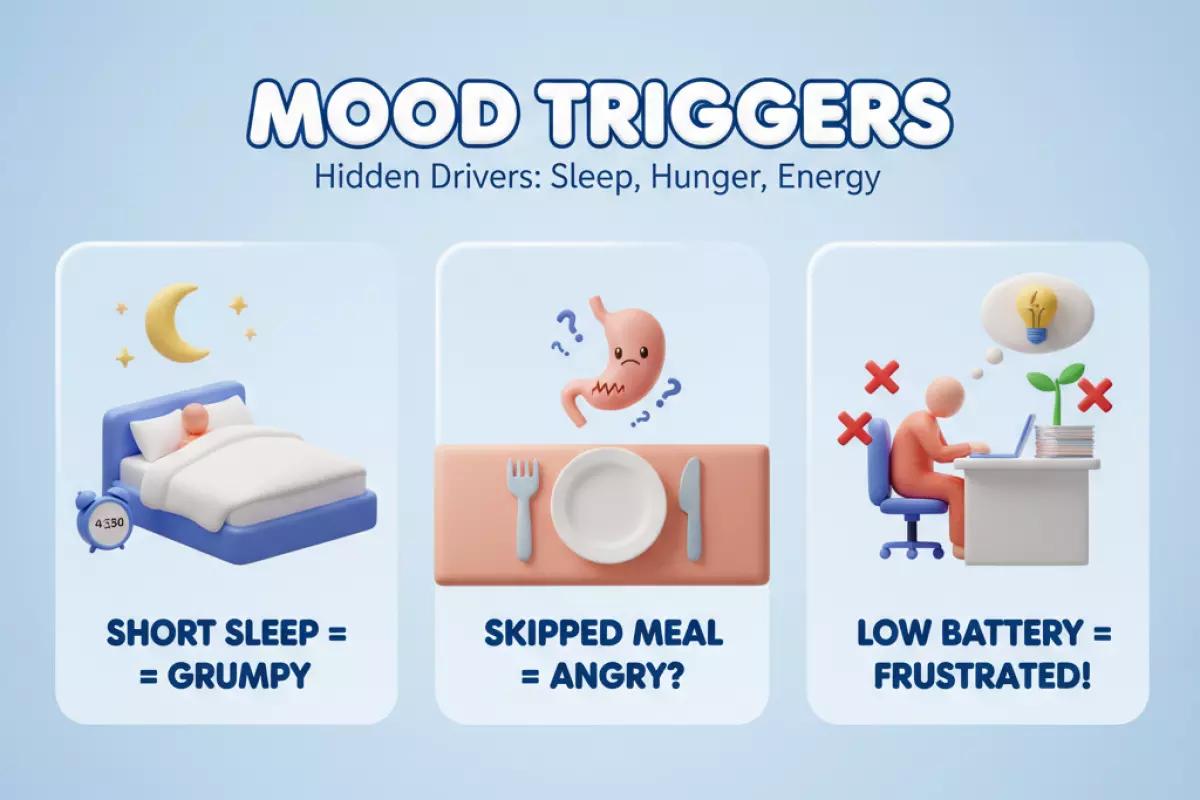
Basic body needs can quietly steer emotions, making mood shifts feel sudden or “out of nowhere.” When sleep is short, meals are delayed, or energy is depleted, the brain tends to interpret everyday events as more stressful and less manageable. Small frustrations can land harder, patience runs thinner, and it may feel difficult to access motivation even when nothing “big” has happened.
These patterns are common because the body prioritizes survival and efficiency. When resources are low, attention narrows, self-control takes more effort, and the nervous system is more reactive. The result can look like irritability, sadness, anxiety, or emotional numbness, even though the real driver is physical strain rather than a meaningful change in circumstances.
- Sleep debt: Less sleep reduces emotional buffering. People often notice quicker annoyance, more negative interpretations of texts or tone, and stronger reactions to minor setbacks.
- Hunger and blood sugar dips: When meals are skipped or delayed, it’s typical to feel edgy, shaky, unfocused, or unusually sensitive. Decision-making can become more impulsive, and conflicts can escalate faster.
- Low energy from overexertion: After long workdays, heavy caretaking, intense workouts, or sustained stress, emotions may flatten or swing. It can feel like “I don’t care” or “everything is too much,” depending on the person and situation.
- Dehydration and caffeine swings: Too little water or too much caffeine can mimic anxiety (racing thoughts, restlessness) or amplify irritability, especially when paired with poor sleep.
| Body state | How it can show up emotionally | Common behavior patterns | Simple first step to test the theory |
|---|---|---|---|
| Short or broken sleep | More reactive, pessimistic, tearful, or easily overwhelmed | Snapping, overthinking, reading criticism into neutral comments | Reduce demands for a few hours; aim for an earlier bedtime or a short nap if possible |
| Skipped meal / long gap between meals | Irritability, anxiety-like tension, sudden low mood | Impatience, cravings, “everything feels urgent,” trouble concentrating | Eat something with protein and carbs; reassess mood 20–40 minutes later |
| Overextended / depleted | Numbness, low motivation, feeling “done” with everything | Withdrawal, procrastination, shutting down during conversations | Take a real break (sit, breathe, step outside); postpone non-urgent decisions |
| Caffeine spike or dehydration | Jittery, restless, unusually tense or irritable | Rushing, fidgeting, catastrophizing, difficulty relaxing | Drink water and eat a small snack; consider pausing caffeine for the next few hours |
A useful rule of thumb is to check the basics before searching for a deeper explanation: “How did I sleep, when did I last eat, and how drained am I?” This doesn’t dismiss real emotional issues; it helps separate a true emotional signal from a low-fuel state that temporarily distorts perception and reactions.
When these hidden mood drivers are the cause, feelings often shift noticeably after rest, food, hydration, or a reduction in stimulation. If the mood remains intense even after the body’s needs are met, that can be a sign the trigger is more psychological or situational and worth exploring separately.
How overstimulation affects patience and mood
When the brain is taking in more input than it can comfortably process, tolerance for small problems tends to shrink. Everyday noise, notifications, crowded spaces, multitasking, or emotionally charged conversations can push the nervous system into a “too much” state. In that state, reactions often look disproportionate: a minor delay feels unbearable, a harmless comment lands as criticism, or a simple request feels like pressure.
Overload doesn’t always feel dramatic. It can show up as restlessness, a busy mind that won’t settle, or a sense of being “on edge” without a clear reason. Because attention is already stretched thin, the brain has less capacity for filtering, prioritizing, and self-soothing. That reduced capacity is a common reason patience drops and mood swings can seem to come out of nowhere.
- Lower frustration threshold: Small obstacles (slow apps, traffic, interruptions) trigger irritation faster because mental resources are already spent.
- Shorter emotional fuse: When sensory or cognitive load is high, it takes less to tip into snapping, sarcasm, or abrupt tone changes.
- More misreads of intent: Tired attention can interpret neutral cues as negative, so people may seem rude, demanding, or dismissive even when they aren’t.
- Decision fatigue: Too many choices and micro-decisions can lead to impatience, avoidance, or a sudden “I can’t deal with this” feeling.
- Less flexibility: Plans changing or unexpected tasks feel harder to adapt to, which can look like stubbornness or emotional rigidity.
- Delayed emotional rebound: After the triggering moment passes, the body may stay activated, so the mood doesn’t reset quickly.
| Common overload trigger | What it often looks like | Why patience and mood shift |
|---|---|---|
| Constant notifications and switching tasks | Snappier replies, trouble focusing, feeling “behind” | Attention keeps resetting, leaving less bandwidth for calm responses |
| Busy environments (noise, crowds, bright lights) | Urge to escape, irritability, physical tension | Sensory input stays high, keeping the stress response active |
| Back-to-back social interaction | Sudden withdrawal, bluntness, feeling emotionally “flat” | Social processing takes effort; fatigue reduces emotional regulation |
| Too many decisions in a short time | Indecision, impatience with questions, wanting someone else to choose | Decision fatigue increases irritability and reduces tolerance for extra demands |
| Unresolved stress plus new demands | Overreacting to small issues, feeling overwhelmed quickly | Baseline stress is already elevated, so new input pushes it over the edge |
A key pattern is that the mood change is often less about the immediate event and more about accumulated input. Once the system is saturated, the next small inconvenience becomes the “last straw,” even if it would normally be easy to handle. Recognizing this pattern can explain why emotions feel random: the trigger is real, but it’s frequently the overall load rather than a single obvious cause.
Why emotions surface after pushing them aside
Feelings that were ignored often return because the brain doesn’t treat them as “resolved” just because attention moved elsewhere. When something is stressful, embarrassing, or painful, it’s common to switch into problem-solving mode, distraction, or “get through the day” behavior. That can work short-term, but the underlying emotional signal still looks unfinished to the nervous system, so it tends to reappear when there’s less distraction or when something similar happens again.
What makes these swings feel random is timing. Emotions can surface later during quiet moments, after a deadline, on weekends, or right when things finally seem stable. The mind is no longer busy holding everything together, so the body’s stored tension and the brain’s unresolved “alert” can become noticeable again as mood shifts, irritability, tearfulness, or sudden worry.
- Suppression takes effort. Holding back reactions uses mental energy. When that effort drops (fatigue, lower stress, fewer tasks), the feeling can break through more easily.
- Triggers don’t have to be obvious. A smell, tone of voice, place, or even a similar situation can reactivate the same emotional network without a clear “reason” in the moment.
- The body keeps a record. Unprocessed stress can show up as restlessness, tightness, headaches, stomach discomfort, or trouble sleeping, which then feeds into mood changes.
- Delayed processing is normal. Some people only recognize what they felt after the event is over, once they’re safe enough to notice it.
- Unmet needs stay active. If the original situation involved a boundary being crossed, loneliness, unfairness, or fear, the emotion can return until the need is acknowledged or addressed.
- Rebound effects happen. The more strongly something is pushed away, the more likely it is to pop up later as intrusive thoughts, sudden sadness, or a sharper-than-expected reaction.
| Common way feelings get pushed aside | What it looks like day-to-day | How emotions often resurface later |
|---|---|---|
| Staying busy to avoid thinking | Overworking, constant scrolling, filling every quiet moment | A wave of sadness or anxiety at night, on days off, or when plans fall through |
| “It’s fine” self-talk | Minimizing, joking it away, changing the subject | Irritability, sudden tears, or feeling emotionally numb and then overwhelmed |
| People-pleasing | Saying yes automatically, avoiding conflict, swallowing resentment | Anger that comes out sideways, guilt, or a strong reaction to small requests |
| Powering through stress | Ignoring fatigue, skipping meals/rest, “I’ll deal with it later” | Burnout-like crashes, low mood, heightened sensitivity, or panic-like sensations |
| Emotional shutdown | Feeling detached, going on autopilot, not naming feelings | Sudden emotional spikes, vivid dreams, or feeling flooded when something finally hits |
These patterns don’t mean something is wrong; they reflect how the mind and body prioritize immediate functioning. When emotional signals are postponed, they tend to return in indirect ways, especially when stress levels change, reminders appear, or there’s finally enough space to feel what was set aside.
Simple routines that make emotions feel steadier
Emotional swings often feel “random” when the day has no reliable anchors. Small, repeatable habits reduce the number of decisions the brain has to make, smooth out energy dips, and make mood shifts easier to predict. The goal is not to control feelings on command, but to create conditions where reactions are less extreme and recovery is quicker.
- Keep sleep and wake times within a narrow window. Irregular sleep is one of the most common drivers of irritability, anxiety spikes, and low frustration tolerance. A consistent wake time tends to stabilize the day more than trying to “catch up” with long sleep-ins.
- Eat at roughly consistent times, with a real first meal. Long gaps without food can look like sudden moodiness, shakiness, or feeling overwhelmed. A simple breakfast with protein and fiber often reduces late-morning emotional volatility.
- Use a short “transition ritual” between activities. Many mood jolts happen during switches: work to home, social time to alone time, task to task. A 2–5 minute routine (wash hands, refill water, quick stretch, write the next step) signals closure and reduces the sense of being mentally yanked around.
- Get daylight early and dim light late. Light cues help regulate the body clock, which affects energy and emotional reactivity. Morning light can support alertness; lower light in the evening can reduce the wired-but-tired feeling that feeds late-night spirals.
- Do a brief daily body “check-in.” Many “out of nowhere” feelings are amplified by physical states: tension, dehydration, hunger, or overstimulation. A quick scan (jaw, shoulders, stomach, breath) followed by one adjustment (water, snack, loosen posture) can prevent escalation.
- Move a little at the same time most days. Regular movement is less about intensity and more about predictability. A 10–20 minute walk, light strength work, or stretching can reduce restlessness and make stress responses less sharp.
- Limit rapid input when emotions are already high. When the nervous system is activated, fast-scrolling, constant notifications, and multitasking can intensify swings. A simple rule like “no feeds for 20 minutes after waking” or “one screen at a time” helps reduce spikes.
- Use a “minimum viable plan” for hard days. When mood drops, people often either overpush or shut down completely. A short list of non-negotiables (shower, one meal, one small task, brief contact with someone) keeps the day from becoming chaotic, which can worsen emotional whiplash.
| Routine anchor | What it prevents | Simple version to try |
|---|---|---|
| Consistent wake time | Energy crashes that feel like sudden sadness or irritability | Wake within the same 60 minutes daily; get out of bed on the first alarm |
| Regular meals and hydration | “Out of nowhere” overwhelm driven by blood sugar dips or dehydration | Eat every 3–5 hours; keep a water bottle visible |
| Transition reset | Carrying stress from one situation into the next | 2 minutes: breathe slowly, unclench shoulders, write the next step |
| Daily movement | Restlessness, agitation, and difficulty settling after stress | 10-minute walk after lunch or after work |
| Evening wind-down | Late-night rumination and next-day emotional reactivity | Same 20-minute routine: dim lights, light stretch, prepare for tomorrow |
These routines work best when they are easy enough to repeat even on an off day. Consistency creates a baseline; once the baseline is steadier, it becomes clearer which emotional shifts are tied to specific triggers like conflict, overstimulation, loneliness, or fatigue rather than feeling completely unpredictable.