Attachment Patterns in Long-Term Relationships

 This article explores how attachment patterns appear after the early stages of love, influence everyday reactions, and change through trust, communication, boundaries, and repeated experiences of reliable repair.
- What attachment patterns mean in long-term relationships
- Why attachment patterns become clearer over time
- Four common attachment patterns
- Everyday triggers and the meanings behind them
- The pursue-withdraw cycle
- Balancing closeness, independence, and boundaries
- Reassurance without repeated checking
- Repairing connection after conflict
- How attachment patterns change
- A practical pattern-mapping exercise
- When attachment language is not enough
- Recommended reading
- Frequently asked questions
Long-term relationships do not simply preserve the version of two people who first fell in love. They create repeated experiences of closeness, disappointment, dependence, routine, separation, reunion, and repair. Over time, each partner’s attachment pattern becomes visible through ordinary moments: a delayed message, a request for space, a change in tone, an unfinished disagreement, or a need for reassurance.
Attachment patterns in long-term relationships are not fixed personality labels. They are recurring ways of seeking connection, interpreting uncertainty, and protecting oneself from feeling rejected, controlled, overlooked, or emotionally alone. A person may appear steady in one relationship and much less secure in another, depending on trust, consistency, communication, and the history shared by the couple.
What attachment patterns mean in long-term relationships
An attachment pattern can be understood as a familiar relationship response. It often appears when connection feels uncertain or emotionally important. The response may involve moving closer, asking questions, seeking confirmation, becoming quiet, minimizing feelings, taking control, or trying to create distance.
These reactions are rarely random. Even when they seem unhelpful from the outside, they usually serve a protective purpose. Repeated questions may be an attempt to restore certainty. Silence may be an attempt to prevent escalation. Emotional self-reliance may protect a person from disappointment. Strong pursuit may protect against the fear that an important bond is weakening.
Attachment patterns can influence:
- How closeness is requested: directly, indirectly, urgently, cautiously, or not at all.
- How distance is interpreted: as normal independence, rejection, punishment, or loss of interest.
- How conflict is handled: through discussion, pursuit, withdrawal, defensiveness, or quick compromise.
- How reassurance is received: as comforting, insufficient, uncomfortable, or difficult to believe.
- How personal needs are expressed: with openness, apology, frustration, hints, or emotional restraint.
- How repair takes place: through words, affection, practical action, time, or a return to normal routines.
Two people can care deeply about each other while using very different methods to protect the relationship. One may move closer when worried, while the other becomes quieter to avoid making matters worse. Each person then interprets the other’s protection as evidence that the relationship is unsafe.
Author’s note: Attachment language is most useful when it increases curiosity. The moment it becomes a verdict—“You are avoidant” or “You are needy”—it usually closes the conversation instead of improving it.
Why attachment patterns become clearer over time
Early attraction can temporarily soften many relationship concerns. Both partners may communicate more often, offer frequent reassurance, plan around each other, and make a deliberate effort to stay emotionally available. As the relationship becomes established, daily responsibilities return and behavior becomes less carefully managed.
This does not necessarily mean that affection has decreased. It means the relationship now contains more ordinary life and more opportunities for established patterns to appear.
- Dependence becomes more meaningful: Shared finances, housing, routines, friendships, and future plans raise the emotional importance of the bond.
- Novelty gives way to predictability: Partners stop relying on constant excitement and begin noticing how dependable everyday connection feels.
- Unresolved moments accumulate: Small disappointments can gain meaning when similar situations happen repeatedly without clear repair.
- Individual differences become harder to hide: Preferences around affection, privacy, conflict, and personal space become part of daily life.
- Life pressure reduces flexibility: Fatigue, work demands, caregiving, and uncertainty can make familiar protective responses more likely.
Some reactions are influenced by early expectations about whether other people will remain available, respond consistently, respect boundaries, or take emotional needs seriously. These expectations are not predictions of the future, but they can quietly influence what a person notices and how quickly a situation feels threatening.
For example, a delayed reply may be a neutral event for one person. For another, it may activate a familiar expectation of being forgotten. A request for solitude may feel respectful to one partner and emotionally distancing to the other. The event is the same, but the meaning attached to it is different.
Important distinction: A long-term relationship does not automatically create attachment difficulties. It often reveals how each person responds when love must coexist with routine, frustration, uncertainty, and separate needs.
Four common attachment patterns
Attachment is better understood as a range of tendencies than as four rigid boxes. People can move between patterns, show different responses in different situations, and become more flexible through reliable experiences. The descriptions below are practical reference points rather than tests.
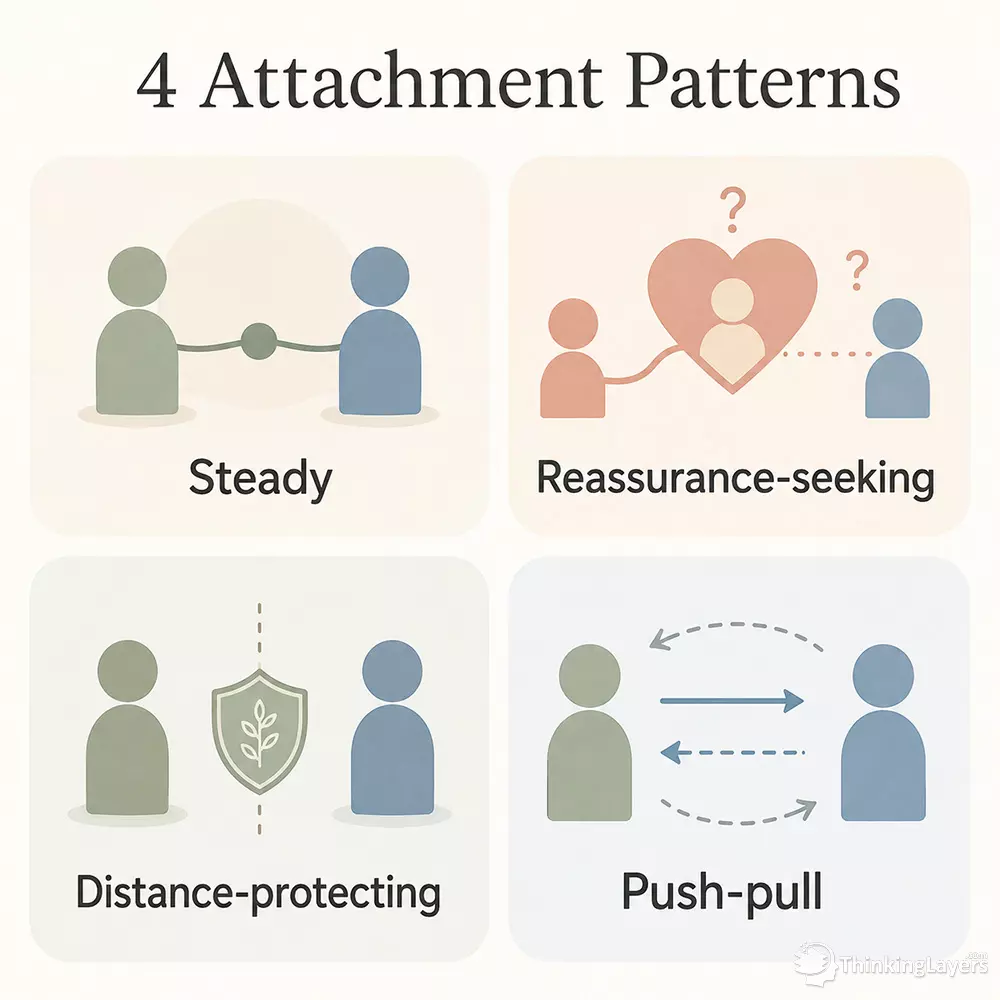
Steady and connected attachment
A person with a generally steady pattern can value closeness without treating every period of distance as a threat. They are usually able to ask for support, tolerate a partner’s separate interests, and return to difficult conversations after emotions settle.
Under pressure, even a steady person may become defensive, impatient, or unsure. The difference is often that the reaction does not completely determine what happens next. They can usually consider more than one explanation, communicate a need, and remain open to repair.
- Closeness feels welcome rather than dangerous.
- Independence does not automatically mean rejection.
- Conflict feels uncomfortable but not necessarily final.
- Reassurance can be accepted without constant testing.
- Needs can be expressed without excessive apology or blame.
Reassurance-seeking attachment
A reassurance-seeking pattern becomes active when signs of distance are interpreted as signs of weakening love. The person may monitor changes in communication, affection, plans, or tone. They may ask repeated questions, seek immediate discussion, or feel unsettled until the relationship is clearly confirmed.
This pattern often contains strong relational strengths. The person may be attentive, emotionally responsive, loyal, and quick to notice changes. Difficulty appears when uncertainty becomes so uncomfortable that reassurance must be repeated, immediate, and complete.
What reassurance-seeking is trying to protect
The underlying wish is often simple: “Please show me that our connection still matters and that I have not been left alone with this uncertainty.” The protective strategy may become intense because the need is not expressed in that clear form.
A useful question to ask
Am I asking for one understandable sign of connection, or am I trying to remove every possible doubt about the relationship?
Distance-protecting attachment
A distance-protecting pattern becomes active when emotional demands begin to feel overwhelming, controlling, or impossible to satisfy. The person may become quiet, change the subject, focus on practical facts, minimize the importance of the issue, or ask for more space.
This pattern can also contain valuable strengths. The person may be self-reliant, calm during practical difficulties, respectful of independence, and less likely to make impulsive promises. Problems develop when space becomes the only available response and the partner is left without explanation or a reliable return.
- Strong emotion may feel like pressure rather than invitation.
- Repeated questions may be experienced as criticism or control.
- Private processing may feel safer than immediate conversation.
- Dependence may be confused with loss of personal freedom.
- Needs may be reduced or hidden to avoid disappointment.
Push-pull attachment
In a push-pull pattern, closeness is strongly desired but can also create doubt or discomfort. A person may seek connection, receive it, and then become guarded. They may miss a partner intensely during distance but feel crowded when closeness returns.
This can be confusing for both people. The person experiencing the pattern may genuinely want intimacy while also questioning whether it is safe to depend on someone. The partner may receive mixed signals: “Come closer,” followed by “Do not expect too much from me.”
The practical goal is not to force constant closeness. It is to notice the moment when connection shifts from comforting to uncomfortable and express that change before it becomes withdrawal, testing, or sudden rejection.
Everyday triggers and the meanings behind them
Attachment reactions are often shaped less by the visible event than by the meaning assigned to it. The same situation can activate opposite fears in two partners. One may fear abandonment, while the other fears losing autonomy or being judged unfairly.
| Everyday situation | Possible private meaning | Visible response | A more helpful response |
|---|---|---|---|
| A message is answered much later than usual | “I am becoming less important” or “I will be questioned no matter what I do” | Repeated messages, cold replies, excuses, or avoidance | Share the practical reason and name when communication can resume |
| One partner asks for time alone | “They are pulling away” or “My need for space will not be respected” | Pursuit, guilt, emotional shutdown, or leaving without explanation | Agree on what the space means and when connection will resume |
| Affection becomes less frequent during a busy period | “The relationship is fading” or “Nothing I offer will be enough” | Testing, criticism, pressure, or further withdrawal | Discuss the change directly and choose one realistic form of connection |
| A partner raises a complaint | “I am failing” or “I am about to be blamed for everything” | Defensiveness, countercriticism, over-apologizing, or silence | Separate the specific complaint from the value of the whole relationship |
| Plans change unexpectedly | “I cannot rely on you” or “I am not allowed to be flexible” | Disproportionate disappointment, dismissal, or argument | Acknowledge the impact before discussing the practical solution |
| A disagreement remains unfinished | “We may never be okay again” or “The discussion will continue forever” | Urgent pursuit, emotional distance, or pretending nothing happened | Confirm that the issue matters and schedule a realistic time to return |
The purpose of identifying the private meaning is not to prove that it is irrational. It is to separate the event from the conclusion. “You were quiet tonight” is an observation. “You no longer care about me” is an interpretation. The interpretation may deserve discussion, but treating it as confirmed fact usually makes communication harder.
Practical tip: Before responding to a relationship trigger, complete three sentences: “What happened was...” “The meaning I gave it was...” “What I need to understand is...”
The pursue-withdraw cycle
One of the most common attachment patterns in long-term relationships is a cycle in which one partner moves closer under stress while the other creates distance. The problem is not simply that one person talks and the other remains silent. The problem is that each response increases the exact fear driving the other response.
- A sign of distance appears: A brief answer, missed plan, quiet evening, or unresolved concern creates uncertainty.
- One partner pursues clarity: They ask questions, repeat the issue, increase emotional intensity, or request immediate reassurance.
- The other partner feels pressured: They become defensive, quiet, practical, distracted, or physically unavailable.
- Pursuit becomes stronger: The first partner interprets withdrawal as confirmation that something is wrong.
- Withdrawal becomes stronger: The second partner interprets pursuit as confirmation that conversation is unsafe or endless.
Understanding individual conflict reactions can help couples recognize this sequence before it becomes a familiar argument. Neither partner has to be deliberately creating the cycle. Both may believe they are trying to protect the relationship in the only way available to them.
The cycle can be interrupted when each person makes their protective move more understandable:
- Translate pursuit into a clear request: Replace multiple questions with one specific need.
- Translate withdrawal into a time-limited pause: Explain why space is needed and when the conversation will resume.
- Discuss one issue at a time: Avoid using the current disagreement to review every previous disappointment.
- Return when promised: A pause becomes safer when it has a dependable ending.
- Name the cycle together: “We are entering the pattern where I chase and you disappear” is more useful than deciding who started it.
Balancing closeness, independence, and boundaries
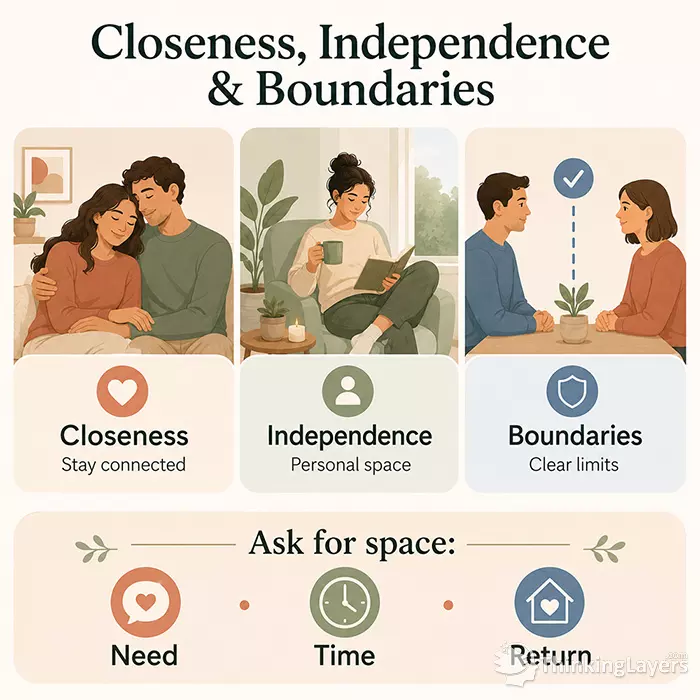
Healthy closeness does not require permanent availability, and healthy independence does not require emotional distance. Long-term relationships work better when both partners understand that connection and individuality are not opposing goals.
Many disagreements become easier when several similar-looking ideas are separated:
- Closeness is not unlimited access: A loving partner can still need privacy, concentration, rest, or time with other people.
- Independence is not emotional absence: Personal space works best when the relationship still includes responsiveness and return.
- A boundary is not a punishment: A boundary explains what a person can participate in; punishment removes connection to force compliance.
- A need is not a demand: A need can be expressed clearly while leaving room to discuss timing and form.
- Compromise is not self-erasure: Both partners should remain visible in the final arrangement.
Clear communication habits reduce the need to guess whether space means rejection or whether closeness means control. For example, “I need an hour to finish this task, and then I want to hear about your day” protects both independence and connection.
A vague departure creates uncertainty. A rigid demand creates resistance. A clear boundary with a return point gives both partners usable information.
Recommendation: When asking for space, include three details: what you need, approximately how long you need it, and how you intend to reconnect afterward.
Reassurance without repeated checking
Reassurance is a normal part of a close relationship. Partners regularly confirm affection, commitment, appreciation, and future intention. Difficulty begins when reassurance provides relief for only a few minutes and must then be requested again in a slightly different form.
Repeated seeking reassurance can gradually change the conversation. Instead of creating connection, it becomes an attempt to achieve complete certainty. The responding partner may become frustrated, while the asking partner notices the frustration and feels even less secure.
More useful reassurance has three qualities:
- It is specific: The person identifies what feels uncertain instead of asking whether the entire relationship is okay.
- It is realistic: The response offers honesty and consistency rather than impossible guarantees.
- It leads to action: Both partners agree on one behavior that will make the situation clearer next time.
| Situation | Reassurance loop | Clearer request | Grounded response |
|---|---|---|---|
| A reply is delayed | “Are you upset? Are you sure? Did I do something?” | “When communication changes suddenly, I start guessing. Can you tell me whether you are simply busy?” | “I am not upset. I have a meeting and will reply properly this evening.” |
| A conflict needs a pause | “Promise you are not leaving. Tell me we are okay right now.” | “Can we agree that this is a pause and choose a time to continue?” | “I still care about us. I need an hour, and I will come back at seven.” |
| Affection has felt limited | Testing love through coldness, hints, or comparison | “I have been missing physical closeness. Could we spend some quiet time together tonight?” | “Yes. I have been distracted, but I want that connection too.” |
| Plans have changed repeatedly | “I obviously do not matter to you.” | “The repeated changes make it difficult for me to rely on our plans. What can we arrange more realistically?” | “I understand the impact. Let us choose a time I can protect and confirm it in advance.” |
Reassurance should not require one partner to deny every difficulty. A grounded response can contain both connection and truth: “I am frustrated, but I am still committed to discussing this respectfully.” This is more dependable than offering a comforting statement that does not match the person’s real feelings.
Practical agreement: Couples can decide in advance what a pause means, how changes in plans will be communicated, and which small signals help each person feel remembered during busy periods.
Repairing connection after conflict
Conflict does not reveal the whole quality of a relationship. What happens after conflict is often more informative. Repair is the process of making the interaction understandable again, acknowledging its impact, and showing that both people still have a place in the relationship.
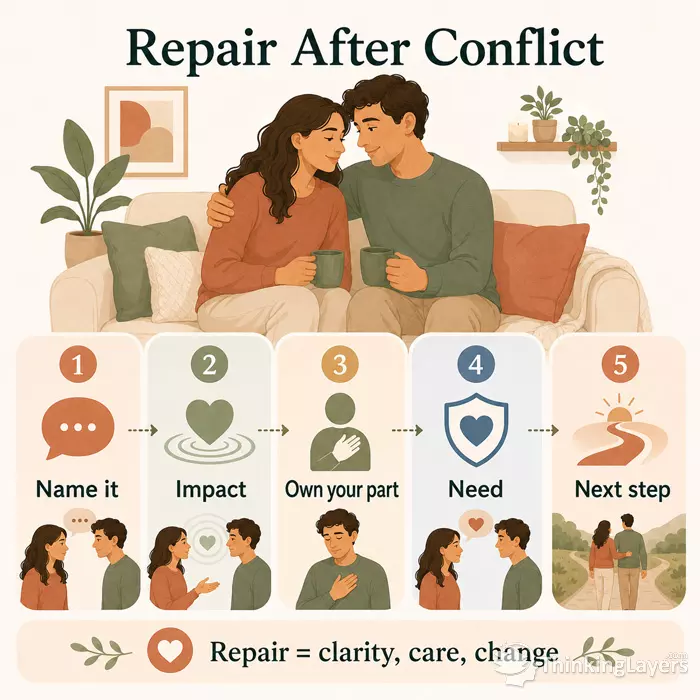
Useful repair usually includes five parts:
- Name the moment: Describe what happened without turning it into a judgment about character.
- Acknowledge the impact: Recognize how the behavior may have affected the other person, even when the impact was not intended.
- Take appropriate responsibility: Own the part that belongs to you without accepting blame for everything.
- Clarify the underlying need: Explain what you were trying to protect, request, or avoid.
- Choose a different next step: Agree on one realistic behavior that can interrupt the pattern in the future.
A repair attempt does not have to be perfectly worded. It does need to address the part that caused uncertainty. A quick apology followed by the same unexplained behavior may offer temporary relief, but it does not create new information.
Repair can also be nonverbal, but actions work best when their meaning is clear. Preparing tea, sitting nearby, or offering affection may communicate care. However, if the original issue remains confusing, practical kindness should accompany rather than replace a direct conversation.
What makes an apology believable
- It identifies a specific behavior rather than offering a vague “sorry for everything.”
- It does not immediately shift attention to the other partner’s mistakes.
- It acknowledges impact without arguing over whether the reaction was justified.
- It includes a realistic change rather than a dramatic promise.
- It allows the other person time to respond instead of demanding immediate forgiveness.
How attachment patterns change
Attachment patterns can become more flexible. Change rarely happens through one major realization. It develops through repeated experiences in which needs are expressed more clearly, boundaries are respected, pauses have dependable endings, and difficult conversations lead to repair rather than permanent distance.
The process of building trust is usually ordinary rather than dramatic. It includes keeping manageable promises, communicating changes, acknowledging mistakes, and responding consistently enough that the relationship becomes easier to interpret.
Signs of increasing attachment security may include:
- Waiting for more information before assuming rejection or bad intent.
- Making one direct request instead of using tests, hints, or repeated questions.
- Taking space without threatening the relationship or disappearing indefinitely.
- Returning to unfinished conversations at the agreed time.
- Allowing a partner to have a different emotional pace.
- Separating one disappointing moment from the value of the entire relationship.
- Recovering from conflict without days of guessing, punishment, or emotional distance.
- Accepting reassurance without requiring complete certainty about the future.
Change does not mean that a person never feels activated. It means they recognize the pattern earlier and have more than one response available. A partner may still want reassurance but ask for it clearly. Another may still need space but remain emotionally accountable while taking it.
A practical pattern-mapping exercise
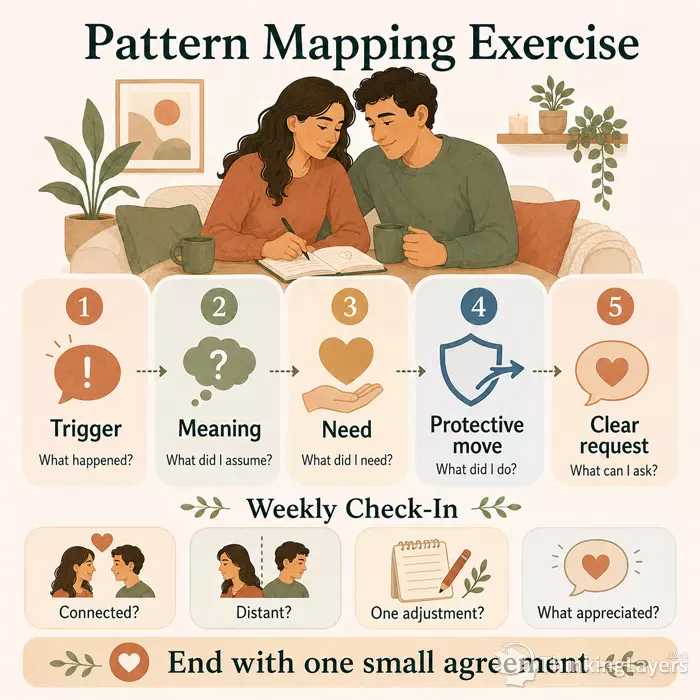
A pattern becomes easier to change when it is described as a sequence rather than as a flaw. The following exercise can be completed individually or discussed by both partners during a calm moment.
A five-part pattern map
- Trigger: What observable event happened? Avoid explaining motives at this stage.
- Meaning: What conclusion did you quickly draw about yourself, your partner, or the relationship?
- Need: What did you need at that moment—clarity, reassurance, respect, rest, affection, choice, or time?
- Protective move: What did you do to protect yourself? Pursue, withdraw, criticize, joke, over-explain, agree too quickly, or become cold?
- Clear request: What could you ask for next time that would express the need without repeating the protective move?
Example of a completed pattern map
- Trigger: My partner came home and spoke very little.
- Meaning: I assumed they were disappointed in me or losing interest.
- Need: I wanted clarity and a small sign of connection.
- Protective move: I asked several questions, became sarcastic, and then stopped talking.
- Clear request: “You seem quiet. Is something happening between us, or do you need some time to settle after your day?”
This process does not require ignoring intuition. It creates enough space to check whether an intuition is accurate before acting as though it has already been confirmed.
A ten-minute weekly check-in
A short, predictable conversation can prevent small uncertainties from accumulating. Each partner can answer four questions:
- When did you feel connected to me this week?
- Was there a moment when you felt distant, unsure, or overlooked?
- Is there one practical adjustment that would help next week?
- What is something you appreciated but did not say at the time?
The check-in should not become a complete review of the relationship. Its purpose is to keep communication open and make minor adjustments before frustration gains additional meaning.
Practical tip: End the check-in with one specific agreement. A small agreement that is remembered is more useful than five ambitious promises that disappear during the week.
When attachment language is not enough
Attachment can explain many differences in closeness, communication, reassurance, and conflict. It should not be used to explain everything. Sometimes the central issue is not an attachment pattern but repeated dishonesty, incompatible expectations, lack of responsibility, contempt, or unwillingness to participate in repair.
Attachment labels should never be used to excuse:
- Threats, intimidation, or deliberate humiliation.
- Monitoring someone’s communication, location, money, or friendships without agreement.
- Repeatedly violating clearly stated boundaries.
- Using silence, affection, or access to resources as punishment.
- Pressuring a partner to accept behavior that makes them feel unsafe.
- Blaming every concern on the other person’s supposed attachment style.
A workable relationship pattern requires mutual participation. One person can improve how they communicate, but they cannot create honesty, respect, and repair on behalf of both partners.
Outside support may be useful when the couple repeatedly enters the same cycle despite sincere attempts to change it, when conversations become impossible to complete, or when one or both partners no longer feel able to speak openly. A qualified relationship professional can provide structure, help separate the current issue from accumulated history, and keep the discussion focused on observable behavior.
Important: When a relationship includes fear, coercion, threats, or ongoing violations of personal safety, the priority is not improving attachment communication. The priority is obtaining appropriate support and protecting personal safety.
Recommended reading

The following works provide useful background on attachment, emotional connection, trust, and long-term relationship patterns:
- John Bowlby: Attachment and Loss
- Mary D. Salter Ainsworth, Mary C. Blehar, Everett Waters, and Sally Wall: Patterns of Attachment
- Mario Mikulincer and Phillip R. Shaver: Attachment in Adulthood
- Sue Johnson: Hold Me Tight
- Stan Tatkin: Wired for Love
These works approach attachment from different perspectives. They are most useful when read as frameworks for reflection rather than as tools for assigning permanent categories to oneself or a partner.
Frequently asked questions
1. Can attachment patterns change in a long-term relationship?
Yes. Attachment patterns can become more flexible through repeated experiences of consistency, honest communication, respected boundaries, and reliable repair. A person may still notice familiar fears, but they can learn to pause, check assumptions, and choose a clearer response.
Change also depends on the relationship environment. It is easier to develop trust when both partners communicate changes, keep reasonable promises, and take responsibility after conflict. Insight helps, but repeated behavior is what gradually changes expectations.
2. Why do I feel less secure now than at the beginning?
The beginning of a relationship often includes frequent attention, clear interest, novelty, and reassurance. Later, work, routine, fatigue, and separate responsibilities reduce some of those visible signals. A normal change in rhythm can therefore feel like a change in love.
Long-term commitment also raises the importance of the relationship. When more of your future, identity, and daily life is connected to another person, uncertainty may carry more emotional weight. The useful question is not only “Why am I reacting?” but also “What has changed, and have we discussed what that change means?”
3. Can two partners have completely different attachment patterns?
Yes. One partner may seek immediate conversation when worried, while the other needs time before speaking. One may experience frequent reassurance as loving, while the other experiences it as pressure. These differences do not automatically make the relationship incompatible.
Problems arise when each person treats their preferred response as the only reasonable response. Couples usually make progress when both needs become visible: one person may need confirmation that the relationship is intact, while the other needs a respectful and time-limited pause.
4. Is wanting reassurance unhealthy?
No. Reassurance is part of emotional connection. Partners naturally confirm affection, commitment, appreciation, and continued interest. The important questions are how reassurance is requested, whether the request is specific, and whether the response can be accepted.
Reassurance becomes less helpful when it turns into repeated checking that no answer can satisfy. In that situation, it is often better to identify the exact uncertainty and create one practical agreement rather than asking increasingly broad questions about the whole relationship.
5. Why does my partner need space after conflict?
Some people understand their feelings more clearly after a pause. They may want to avoid saying something impulsive, becoming defensive, or agreeing to something they do not mean. Space can therefore be a responsible choice rather than a rejection.
However, useful space includes communication and return. A partner can say why they need a pause, approximately how long it will last, and when they will continue the conversation. Disappearing without explanation leaves the other person to create their own meaning.
6. How can we discuss attachment without blaming each other?
Describe sequences instead of assigning identities. Replace “You are avoidant” with “When I ask several questions, you become quiet, and then I ask even more because I feel uncertain.” This gives both partners something observable to discuss.
It also helps to describe the protective purpose behind each response. One person may be trying to restore connection, while the other is trying to reduce pressure. Naming both purposes creates more room for cooperation than deciding which person is the problem.
7. Does secure attachment mean never feeling jealous or upset?
No. A generally secure person can still feel jealous, disappointed, angry, or afraid of loss. Security is not the absence of emotional reactions. It is the ability to remain curious, communicate directly, consider alternative explanations, and recover without turning every difficult moment into a verdict on the relationship.
Secure behavior also includes responding to real concerns. Trust does not require ignoring inconsistency, secrecy, or repeated broken agreements. It allows concerns to be discussed without immediately assuming either catastrophe or complete innocence.
8. When is a problem more than an attachment difference?
A problem is more than an attachment difference when it involves repeated dishonesty, intimidation, humiliation, controlling behavior, disregard for boundaries, or refusal to participate in repair. Attachment language may describe why someone feels afraid of closeness or loss, but it does not excuse harmful choices.
It is also important to look at mutual effort. Different patterns can be negotiated when both partners are willing to listen, communicate, and adjust. When only one person is expected to adapt while the other avoids all responsibility, the central problem is no longer simply a difference in attachment.