Why Relationship Uncertainty Feels So Intense

 This article explains why delayed replies, changing closeness, unclear intentions, and undefined relationships can feel emotionally intense—and offers practical ways to separate facts from fears, ask for clarity, and protect your boundaries.
- What relationship uncertainty means
- Different forms of relationship uncertainty
- Why uncertainty creates such strong emotions
- Common emotional responses to uncertainty
- Everyday triggers and their hidden meanings
- How attachment patterns shape uncertainty
- Temporary confusion versus ongoing mixed signals
- The reassurance-seeking loop
- Withdrawal, emotional distance, and self-protection
- How to have a useful clarity conversation
- A practical relationship uncertainty map
- Boundaries while answers remain incomplete
- Signs you are responding more steadily
- When additional support may be useful
- Recommended reading
- Frequently asked questions
Relationship uncertainty appears when an emotionally important question remains unanswered. You may not know how serious the relationship is, whether the other person still feels invested, why their behavior has changed, or whether the future you discussed is still shared. The uncertainty may exist in a new relationship, after a conflict, during a period of distance, or inside a long-term partnership that suddenly feels less predictable.
The emotional response can be surprisingly strong because uncertainty does not give the mind a clear place to stop. A direct answer may be painful, but it provides information. An unclear answer leaves several possibilities open at once, so attention keeps returning to messages, pauses, changes in tone, future plans, and small signs that might finally explain what is happening.
Fast takeaway: Strong feelings during relationship uncertainty do not automatically prove that the relationship is in danger. They often show that something important remains unclear.
- Separate what happened from the meaning you immediately gave it.
- Look for repeated patterns rather than treating one moment as a final answer.
- Ask one direct question instead of searching for certainty through hints and tests.
- Use reassurance to create usable information, not to remove every possible doubt.
- Decide how long you are willing to remain in an undefined situation.
- Remember that continued ambiguity is also information about the relationship.
What relationship uncertainty means
Relationship uncertainty is not simply a lack of knowledge. It is uncertainty about something that affects closeness, trust, belonging, personal choice, or the future. That is why a small event can carry a large emotional meaning.
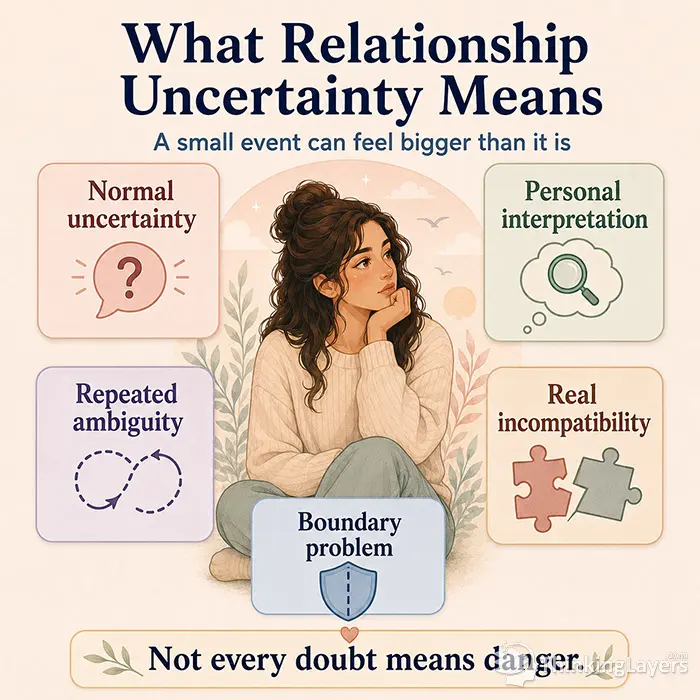
A delayed reply may raise the question, “Are they losing interest?” A cancelled plan may become, “Can I rely on this person?” A request for space may feel like, “Is this the beginning of the end?” The visible event is limited, but the conclusion attached to it may concern the whole relationship.
The aim is not to eliminate all uncertainty. Every relationship contains unanswered questions because people have separate thoughts, changing circumstances, and different emotional rhythms. The aim is to distinguish between:
- Normal uncertainty: Temporary questions that can be discussed and gradually clarified.
- Personal interpretation: A conclusion created before enough information is available.
- Repeated ambiguity: An ongoing pattern in which clarity is continually postponed.
- Real incompatibility: Two people wanting different levels of closeness, commitment, or communication.
- A boundary problem: Remaining in a situation that repeatedly asks you to ignore your own limits.
Practical principle: You do not need complete certainty before making a decision. You need enough reliable information to decide what you are willing to participate in.
Different forms of relationship uncertainty
People often say, “I do not know where I stand,” but that sentence can describe several different problems. Identifying the exact uncertainty makes it easier to ask a useful question.
Uncertainty about relationship status
You may be spending significant time together, communicating daily, or behaving like partners without knowing whether the relationship is exclusive, casual, developing, or undefined.
Uncertainty about emotional investment
You may know the official relationship status but feel unsure about how emotionally present the other person is. Affection, interest, or responsiveness may have changed without explanation.
Uncertainty about intentions
The person may say that they care about you while avoiding questions about commitment, exclusivity, living arrangements, or future plans.
Uncertainty about reliability
You may not know whether plans, promises, or agreements will be followed. The central question is not necessarily “Do they love me?” but “Can I depend on what they say?”
Uncertainty after conflict
A disagreement may end without a clear repair. Both people continue daily life, yet one or both remain unsure whether the issue has been resolved, ignored, or added to a growing distance.
Uncertainty about your own feelings
Sometimes the unanswered question belongs to you. You may care about the person but remain unsure whether the relationship feels respectful, sustainable, or aligned with the life you want.
Author’s note: Before asking another person for clarity, try to name the question in one sentence. “I need clarity” is broad. “I need to know whether we are building an exclusive relationship” gives both people something concrete to answer.
Why uncertainty creates such strong emotions
Uncertainty keeps attention active because the situation appears unfinished. Each new message, pause, plan, or change in behavior may seem capable of resolving the question. Instead, it often produces another interpretation.
This can create relationship mental loops: you review the same information repeatedly, trying to reach a level of confidence that the available evidence cannot provide.
Several factors make the emotional response stronger:
- The relationship matters: Uncertainty about an important bond carries more weight than uncertainty about a casual interaction.
- Several explanations remain possible: A quieter week could mean stress, distraction, changed feelings, or a need for space.
- The answer affects your choices: You may be deciding whether to invest more deeply, wait, make plans, or step back.
- The situation feels personal: Changes in another person’s behavior can quickly become conclusions about your value.
- There is no clear stopping point: Without a direct conversation or boundary, interpretation can continue indefinitely.
- Occasional warmth preserves hope: One affectionate interaction can appear to cancel several weeks of inconsistency.
Strong emotion is therefore not always a response to what has already happened. It may be a response to everything that might happen: rejection, loss, embarrassment, wasted time, changed plans, or discovering that the relationship meant something different to each person.
Common emotional responses to uncertainty
People respond to relationship uncertainty in different ways. Some move closer and seek information immediately. Others become quiet, guarded, or unusually independent. Many alternate between both responses.
| Emotional response | What it may look like | The question underneath | A useful first step |
|---|---|---|---|
| Urgency | Sending several messages, demanding an immediate conversation, or feeling unable to focus until the issue is resolved | “Can I make this situation safe right now?” | Decide which question genuinely requires an answer today |
| Overthinking | Reviewing messages, punctuation, timing, facial expressions, and past conversations | “What important information am I missing?” | Write down the observable facts separately from your conclusions |
| Jealousy | Comparing yourself with other people or monitoring social media activity | “Am I being replaced or becoming less important?” | Ask what agreement or status is actually unclear |
| Irritability | Becoming angry about small changes, short replies, or practical disappointments | “Why am I being left to guess?” | Name the uncertainty beneath the anger |
| Self-blame | Searching for the exact mistake that supposedly changed the relationship | “Could I restore closeness if I corrected myself?” | Consider the other person’s choices and circumstances as well |
| Withdrawal | Going quiet, refusing to ask questions, or pretending not to care | “Can I avoid being hurt by becoming less available first?” | State one need without demanding a particular outcome |
| Over-functioning | Planning everything, initiating every conversation, and carrying the emotional work alone | “Can I keep the relationship stable through extra effort?” | Pause and observe what happens when effort becomes more balanced |
A reaction to perceived rejection can become intense even before rejection has been confirmed. The reaction is real, but the conclusion may still need checking.
Important distinction: A strong feeling is evidence that something matters to you. It is not automatically evidence that your interpretation is correct.
Everyday triggers and their hidden meanings
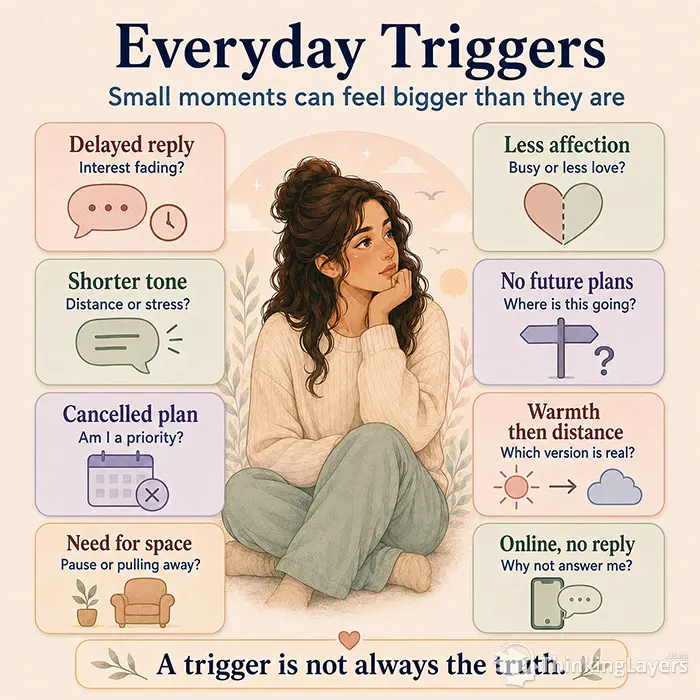
Relationship uncertainty usually becomes visible through ordinary moments. The event may be small, but it touches a larger unanswered question.
- A delayed reply: The delay may become evidence that interest is fading, especially when previous communication was frequent.
- A shorter tone: A practical or tired message may be interpreted as anger, disappointment, or emotional distance.
- A cancelled plan: One change may raise the larger question of whether you are a priority.
- A request for space: The request may feel like a temporary need to one person and the beginning of separation to the other.
- Less affection: A busy or distracted period may be interpreted as a change in love.
- Future plans disappear: The absence of shared planning may feel more important than any direct statement.
- Warmth followed by distance: Alternating closeness and absence makes it difficult to understand which version of the relationship is reliable.
- Online activity without a reply: Seeing someone active elsewhere can turn a delay into a personal choice in your mind.
For some people, silence feels threatening because it removes the small signals that usually confirm connection. The absence of information then becomes filled with imagined explanations.
Changes in wording, punctuation, facial expression, or vocal emphasis can also activate strong tone sensitivity. This is especially likely when the relationship already feels unstable. Once uncertainty is active, a neutral cue can carry far more meaning than it would during a secure period.
Use three columns before reacting
When a trigger appears, divide it into three parts:
- Event: “They replied six hours later than usual.”
- Interpretation: “They are losing interest.”
- Question: “Has our communication changed, and if so, why?”
The event is known. The interpretation is possible. The question is what may need clarification.
Practical tip: Replace “I know what this means” with “This is the meaning I am currently giving it.” That small change creates room for both intuition and additional information.
How attachment patterns shape uncertainty
Attachment patterns influence what people do when closeness feels uncertain. They do not determine personality or predict every relationship. They describe familiar ways of seeking safety, information, space, or control.
Steady and connected response
A person with a generally steady response can notice uncertainty without immediately treating it as rejection. They may ask a direct question, wait for an answer, and evaluate behavior over time. They can still feel jealous, disappointed, or afraid. The difference is that the feeling does not automatically become the only explanation.
Reassurance-seeking response
This response moves toward the relationship. The person may ask repeated questions, monitor contact, request immediate discussion, or seek frequent signs of affection.
The underlying need is often understandable: “Please show me that the connection still exists.” Difficulty appears when no answer lasts because the larger uncertainty remains unresolved.
Distance-protecting response
This response moves away from the relationship. The person may minimize the issue, become highly practical, avoid emotional discussion, or insist that they need no reassurance. The underlying need may be: “Please do not place me in a conversation where I feel controlled, blamed, or unable to give the right answer.”
Push-pull response
This response alternates between pursuit and withdrawal. A person may seek intense closeness when the other becomes distant, then feel crowded or doubtful when closeness returns.
Both partners can become confused because the apparent need changes. In reality, the person may be trying to manage two concerns at once: fear of losing the bond and fear of becoming too dependent on it.
When two patterns meet
Relationship uncertainty often becomes more intense when one partner seeks immediate closeness and the other seeks immediate space.
- One person notices a change and asks for reassurance.
- The other experiences the questions as pressure.
- They become quieter or less available.
- The first person sees the withdrawal as confirmation that something is wrong.
- The questions become more urgent.
- The withdrawal becomes stronger.
The couple may then argue about messages, timing, or tone while the deeper issue remains unnamed: one person needs confirmation that the bond is intact, and the other needs confidence that a difficult conversation will not remove their freedom to pause.
Temporary confusion versus ongoing mixed signals
Not every confusing period means that a relationship is unhealthy or ending. Work demands, family responsibilities, travel, fatigue, and unresolved disagreements can temporarily change communication.
The more important question is whether uncertainty moves toward clarity or repeatedly returns in the same form.
| Temporary uncertainty | Ongoing ambiguity |
|---|---|
| A specific change has an understandable explanation | The explanation changes whenever clarity is requested |
| The person acknowledges the impact of their behavior | Your reaction is dismissed while the behavior continues |
| There is a realistic time for returning to the conversation | Clarity is always postponed until an undefined later time |
| Words and actions remain broadly consistent | Affectionate words repeatedly conflict with unavailable behavior |
| Both people can ask questions without punishment | Questions lead to withdrawal, blame, mockery, or more confusion |
| The relationship gradually becomes easier to understand | You remain responsible for interpreting every signal |
| Agreements are updated when circumstances change | Benefits of closeness continue without clear responsibility or commitment |
Repeated mixed signals can keep a person emotionally invested because every warm moment appears to promise clarity. The next period of distance then restarts the search for meaning.
Warning: Do not use attachment language to excuse indefinite ambiguity. A person may genuinely struggle with closeness and still be responsible for communicating honestly about what they can and cannot offer.
The reassurance-seeking loop
Reassurance is normal in close relationships. Partners regularly confirm affection, commitment, appreciation, and future intention. The problem is not the need for reassurance itself. The problem begins when reassurance becomes a repeated attempt to achieve complete certainty.
The loop often develops like this:
- A change in communication creates uncertainty.
- You ask whether the relationship is okay.
- The person says that everything is fine.
- You feel better briefly.
- The behavior remains unclear or inconsistent.
- You ask again using different words.
- The other person becomes frustrated or less responsive.
- Their frustration becomes new evidence that the relationship is unsafe.
Repeated seeking reassurance may therefore provide emotional relief without producing the information needed to make a decision.
Broad reassurance versus specific information
Broad question:
Specific question:
The second question may feel more vulnerable because it allows a real answer. It is also more likely to create usable clarity.
Recommendation: Ask for reassurance once in a clear form. Then evaluate whether the person’s following behavior supports the answer. Repeated words cannot permanently compensate for repeated inconsistency.
Withdrawal, emotional distance, and self-protection
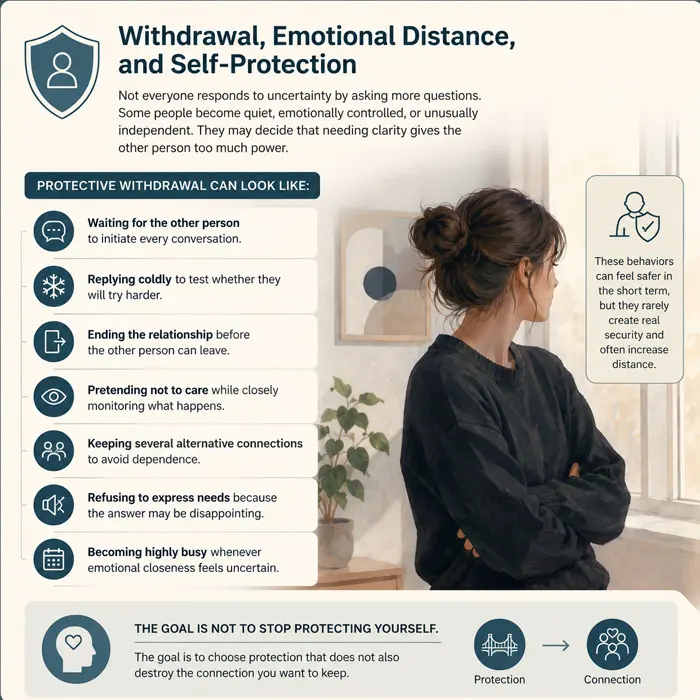
Not everyone responds to uncertainty by asking more questions. Some people become quiet, emotionally controlled, or unusually independent. They may decide that needing clarity gives the other person too much power.
Protective withdrawal can look like:
- Waiting for the other person to initiate every conversation.
- Replying coldly to test whether they will try harder.
- Ending the relationship before the other person can leave.
- Pretending not to care while closely monitoring what happens.
- Keeping several alternative connections to avoid dependence.
- Refusing to express needs because the answer may be disappointing.
- Becoming highly busy whenever emotional closeness feels uncertain.
Withdrawal may reduce immediate vulnerability, but it can also remove the information needed to understand the relationship. The other person may interpret silence as disinterest and create additional distance.
A more accountable form of space
Instead of disappearing, try naming the pause:
This protects personal space without turning the pause into another source of uncertainty.
How to have a useful clarity conversation
A clarity conversation is not an interrogation, emotional test, or attempt to force a particular answer. Its purpose is to understand the relationship well enough to make an informed choice.
Useful clear communication begins with observable behavior rather than assumptions about motive.
Prepare before the conversation
- Choose one central question instead of raising every past disappointment.
- Decide what information you actually need.
- Consider which answers may be difficult but still useful.
- Choose a calm time rather than beginning during a message delay or argument.
- Know what boundary you may need if the answer remains unclear.
A six-sentence clarity structure
- Observation: “During the past month, we have spoken less and several plans have been cancelled.”
- Personal impact: “I have started feeling unsure about where we stand.”
- Your position: “I want a relationship with consistent communication and shared planning.”
- Direct question: “Do you still want to build that kind of relationship with me?”
- Practical request: “If you do, I would like us to agree on what needs to change.”
- Boundary: “If you are unsure, I need to decide how long I am willing to remain in an undefined situation.”
What a useful answer sounds like
A useful answer does not have to be the answer you want. It should be understandable enough to guide a decision.
- “Yes, I want the relationship, and I recognize that my behavior has been inconsistent.”
- “I care about you, but I am not ready for the commitment you want.”
- “I need one week to think, and I will return to this conversation on Sunday.”
- “I want to continue, but I cannot offer daily contact. Can we discuss whether that works for both of us?”
Statements such as “Why are you making this complicated?” or “Let us just see what happens” may also provide information, especially when the same answer appears repeatedly.
Remember: Clarity is not the same as agreement. Two people can understand each other clearly and still discover that they want different relationships.
A practical relationship uncertainty map
A useful way to reduce emotional confusion is to describe the situation as a sequence. This turns a broad feeling of “something is wrong” into specific information.
The six-part map
- Fact: What happened that another person could also observe?
- Immediate story: What meaning did you give the event?
- Deeper fear: What outcome are you afraid the event predicts?
- Actual need: Do you need reassurance, information, consistency, time, respect, or a decision?
- Direct request: What can you ask without accusation or hidden testing?
- Personal boundary: What will you do if the pattern remains unchanged?
Example of a completed uncertainty map
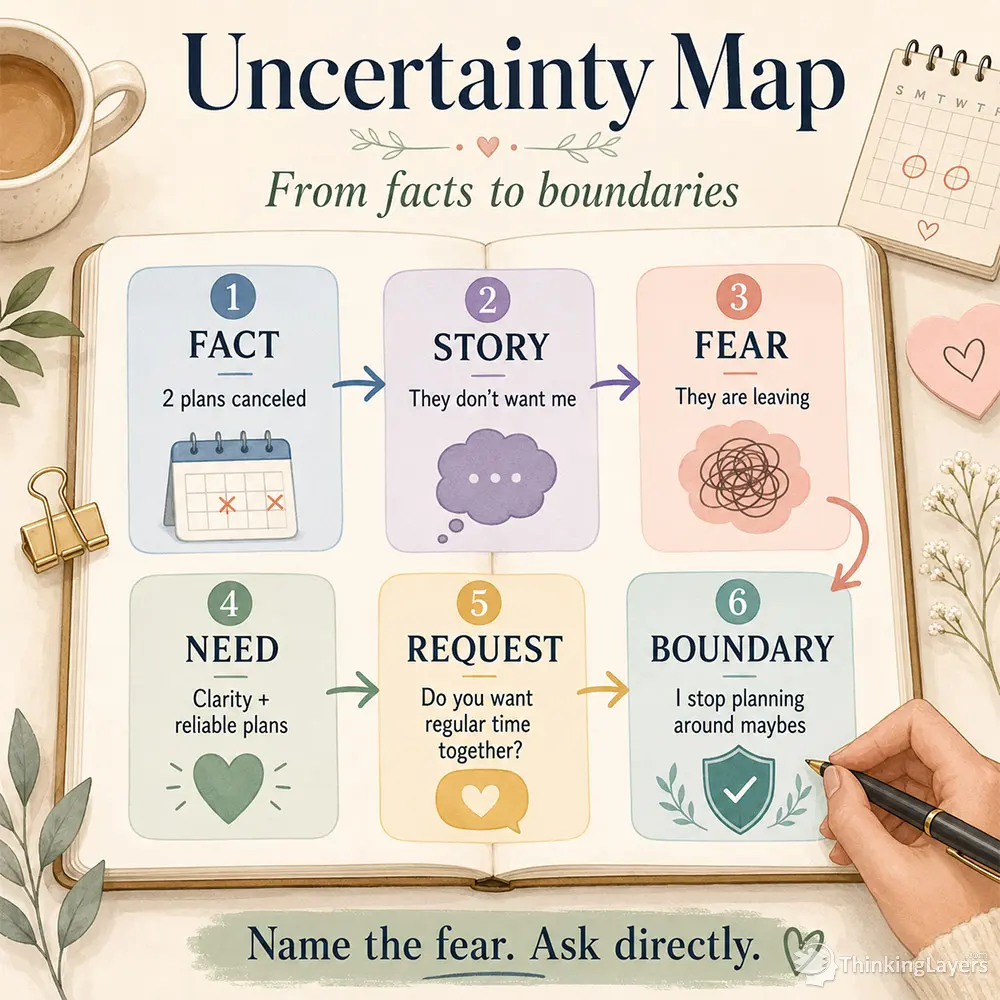
- Fact: My partner cancelled two weekend plans and has not suggested another date.
- Immediate story: They no longer want to spend time with me.
- Deeper fear: They are slowly leaving but do not want to say it directly.
- Actual need: I need reliable planning and clarity about whether we are still investing in the relationship.
- Direct request: “Our last two plans were cancelled without being rearranged. Do you still want to make regular time for this relationship?”
- Personal boundary: If plans continue to be cancelled without discussion, I will stop organizing my schedule around uncertain arrangements.
Composite example: Maya had been seeing someone for four months. He sent affectionate messages and spoke about future trips, but avoided defining the relationship and regularly disappeared for several days. Maya kept asking whether he liked her, and he always said yes.
When she mapped the pattern, she realized that the missing information was not whether he felt affection. She needed to know whether he wanted consistent, exclusive involvement. She asked that question directly. He said he was not ready to offer it.
The answer was disappointing, but it ended a cycle of trying to use reassurance about feelings to solve uncertainty about commitment. This is an illustrative composite based on common relationship patterns, not an account of an identifiable individual.
A 24-hour pause for non-urgent triggers
When a trigger does not require an immediate practical response, use the following process:
- Write the message you want to send without sending it.
- List the known facts.
- List at least two possible explanations.
- Name the exact question you want answered.
- Decide whether the question is better asked in person or during a calm conversation.
- Return to your normal plans rather than spending the entire pause monitoring the relationship.
The aim is not to suppress emotion. It is to prevent the first interpretation from becoming an impulsive action.
Boundaries while answers remain incomplete
Sometimes a person genuinely needs time to think. Sometimes circumstances temporarily prevent an immediate answer. Waiting can be reasonable when it has a clear purpose, an approximate timeframe, and mutual respect.
Waiting becomes more costly when it has no structure and requires you to remain fully available while the other person avoids making a choice.
Boundaries you can consider
- Time boundary: How long are you willing to wait for a conversation or decision?
- Contact boundary: What level of communication feels respectful during the waiting period?
- Exclusivity boundary: Are you both free to date other people, or is exclusivity expected?
- Physical boundary: Are you comfortable continuing intimacy while commitment remains unclear?
- Planning boundary: Will you keep future time open for plans that have not been confirmed?
- Emotional boundary: Are you being asked to provide partner-level support without partner-level responsibility?
- Information boundary: Do social media checks and indirect updates keep you in constant uncertainty?
A boundary is not, “You must decide by Friday.” A boundary is, “I understand that you need time. I am willing to wait until Friday, and after that I will make my own decision based on the information available.”
Do not wait indefinitely: A request for time should eventually lead to a conversation, decision, or changed behavior. Repeatedly extending the waiting period without new information keeps one person responsible for carrying all the uncertainty.
Six questions before deciding to wait
- Has the person clearly explained what they need time to consider?
- Have they given a realistic point for returning to the conversation?
- Does their behavior remain respectful during the pause?
- Are you free to make your own choices while waiting?
- Is this the first uncertain period or a repeated pattern?
- What is the waiting period costing you emotionally and practically?
Signs you are responding more steadily
Progress does not mean that uncertainty stops affecting you. It means that you have more choices between the trigger and the response.
- You can notice a delayed reply without immediately deciding what it means.
- You ask one specific question instead of several versions of the same question.
- You evaluate repeated behavior rather than relying on one unusually warm or cold interaction.
- You allow another person time to answer without abandoning your own timeframe.
- You continue work, friendships, sleep, and daily plans while the issue is being clarified.
- You can hear an incompatible answer without trying to negotiate someone into wanting the same relationship.
- You stop using social media as the main source of relationship information.
- You recognize that affection and availability are not always the same thing.
- You make boundaries based on what is happening rather than what might eventually happen.
A useful measure: Ask, “Am I becoming clearer about the relationship, or am I simply becoming better at tolerating the same confusion?”
When additional support may be useful
Trusted friends, reflective writing, and direct communication can help with many uncertain relationship periods. Outside support may be useful when you repeatedly lose sight of your own boundaries, return to the same unresolved cycle, or feel unable to evaluate the situation without immediate reassurance.

A qualified relationship professional can help organize the pattern, identify the unanswered question, and separate current behavior from older expectations about closeness and rejection. The purpose is not to tell you whether to stay or leave, but to help you see the choices and costs more clearly.
Additional support may be especially useful when:
- The relationship repeatedly ends and restarts without resolving the main issue.
- You feel unable to ask direct questions because you fear punishment or abandonment.
- One person controls all decisions about closeness, contact, and commitment.
- Uncertainty is used to keep you available without offering mutual responsibility.
- Your friendships, work, sleep, or daily functioning increasingly revolve around interpreting the relationship.
- You no longer trust your ability to distinguish facts from repeated promises.
Safety note: Threats, intimidation, unwanted monitoring, coercion, deliberate humiliation, and repeated violations of personal boundaries are not simply communication differences. In those situations, personal safety and appropriate local support take priority over achieving relationship clarity.
This article provides general information and reflection tools. It does not evaluate a specific relationship or replace individualized professional guidance.
Research and reading behind this article
This article was shaped by research and practical writing on relational uncertainty, attachment, communication patterns, and the way people manage unclear emotional information in close relationships.
- Leanne K. Knobloch and Denise Haunani Solomon: Research on relational uncertainty, relationship development, and how unclear partner signals affect communication.
- Charles R. Berger and Richard J. Calabrese: Foundational work on uncertainty reduction and why people search for information when another person’s intentions feel unclear.
- Walid A. Afifi and Judith L. Weiner: Work on motivated information management and why people sometimes seek clarity, avoid clarity, or delay difficult conversations.
- Dale E. Brashers: Research on uncertainty management, especially the idea that people do not always want more information immediately.
- Pauline Boss: Ambiguous Loss, for understanding why unclear endings and unresolved emotional situations can feel especially hard to process.
- Harriet Lerner: The Dance of Connection, for practical perspectives on difficult conversations, emotional honesty, and self-respect in relationships.
- Mario Mikulincer and Phillip R. Shaver: Research on adult attachment and how people respond differently when closeness, distance, or reassurance becomes uncertain.
These sources are not used here to label readers or turn normal relationship pain into a clinical issue. They are used as background for understanding why uncertainty can feel so emotionally powerful, why people react differently to unclear signals, and how direct communication and boundaries can make the situation easier to navigate.
Frequently asked questions
1. Why can uncertainty feel worse than a clear rejection?
A clear rejection is painful, but it closes an important question. Uncertainty keeps several outcomes open at once, so attention continues searching for new information.
Occasional warmth can make the uncertainty even stronger because it appears to preserve the possibility of the outcome you want. You may therefore experience repeated hope and disappointment instead of one clear ending.
2. How do I know whether it is intuition or overthinking?
Intuition often begins with a concise observation: something feels different, an agreement is not being followed, or words and actions do not match. Overthinking usually adds repeated predictions, imagined conversations, and attempts to achieve certainty without new information.
Write down the facts, the interpretation, and the question. Then ask directly or observe the pattern over time. Intuition deserves attention, but it still benefits from evidence and clarification.
3. Does a delayed reply mean someone is losing interest?
Not by itself. People reply late for many reasons, including work, concentration, fatigue, family responsibilities, or a different communication style.
A delay becomes more meaningful when it is part of a wider pattern: contact has changed without explanation, plans are no longer made, questions are avoided, and affection is available only intermittently. Evaluate the whole pattern rather than one response time.
4. Is it wrong to ask for reassurance?
No. Reassurance is a normal part of a close relationship. It becomes less helpful when the same broad question must be answered repeatedly because the behavior creating uncertainty has not changed.
Ask for something specific: confirmation of a plan, an explanation of changed contact, or clarity about commitment. Specific reassurance can lead to action; general reassurance may provide only temporary relief.
5. Should I ask, “What are we?”
Yes, when the answer affects your decisions, boundaries, or expectations. Asking about the relationship is not automatically demanding or premature.
It is often more useful to say what you want and ask whether the other person wants the same thing: “I want an exclusive relationship. Is that what you want to build with me?” This is clearer than asking for a label without discussing what the label means.
6. Can mixed signals be unintentional?
Yes. A person may feel affection while also feeling unsure about commitment, overwhelmed by other responsibilities, or uncomfortable with direct conversation. Their confusion may be genuine.
However, lack of harmful intention does not remove the impact on you. The person is still responsible for communicating honestly, and you remain responsible for deciding whether the situation works for you.
7. How long should I wait for someone to become certain?
There is no universal number of days or weeks. The important questions are whether the person has named what they are considering, provided a realistic timeframe, and continued treating you respectfully.
Set your own limit based on the cost of waiting. A timeframe is not punishment; it prevents someone else’s uncertainty from becoming an indefinite condition of your life.
8. Why do I become angry when I am actually afraid?
Anger can feel more active and protective than fear. It may appear when you feel ignored, powerless, or forced to guess about something important.
Before responding, complete the sentence, “What I am afraid this means is...” Naming the fear does not invalidate the anger. It helps you communicate the actual issue rather than fighting only about the visible trigger.
9. When is it reasonable to step away from an uncertain relationship?
Stepping away may be reasonable when direct questions repeatedly produce no clarity, words and actions remain inconsistent, agreements are not followed, or the relationship requires you to ignore your own needs indefinitely.
You do not need proof that the other person is bad or intentionally misleading you. It is enough to recognize that the relationship available to you is not one you can continue participating in with self-respect and emotional stability.