Why It Is So Hard to Let Go of Someone

 This article explains why letting go can feel harder than the breakup itself, how attachment, uncertainty, memory, and lost routines keep a bond active, and what practical steps help you move forward without denying what mattered.
- Fast takeaway: what letting go actually requires
- Why letting go can feel so difficult
- What you may really be holding onto
- How attachment patterns shape the ending
- Why uncertainty keeps the bond open
- Memory, idealization, and imagined alternatives
- Creating closure without another conversation
- Habits that keep emotional attachment active
- No contact, limited contact, and clear boundaries
- A practical four-week letting-go plan
- Rebuilding identity after the relationship
- What to do if the person contacts you again
- Signs that you are beginning to move forward
- When additional support may be useful
- Recommended reading
- Frequently asked questions
Letting go is often described as though it were a single decision: accept that the relationship is over, stop contacting the person, and move forward. In reality, a decision can happen much faster than emotional attachment changes. You may clearly understand that a relationship was not working and still feel an almost automatic urge to check your phone, replay a conversation, or imagine one more chance.
This does not necessarily mean that the person was right for you or that ending the relationship was a mistake. It may mean that they became connected to your routines, sense of belonging, future plans, confidence, and way of finding comfort. Letting go therefore involves more than losing contact. It involves reorganizing the parts of life that had started to revolve around the bond.
Fast takeaway: what letting go actually requires
The central idea: You do not have to stop caring before you can move forward. Letting go means accepting that the relationship is no longer available in the form you wanted and gradually stopping it from directing your present choices.
- You may be grieving the person, the routine, the future you imagined, and the version of yourself that existed with them.
- Uncertainty often keeps attachment active longer than a clear ending because the mind continues searching for a final answer.
- Checking messages, social media, mutual friends, and old photographs may bring brief relief while keeping the bond emotionally current.
- Useful boundaries reduce fresh emotional input and create space for reality to become more familiar than hope.
- Progress does not mean never thinking about the person. It means the thought no longer controls what you do next.
Why letting go can feel so difficult
A close relationship creates expectations. You become accustomed to knowing where to send good news, who will notice a difficult day, how weekends are arranged, and what the next year may look like. When the relationship ends, those expectations do not disappear at the same speed as the relationship itself.
This is why apparently small moments can feel unexpectedly painful. You reach for your phone after something funny happens. You hear a familiar song. You pass a restaurant where plans were once discussed. The loss becomes visible not only in dramatic memories but also in dozens of ordinary moments that used to include the other person.
For some people, an ending also activates a deeper fear of abandonment. The pain then contains more than missing one relationship. It may touch older expectations about being forgotten, replaced, left without explanation, or becoming unimportant when another person creates distance.
Several losses can therefore exist at the same time:
- The actual person: Their presence, personality, attention, affection, and familiar way of interacting.
- Your relationship role: Being someone’s partner, priority, confidant, or future companion.
- The imagined future: Plans, trips, shared milestones, family ideas, or ordinary routines that had not happened yet.
- A familiar version of yourself: How you felt, behaved, dressed, socialized, or imagined yourself when the bond felt secure.
- Emotional structure: The messages, calls, rituals, and predictable contact that helped organize the day.
- A complete explanation: The belief that one final answer would make the ending understandable and emotionally settled.
Because these losses overlap, telling yourself to “just move on” often creates additional frustration. You are trying to release a whole arrangement of meaning, not merely one person’s phone number.
What you may really be holding onto

When someone says, “I cannot let them go,” it helps to ask what exactly feels impossible to release. The answer is not always the relationship as it actually existed. Sometimes the strongest attachment is to what the relationship represented.
| What you say you miss | What may be underneath | A useful question |
|---|---|---|
| Their daily messages | The feeling of being remembered, chosen, and included in someone’s day | Where else can I create reliable connection rather than waiting for unpredictable contact? |
| Their approval | A sense that your value depended on how warmly they responded to you | Which parts of my worth have I placed in this person’s hands? |
| The best moments | Hope that the relationship could permanently become its most loving version | Was that warmth consistent, or was I repeatedly waiting for it to return? |
| Your future plans | Continuity, direction, and relief from having to imagine a different future | Which part of that future still belongs to me, even without this person? |
| The chemistry | Intensity, anticipation, excitement, or the feeling of being emotionally awake | Did intensity also provide steadiness, respect, and emotional clarity? |
| The possibility of reunion | Protection from the finality and uncertainty of beginning again | What is waiting costing me in the life that is available now? |
This distinction does not make your feelings less real. It makes them more workable. Missing the feeling of being chosen requires a different response from missing a specific shared activity. Missing an imagined future requires a different response from needing one practical conversation about unfinished responsibilities.
It can also help to distinguish attachment from emotional dependence. Attachment allows a person to matter deeply. Dependence becomes more restrictive when your sense of stability, identity, or value seems available only through that person’s attention.
Reflection prompt: Complete the sentence, “If I fully accepted that this person was not returning, the hardest thing I would have to face is...” The answer often reveals the deeper loss.
How attachment patterns shape the ending
People do not all respond to separation in the same way. Some seek immediate answers and reassurance. Others appear calm, become highly practical, and feel the loss later. Some move repeatedly between wanting reunion and wanting distance.
These tendencies are not rigid labels or predictions. They are familiar protective strategies that may become stronger when a meaningful bond feels uncertain.
Steady attachment after an ending
A person with a generally steady pattern can still grieve intensely. The difference is that they are more able to hold two truths at once: “I miss this person” and “the relationship is over.” They may seek support, allow sadness, and avoid turning every emotional wave into a reason to reverse the decision.
Reassurance-seeking attachment
A reassurance-seeking response often turns the ending into a search for certainty. The person may ask the same questions in different forms, monitor changes in tone, reread messages, or interpret small signs as evidence that reunion remains possible.
The deeper wish is often not merely “come back.” It may be “show me that I mattered,” “prove that I was not easily replaced,” or “help me believe that the whole relationship was real.”
Distance-protecting attachment
A distance-protecting response may look like immediate acceptance. The person becomes busy, avoids conversations, removes reminders, and insists that the ending does not affect them. Feelings may become clearer only when enough time has passed for closeness to feel less threatening.
This can create confusing timing. One person may begin reaching out just as the other has started to recover. Delayed emotion does not automatically mean the relationship should restart; it may simply mean that distance has made the feelings easier to notice.
Push-pull attachment
In a push-pull pattern, absence makes the relationship feel precious, while renewed closeness brings back discomfort, doubt, or conflict. The couple may separate, miss each other intensely, reunite, and then recreate the conditions that led to the separation.
The useful question is not only “Do we still have feelings?” It is also “What would actually be different in the relationship structure, communication, and daily behavior?”
A simple pattern map
- Trigger: What happened? For example, you saw a photograph or received a brief message.
- Meaning: What conclusion appeared? For example, “Maybe they still want me.”
- Impulse: What did you want to do? Reply immediately, investigate, ask a friend, or reopen old messages.
- Short-term result: What relief did that action offer?
- Long-term result: Did it create clarity, or did it restart uncertainty?
Mapping the sequence turns the reaction into something observable. Instead of judging yourself for “being unable to move on,” you can identify the exact moment when hope becomes checking, checking becomes interpretation, and interpretation becomes another emotional cycle.
Why uncertainty keeps the bond open
A clear ending can be painful, but an unclear ending adds a continuing task: trying to determine whether the ending is real. Statements such as “maybe later,” “I need time,” or “I still love you, but I cannot be with you” may leave enough possibility for the mind to remain in a waiting position.
The same thing happens with inconsistent contact. A warm message arrives after two weeks of silence. The person watches every social media story but avoids a direct conversation. They say they miss you but make no concrete attempt to rebuild the relationship.
These mixed signals can become more powerful than a complete absence because each small sign appears to offer new information. In practice, it may only renew the question.
Common forms of uncertainty include:
- Continuing physical or emotional intimacy without an agreed relationship.
- Speaking about a possible future without making present commitments.
- Sending affectionate messages whenever one person feels lonely.
- Keeping personal belongings as a reason for future contact.
- Following each other closely online while avoiding direct clarity.
- Using mutual friends to communicate indirectly.
- Ending and restarting contact whenever the distance becomes uncomfortable.
Clarity does not require knowing what the other person may feel one year from now. It requires responding to what they are consistently offering now.
Practical recommendation: Base your decisions on repeated behavior rather than occasional emotion. A sincere message can be meaningful, but it is not the same as a clear, sustained offer to rebuild the relationship.
Memory, idealization, and imagined alternatives
After an ending, memory often becomes selective. The most tender, exciting, or emotionally charged scenes return easily, while long periods of frustration, incompatibility, waiting, or loneliness receive less attention.
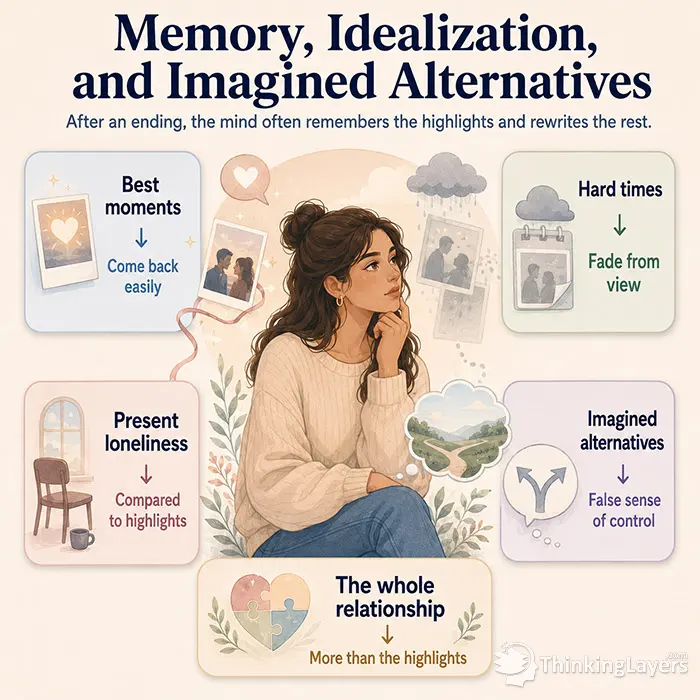
This does not mean that the good moments were false. It means that remembering only the best moments produces an incomplete version of the relationship. You begin comparing present loneliness with the relationship’s highlights rather than with the relationship as a whole.
The mind may also create imagined alternatives: the perfect conversation you should have had, the message that might have changed everything, or the moment when you could have responded differently. These alternatives feel productive because they create a sense of control over something that has already happened.
Reflection versus mental replay
| Helpful reflection | Unproductive replay |
|---|---|
| Focuses on one specific question | Returns to the same scene without a new question |
| Includes your behavior and the other person’s behavior | Places complete responsibility on one perfect sentence or mistake |
| Produces a practical lesson or boundary | Produces another version of what might have happened |
| Has a natural stopping point | Continues until you feel more confused or emotionally activated |
| Helps you make a present decision | Keeps your attention inside the past |
Create a balanced relationship record
Instead of making a list only of the person’s faults, create a fuller record with five headings:
- What I genuinely valued: The qualities and experiences that deserve honest appreciation.
- What repeatedly hurt: Patterns that made the relationship confusing, lonely, unfair, or unstable.
- What I requested: Needs or boundaries that you communicated.
- What actually changed: Observable actions rather than intentions or promises.
- What I require now: The standards that will guide future relationships.
A balanced record protects you from two extremes: pretending the relationship meant nothing and turning it into something consistently better than it was.
Creating closure without another conversation
Many people believe they cannot move forward until the other person provides the correct explanation, apology, or final conversation. Sometimes a respectful conversation is useful. In other situations, another conversation only creates new questions.
The other person may not fully understand their own choices. They may provide an answer that changes according to their mood. They may avoid responsibility, offer comfort without commitment, or explain the ending in a way that does not satisfy you.
Personal closure does not mean inventing an explanation. It means building a story that is honest enough to guide your next decision.
Five parts of self-created closure
- Name what ended: Acknowledge the actual status of the relationship rather than the hoped-for status.
- Recognize the full pattern: Include affection, difficulty, effort, disappointment, and repeated behavior.
- Accept incomplete information: Some motives may remain uncertain without preventing you from choosing a boundary.
- Decide what the experience taught you: Identify one or two lessons rather than turning the whole relationship into a personal failure.
- Choose what happens next: Closure becomes real through present behavior, not only through understanding.
A self-closure statement: “This relationship mattered to me, and it also ended. I may never receive an explanation that resolves every feeling. I can make decisions from what repeatedly happened rather than from what I still wish might happen.”
Habits that keep emotional attachment active
Many post-breakup habits are attempts to reduce uncertainty. They work briefly: checking a profile answers the question of what the person is doing, rereading a message creates temporary closeness, and asking a mutual friend provides new information.
The difficulty is that each answer creates another question. A photograph needs interpretation. A song in a story seems directed at you. A mutual friend’s comment becomes evidence for or against reunion.
Repeated thoughts after emotional distance often continue because the person remains present through small digital and mental rituals even when direct contact has ended.
| Habit | Short-term relief | Hidden cost | A more useful alternative |
|---|---|---|---|
| Checking social media | You temporarily know what they are doing | Every post becomes new material for comparison and interpretation | Mute or unfollow for a defined period and review the decision later |
| Rereading old messages | You briefly feel close to them again | Past warmth begins to feel like present availability | Archive the conversation and keep one private reflection instead |
| Asking mutual friends | You receive new information | Your social circle becomes part of the attachment loop | Ask friends not to provide updates unless something practical is necessary |
| Drafting messages repeatedly | You feel prepared for one final conversation | The relationship remains mentally active every day | Write one unsent letter with no plan to deliver it |
| Keeping visible reminders everywhere | You avoid the feeling that the relationship is truly over | Your environment continually restarts the same emotional response | Place meaningful items in a box rather than destroying them impulsively |
| Waiting for significant dates | You preserve a reason to expect contact | Birthdays and anniversaries become emotional tests | Plan those days around your own activities and supportive people |
The goal is not to remove every reminder in one dramatic act. It is to stop giving the attachment a constant supply of new material.
No contact, limited contact, and clear boundaries
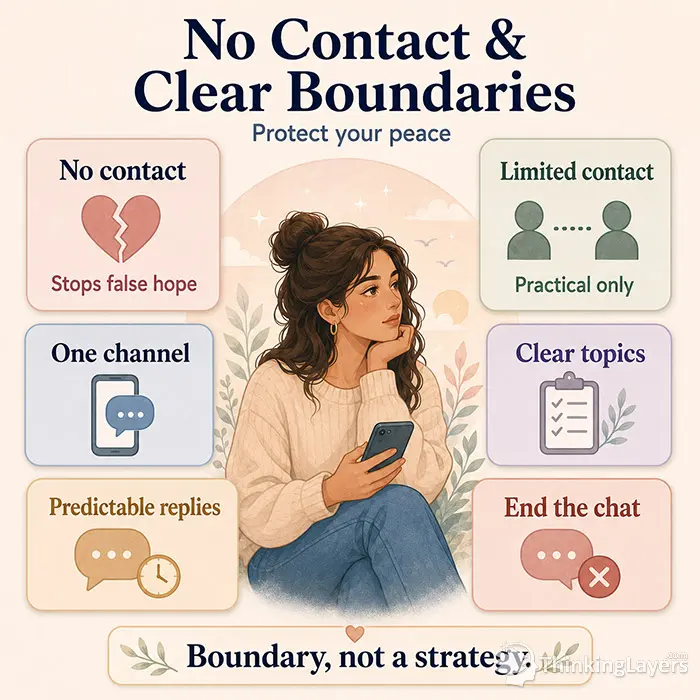
No contact can be useful, but it should not be presented as a universal rule. The right boundary depends on whether you share children, work, housing, finances, belongings, friendships, or other responsibilities.
When no contact may be useful
- Every interaction restarts hope without producing a clear relationship.
- You repeatedly agree to less than you want because temporary closeness feels relieving.
- The relationship moves through the same breakup and reunion cycle without meaningful change.
- Social media monitoring prevents you from engaging with your own life.
- Your stated boundaries are repeatedly ignored.
- Contact is mainly used to check whether you still matter to each other.
No contact is most useful when treated as a boundary, not as a strategy to make the other person miss you. Secretly counting the days until they return keeps the emotional purpose of the contact alive even while the messages stop.
When limited contact is necessary
When practical contact cannot be avoided, make it predictable:
- Use one channel: Keep communication in one place, such as email or a co-parenting platform.
- Limit the subject: Discuss children, work, property, or agreed logistics rather than reviewing the relationship repeatedly.
- Set response expectations: Decide which matters are urgent and which can wait.
- Avoid emotional testing: Do not use practical messages to ask indirectly whether the person still cares.
- End completed conversations: Once the practical question is answered, allow the exchange to finish.
Simple boundary wording: “For the next month, I need communication to stay limited to practical matters. I will use email and respond within one day unless something is urgent.”
A practical four-week letting-go plan
This four-week structure is not a promise that all feelings will disappear within a month. It is a way to reduce confusion, interrupt habits that keep the bond current, and begin rebuilding a life that is not organized around waiting.
Week 1: Reduce fresh emotional injury
- Choose a clear contact rule for the next four weeks.
- Mute, unfollow, or temporarily block accounts that you repeatedly check.
- Archive the message thread so it is not the first thing you see.
- Place photographs and meaningful objects somewhere private rather than destroying them.
- Tell one trusted person what boundary you are trying to maintain.
- Write down the practical reasons the relationship ended.
Week 2: Separate the person from the need
Each time the urge to contact them appears, ask what you are seeking:
- Reassurance that you mattered?
- Relief from loneliness?
- An answer to an unfinished question?
- Proof that they have not moved on?
- A familiar way to calm down after a difficult day?
- Permission to believe the relationship was meaningful?
Then choose an action that responds to the need without reopening the relationship. Loneliness may require company. Uncertainty may require accepting that no answer will be complete. A difficult day may require rest, movement, a conversation, or a simpler evening rather than a message to the person who is no longer available.
Week 3: Reclaim neglected parts of your identity
- Return to one activity that existed before the relationship.
- Reconnect with one person you have seen less often.
- Make one decision without imagining how your former partner would respond.
- Change one routine that strongly belonged to the relationship.
- Begin one small project with a visible result.
- Plan one enjoyable event that has no connection to the past relationship.
Week 4: Build a future that does not depend on reunion
- Write three realistic priorities for the next three months.
- Choose one relationship standard you will carry forward.
- Decide how you will respond if the person contacts you.
- Review which triggers have become easier and which still need boundaries.
- Notice what has returned to your life: time, attention, friendships, energy, or personal choice.
A ten-minute daily pattern map
- Trigger: What brought the person to mind?
- Story: What did you immediately tell yourself?
- Need: What did you want emotionally or practically?
- Urge: What action did you want to take?
- Choice: What action supports the life you are building now?
Composite example: Maya kept checking whether her former partner had viewed her stories. At first, she described this as curiosity. Her pattern map showed that the real need was reassurance that she had not become irrelevant. She muted his account, asked a close friend for a regular weekly check-in, and wrote down the facts she already knew about the ending. She did not stop missing him immediately, but her evenings gradually stopped revolving around whether he had looked at her profile. This is an illustrative composite, not an account of one identifiable person.
When the urge to contact feels urgent: Write the message without sending it, wait until the following day unless the issue is genuinely practical, and ask what answer you hope to receive. Decide only after considering how every likely response—including no response—would affect you.
Rebuilding identity after the relationship
Long relationships create a shared identity. Certain restaurants become “ours,” plans become “our future,” and personal choices begin including the other person automatically. After the ending, even simple questions such as what to do on a weekend can feel strangely empty.
Rebuilding identity does not require becoming a completely different person. It means noticing which parts of you became quiet, postponed, or overly connected to the relationship.
Create a four-part identity map
- Mine before us: Interests, friendships, routines, ambitions, and qualities that existed before the relationship.
- Mine within us: Parts of yourself that developed during the relationship and still belong to you.
- Mine that became neglected: Needs, interests, or relationships that received less attention.
- Mine next: Choices you want to explore without needing them to prove that you have moved on.
Be careful not to turn recovery into another performance directed at the former partner. A new haircut, trip, hobby, or relationship is less freeing when its secret purpose is to be noticed by them.
What to do if the person contacts you again
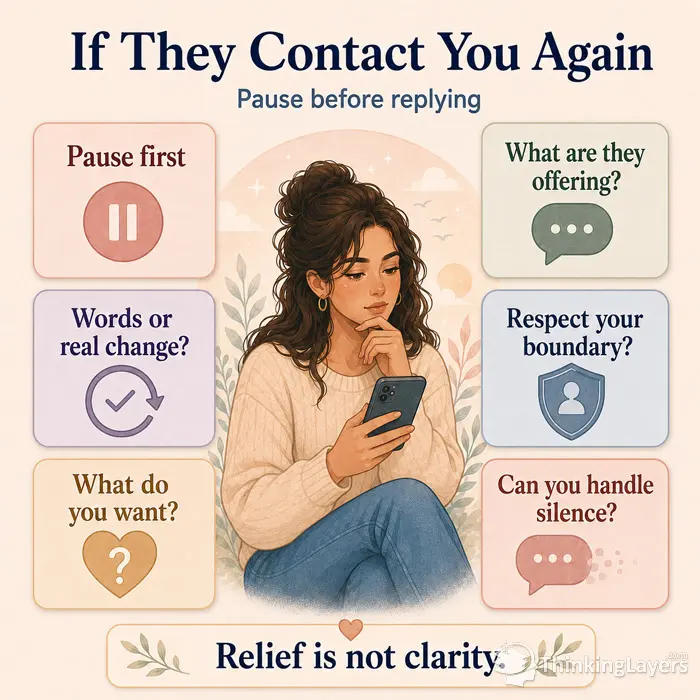
A message from a former partner can create immediate relief, hope, anger, or confusion. The emotional intensity of the moment can make any response feel urgent. Unless the message concerns a real practical emergency, you are allowed to pause.
People sometimes begin pulling away when closeness feels demanding and then return when distance makes the connection feel safer. Their renewed emotion may be genuine, but genuine emotion alone does not correct the pattern that ended the relationship.
Questions to ask before replying
- What is the message actually offering? A clear conversation, an apology, practical information, casual contact, or relief from their loneliness?
- Is anything specific different? Look for changed behavior, not only stronger words.
- Does the message respect my boundary? Contact that ignores a clear request for space already provides useful information.
- What response am I hoping to create? Clarity, reunion, validation, revenge, or proof that you still matter?
- How will I feel tomorrow? Consider the likely effect after the immediate relief has passed.
- Can I tolerate every possible outcome? Warmth followed by silence can be harder than no message at all.
Possible response templates
When you do not want contact:
When practical contact is necessary:
When you would consider a serious conversation:
You do not owe an immediate response simply because the person has become ready to speak.
Signs that you are beginning to move forward
Moving forward is often quieter than people expect. There may be no single morning when the attachment disappears. Instead, small freedoms return.
- You think of the person without automatically checking for new information.
- A memory can remain a memory rather than becoming a reason to make contact.
- You can acknowledge the good parts without forgetting why the relationship ended.
- The person’s online activity no longer determines your mood for the day.
- You make plans without imagining whether they will notice.
- You stop treating every difficult evening as evidence that you should return.
- Your future becomes more detailed than the fantasy of reunion.
- You become interested in people, places, and goals that have no connection to the relationship.
- You can imagine being cared for without requiring it to come from that particular person.
A difficult anniversary, dream, unexpected message, or familiar place may still bring a strong emotional response. That does not erase your progress. Progress is better measured by how you respond after the feeling appears.
A useful measure: Ask, “How much of my behavior is still organized around this person?” The answer is often more informative than asking whether you still miss them.
When additional support may be useful
Some endings become easier to understand through conversations with trusted friends, reflective writing, and clear boundaries. Additional support may be useful when you continue returning to the same relationship despite repeated harm, cannot maintain a boundary you have chosen, or feel that the ending has taken control of most daily decisions.
A qualified counselor or relationship professional can help you organize the story, identify repeating patterns, and separate the loss of the person from older fears that the ending may have activated. Seeking perspective does not mean that your reaction is excessive; it can simply provide a steadier place to think.
Support is particularly important when:
- The other person repeatedly ignores requests for no contact.
- Contact includes threats, intimidation, humiliation, monitoring, or pressure.
- You feel afraid to set a boundary or end communication.
- Shared finances, housing, children, or work create a complicated separation.
- You have become isolated from supportive people.
- The relationship repeatedly ends and restarts without resolving the central problems.
Safety note: When an ending includes threats, stalking, coercion, or fear for personal safety, the priority is not achieving emotional closure. The priority is creating distance, documenting concerning contact where appropriate, and reaching suitable local support.
This article offers general information and reflection tools. It does not evaluate a specific relationship or replace individualized professional guidance.
Recommended reading
The following books offer useful perspectives on attachment, relationship endings, grief, and emotional separation:
- John Bowlby: Attachment and Loss
- Mary D. Salter Ainsworth, Mary C. Blehar, Everett Waters, and Sally Wall: Patterns of Attachment
- Pauline Boss: Ambiguous Loss
- Sue Johnson: Hold Me Tight
- Amir Levine and Rachel Heller: Attached
- Guy Winch: How to Fix a Broken Heart
These works use different frameworks and levels of detail. They are most useful as sources of reflection rather than as tools for assigning a permanent label to yourself or another person.
Frequently asked questions
Why can’t I stop thinking about someone after the relationship ends?
Your thoughts may continue because the person was connected to many parts of daily life: routines, reassurance, future plans, identity, and familiar emotional habits. Ordinary events still activate the expectation that they should be included.
Thinking about the person does not automatically mean that you should contact them. The useful question is what happens after the thought. You can notice it, name the need underneath it, and choose an action that does not restart the same uncertainty.
Does missing someone mean I should go back?
No. Missing someone shows that the bond mattered; it does not show that the relationship was workable. You can miss affection, familiarity, chemistry, or shared history while also recognizing inconsistency, incompatibility, or repeated hurt.
Before considering reunion, look beyond the intensity of the longing. Ask what ended the relationship, what has concretely changed, and whether both people can participate in a different pattern rather than repeating the old one.
How long does it take to let go of someone?
There is no reliable universal timeline. The process is influenced by the length and intensity of the relationship, how clearly it ended, whether contact continues, what future was imagined, and how much of daily life was shared.
A more useful measure is whether the attachment is gradually taking up less behavioral space. You may still feel sadness while checking less, waiting less, making independent plans, and returning attention to the present more easily.
Should I block my former partner?
Blocking can be helpful when seeing their activity repeatedly restarts checking, comparison, or hope, or when they do not respect a request for space. It can create a clearer environment in which the ending is not renewed every day.
Blocking does not have to be an angry statement or permanent decision. It can be a practical boundary for a defined period. When shared responsibilities require communication, use a limited channel instead of unrestricted access.
Can I remain friends with someone I still love?
Friendship is difficult when one person is secretly waiting for it to become a relationship again. In that situation, every friendly message can be interpreted as progress toward reunion, while the other person may believe the relationship status is clear.
Friendship becomes more realistic when both people accept the ending, can tolerate each other having separate lives, and are not using contact to avoid grief. A period of distance may be necessary before that can be assessed honestly.
Why do I miss someone who treated me badly?
Attachment can remain connected to the good moments, apologies, promises, and periods when the relationship felt especially close. Unpredictable warmth can make a person focus intensely on when closeness may return.
Missing the person does not cancel what happened. Hold both realities together: there may have been genuine affection, and the relationship may still have been harmful, disrespectful, or unsuitable for you.
Do I need one final conversation for closure?
Not always. A final conversation can help when both people are willing to be clear, respectful, and realistic. It is less helpful when the conversation repeatedly becomes another round of blame, reassurance, intimacy, or vague future promises.
You can create closure by acknowledging what ended, accepting that some questions may remain unanswered, identifying the pattern, and choosing a boundary based on what consistently happened.
Why do I feel worse again after making progress?
A message, anniversary, dream, photograph, familiar place, or period of loneliness can briefly reactivate the attachment. This does not mean that all previous progress has disappeared.
Notice how you respond after the trigger. Returning to your boundary, asking for support, and avoiding impulsive contact are signs of progress even when the emotional reaction itself is strong.
How do I know when I am ready to date again?
You do not need to have forgotten the previous relationship. However, it helps when dating is motivated by interest and openness rather than by a need to make your former partner jealous, replace them immediately, or escape every uncomfortable feeling.
You may be ready when you can be curious about a new person without constantly comparing them with your former partner, when you can state your needs more clearly, and when the possibility of rejection does not automatically send you back to the old relationship.