Why One Person Feels More Attached Than the Other

 Why can one person seem to care, initiate, and worry more? This article separates emotional intensity from true investment and offers a practical way to evaluate reciprocity, discuss the imbalance, and decide what needs to change.
- What unequal attachment really means
- What “more attached” can actually mean
- Emotional intensity versus relationship investment
- Why attachment can feel unequal
- Different ways of expressing care
- Signs the relationship is genuinely unbalanced
- The experience of the more attached partner
- The perspective of the less attached partner
- A practical two-week reciprocity audit
- How to discuss unequal attachment
- How to stop carrying the whole relationship
- Boundaries when the imbalance continues
- Can emotional investment become more balanced?
- Signs of healthier relationship mutuality
- When additional support may be useful
- Research lenses used for this article
- Frequently asked questions
Feeling more attached than your partner can be confusing because emotional intensity, visible affection, and genuine relationship investment are not always the same thing. One person may think about the relationship more often or initiate more contact, while the other shows care more quietly. The real problem begins when differences in style turn into a lasting imbalance in effort, responsibility, and commitment.
Fast takeaway:
- More visible emotion does not automatically mean more love.
- Unequal attachment becomes a problem when one person carries most of the relationship.
- Judge the balance through initiative, reliability, responsiveness, and shared effort.
What unequal attachment really means
Unequal attachment describes a relationship in which the bond occupies a different emotional and practical place in each person’s life. One partner may organize plans, attention, mood, and future decisions around the relationship, while the other values the connection but gives it less initiative, time, or priority.
Some imbalance is normal. People do not become invested at exactly the same speed, communicate affection in identical ways, or contribute equally during every period of life. One partner may temporarily carry more while the other is dealing with work pressure, family responsibilities, or personal difficulties.
The important question is whether the relationship can rebalance. In a mutual bond, both people notice when effort has become uneven and make reasonable adjustments. In a chronically unequal bond, one person becomes the permanent initiator, planner, emotional interpreter, and repairer.
- Different expression: Both people care, but make that care visible in different ways.
- Different pace: One person becomes invested sooner, while the other communicates honestly about needing more time.
- Temporary imbalance: One partner contributes more during a difficult period, but the relationship later becomes more balanced.
- Chronic imbalance: The relationship continues mainly because one person repeatedly supplies the initiative and emotional work.
Practical principle: Do not measure attachment only by emotional intensity. Look at initiative, reliability, responsiveness, willingness to adjust, and participation in repair.
What “more attached” can actually mean
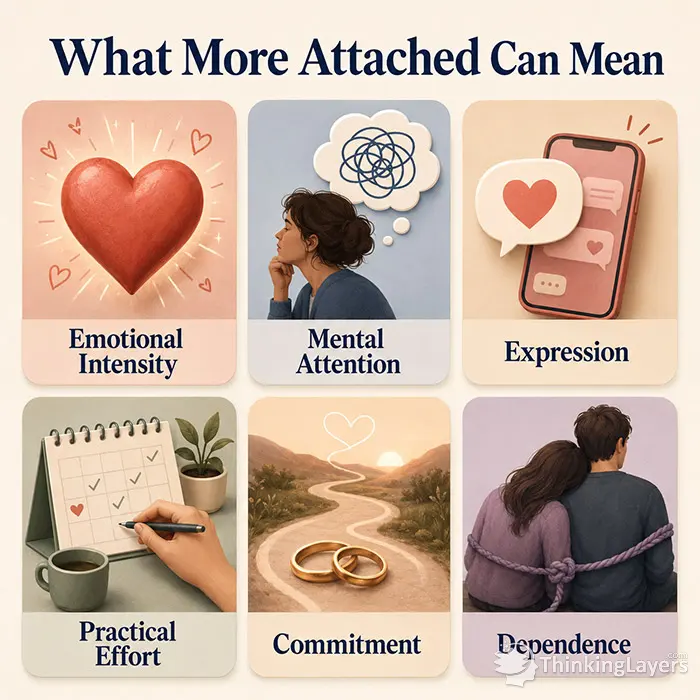
The phrase “I am more attached” can describe several different experiences. Before deciding that the relationship is unequal, identify which kind of difference you are noticing.
| Area of difference | What it may look like | What it does not automatically prove |
|---|---|---|
| Emotional intensity | One person misses the other more strongly, feels separation more deeply, or reacts more visibly to changes | That the other person does not care |
| Mental attention | One partner thinks about the relationship more often and analyzes its meaning | That frequent thinking reflects greater compatibility or commitment |
| Expression | One person sends more affectionate messages, gives more compliments, or speaks more openly about feelings | That a less verbal partner has weaker feelings |
| Practical effort | One person initiates plans, remembers important details, checks in, and follows up after disagreements | That the imbalance is only a communication-style difference |
| Commitment | One partner includes the relationship in future decisions while the other avoids defining what comes next | That affection and commitment are interchangeable |
| Dependence | One person relies heavily on the relationship for reassurance, identity, company, or emotional stability | That needing the relationship more means loving in a healthier or deeper way |
A relationship may contain warmth and genuine emotional closeness while still being unequal in effort or commitment. Conversely, one person may appear extremely attached because they feel anxious about losing the relationship, even though they are not able to participate in it consistently.
Ask a more precise question
Instead of asking, “Do I care more?” try one of the following:
- Do I initiate more of our contact?
- Am I more emotionally expressive?
- Do I make more practical sacrifices?
- Am I more certain about commitment?
- Do I carry most of the repair after conflict?
- Does the relationship occupy more of my identity and daily attention?
- Am I receiving less than I need, or simply receiving care in a different form?
A precise question leads to a practical conversation. A general conclusion such as “I love you more” usually leads to defensiveness because neither person can prove or disprove it.
Emotional intensity versus relationship investment
Emotional intensity happens inside a person. Investment becomes visible through choices. Commitment concerns the place the relationship holds in future decisions. Reciprocity describes whether both people respond to each other’s needs and efforts over time.
These dimensions can move separately.
- A person may feel intensely attached but avoid difficult conversations.
- A person may speak very little about love but consistently show up when needed.
- A person may fear losing the relationship but remain unwilling to define it.
- A person may enjoy daily contact without planning a shared future.
- A person may offer practical support but struggle to respond emotionally.
- A person may promise commitment during emotional moments but return to distant behavior afterward.
This is why the strongest feeling in the room is not always the clearest measure of relationship investment.
Three questions that reveal investment
- Does the person make room for the relationship? They protect time, include you in decisions, and make reasonable adjustments.
- Do they remain engaged when the relationship is inconvenient? Investment becomes clearest when closeness requires patience, responsibility, or repair.
- Does their behavior reduce or increase chronic uncertainty? Consistent participation makes the relationship easier to understand.
Author’s observation: In practice, many people who say, “I am more attached,” are not only describing stronger emotion. They are describing a situation in which they initiate, interpret, organize, repair, and wait more than the other person.
Why attachment can feel unequal
Unequal attachment rarely has one simple cause. It can develop from differences in timing, expectations, communication, life structure, or willingness to commit.
1. Different emotional timing
One person may become invested quickly while the other needs more shared experience before feeling secure. This is especially common in new relationships. A difference in pace is not automatically a problem when both people communicate honestly and the relationship is moving in an understandable direction.
It becomes difficult when the faster-attaching person treats patience as proof of devotion, while the slower person accepts increasing intimacy without explaining what they can realistically offer.
2. Different meanings assigned to the relationship
Two people can participate in the same relationship while understanding it differently. One may see daily communication and physical closeness as signs of a developing partnership. The other may view the connection as enjoyable but still exploratory.
Neither person can safely assume that behavior has the same meaning for both. Shared routines do not automatically create shared expectations.
3. Different capacities for closeness
A person may care deeply but have less time, energy, or emotional availability. Work, caregiving, personal responsibilities, and established habits can affect how much space they create for a relationship.
Capacity matters, but it should not become a permanent explanation that asks the other person to live with unmet needs indefinitely. A relationship is shaped not only by what people feel but also by what they can consistently contribute.
4. Different early expectations
People enter relationships with different ideas about how closeness works. Their early expectations may influence whether frequent contact feels natural, whether dependence feels safe, and how much reassurance seems necessary.
One person may have learned that care is shown through regular checking in. Another may have learned that love should allow wide personal freedom. Neither expectation is automatically wrong, but unspoken differences can create the impression that one person is always asking and the other is always resisting.
5. Unpredictable closeness
Attachment can feel especially strong when attention is inconsistent. Warm, intimate periods may be followed by distance, vague communication, or cancelled plans. The person receiving inconsistent closeness may focus more intensely on the relationship because they are continually trying to understand which version is reliable.
In this situation, emotional intensity may grow partly from uncertainty. The person is not only enjoying closeness; they are also trying to restore it whenever it disappears.
6. One person becomes the relationship manager
Sometimes one partner gradually takes responsibility for everything:
- They initiate most plans.
- They remember every important date.
- They raise every difficult subject.
- They explain both people’s feelings.
- They repair every disagreement.
- They adjust their schedule first.
- They keep future conversations moving.
The more they do, the less visible the other person’s natural level of effort becomes. The relationship continues, but only because one partner continually supplies the structure.
7. The relationship has become too central
A person may feel more attached because the relationship has become their main source of companionship, identity, reassurance, or future direction. This can make every change feel larger and every sign of distance feel more consequential.
It is useful to distinguish strong attachment from emotional dependence. Caring deeply allows the relationship to matter. Dependence becomes restrictive when your sense of worth, direction, or emotional steadiness seems available only through the other person.
Different ways of expressing care
Not every apparent imbalance is an actual lack of care. People make attachment visible in different ways.
One person may express love through:
- Frequent affectionate language.
- Regular messages and calls.
- Physical affection.
- Planning shared activities.
- Asking detailed questions.
- Giving reassurance quickly.
Another may express it through:
- Practical help.
- Reliability during difficult situations.
- Remembering preferences and details.
- Making space in long-term plans.
- Respecting privacy and independence.
- Returning to resolve disagreements.
Different expression can work when three conditions are present.
The care is legible
Both partners can recognize how the other person expresses care. You should not have to decode every action or build an argument proving that hidden affection exists somewhere underneath unavailable behavior.
The care is responsive
Once a need has been clearly expressed, each person makes reasonable adjustments. “This is simply how I am” should not end every conversation.
The care is sustainable
The relationship does not depend on one person continually translating, excusing, or compensating for the other. Both people can participate without one becoming emotionally exhausted.
Useful distinction: A different style says, “I care and show it differently, but I want to understand what helps you feel connected.” An unequal arrangement says, “Accept whatever I offer and stop asking whether it meets your needs.”
Signs the relationship is genuinely unbalanced
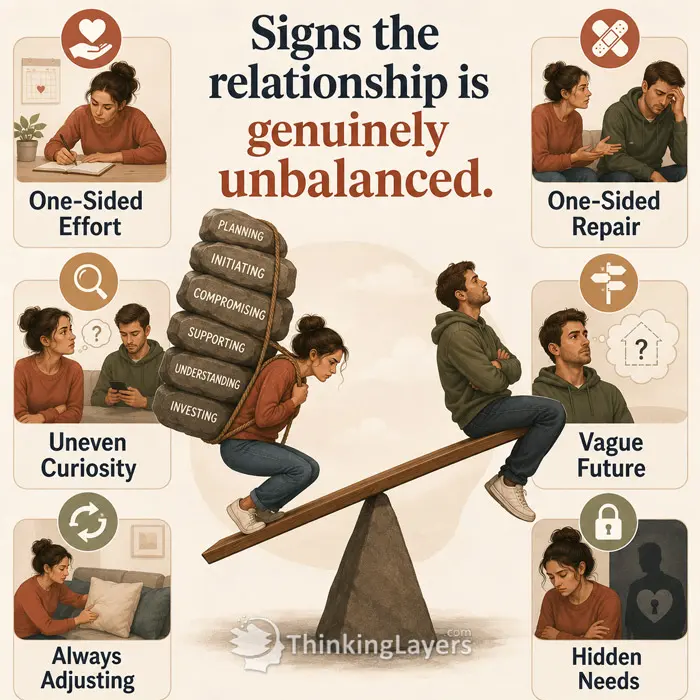
A real imbalance becomes visible across time and across several areas of the relationship. One isolated week, one missed call, or one less expressive personality is not enough to determine that attachment is unequal.
Pay attention when several of the following patterns continue:
- Initiation is consistently one-sided: Contact, dates, and meaningful conversations happen mainly because one person starts them.
- Plans depend on repeated reminders: The relationship moves forward only when one partner organizes every detail.
- Curiosity is uneven: One person knows the other’s inner world, while their own feelings receive little attention.
- Adjustment moves in one direction: One partner repeatedly changes schedules, expectations, and boundaries to keep the connection.
- Repair is one-sided: After conflict, the same person reaches out, explains, apologizes, and reopens communication.
- The future remains vague: One person makes plans around the relationship while the other avoids discussing its direction.
- Closeness occurs on one person’s terms: Contact increases when they want comfort or company and decreases when responsibility is required.
- Effort appears mainly after a threat of loss: The less involved person becomes attentive only when the other starts stepping away.
- One person has become smaller: They hide needs, cancel personal plans, or accept uncertainty to avoid disturbing the bond.
Do not use a single metric: Text frequency, social media activity, gift giving, or verbal affection cannot independently prove who is more invested. Look at the full pattern of initiative, reliability, responsiveness, repair, and commitment.
Unequal effort versus a temporary difficult period
A temporary imbalance usually has context and movement. The partner with less capacity recognizes the difference, communicates what is happening, shows appreciation, and participates in a plan for rebalancing.
A chronic imbalance usually has repetition and defensiveness. The more involved person raises the issue, receives reassurance or excuses, and then returns to carrying the same responsibilities.
The experience of the more attached partner
The more attached partner often lives in a heightened state of relationship awareness. They notice response times, changes in affection, future language, and small shifts in availability. This attention may appear excessive from the outside, but it often develops because important information is inconsistent or because the relationship has become highly central.
Common experiences include:
- Waiting for contact before fully beginning the day.
- Feeling relieved when the person is warm and unsettled when they become distant.
- Reviewing conversations for signs of changed interest.
- Trying to become easier, calmer, or less demanding.
- Accepting vague plans because asking for clarity feels risky.
- Comparing effort and wondering whether expectations are unreasonable.
- Feeling embarrassed about needing more reassurance.
- Making relationship decisions based on potential rather than current behavior.
Repeated seeking reassurance can then become part of the imbalance. The person asks whether everything is okay, receives a comforting answer, and feels better briefly. When behavior remains unchanged, the same uncertainty returns.
The hidden question beneath “Do you love me?”
The question may actually be:
- Will you initiate without being reminded?
- Am I included in your future?
- Will you stay engaged when I express a need?
- Does this relationship matter when it is inconvenient?
- Can I stop managing everything without losing the connection?
These questions cannot be answered permanently through affectionate words alone. They require observable behavior.
The perspective of the less attached partner
The person who appears less attached is not automatically cold, selfish, or incapable of love. They may experience the relationship differently.
They may:
- Need more time before including a partner in future decisions.
- Feel affection without needing frequent communication.
- Have a strong independent identity and several sources of connection.
- Become less expressive when they feel pressured to prove their feelings.
- Assume that the relationship is secure unless a serious problem is stated directly.
- Care about the person but remain unsure about long-term compatibility.
- Enjoy the relationship without wanting the same level of commitment.
The last two possibilities matter. A person can be kind, affectionate, and sincere while still wanting less from the relationship. The fact that they are not intentionally misleading anyone does not make the mismatch disappear.
Honesty is part of emotional responsibility
The less involved partner is responsible for communicating what they can offer. Statements such as “I care about you” may be true, but they are incomplete when the real question concerns commitment, exclusivity, frequency of contact, or shared plans.
A useful answer sounds like:
This answer may be painful, but it allows both people to make informed decisions. Affection without clarity can keep an unequal bond active much longer than either person intended.
A composite example
Composite example: Leah believed she was simply more expressive than Owen. She planned their weekends, initiated nearly every message, raised difficult subjects, and suggested all future activities. Owen was warm and affectionate when they were together, so Leah explained the imbalance as a difference in communication style.
For two weeks, she stopped filling every empty space. She did not become cold or ignore him; she simply stopped sending reminders, proposing backup plans, and reopening every unfinished conversation. Contact became much less frequent, and no new plans appeared.
When they spoke directly, Owen explained that he enjoyed the relationship but did not want it to become more serious. The problem was not that his affection had been false. The problem was that Leah had been interpreting warmth as evidence of a shared direction.
This is an illustrative composite based on common relationship patterns, not an account of an identifiable person.
A practical two-week reciprocity audit
When feelings are intense, it can be difficult to distinguish a temporary fear from a repeated imbalance. A two-week reciprocity audit creates a clearer picture without turning the relationship into a scorecard.
The purpose is not to test your partner by withdrawing affection. Continue behaving respectfully. Stop only the extra work that prevents you from seeing what the other person initiates naturally.
| Area to observe | Evidence of mutuality | Evidence of imbalance |
|---|---|---|
| Initiation | Both people begin conversations, suggest plans, or create moments of closeness | Contact happens mainly when one person starts it |
| Follow-through | Promises and plans are remembered, confirmed, or respectfully changed | One person repeatedly reminds, reorganizes, or accepts cancellations |
| Curiosity | Both partners ask about each other’s thoughts, experiences, and needs | One person’s inner life receives most of the attention |
| Adjustment | Both people make reasonable changes when a need is expressed | The same partner adapts while the other treats every preference as fixed |
| Repair | Both people help reopen communication and address the impact of conflict | One person must restore connection after every disagreement |
| Future inclusion | The relationship appears naturally in upcoming plans and decisions | One person plans ahead while the other keeps the relationship separate from the future |
| Freedom | Both partners can say no, ask for space, and maintain separate interests without punishment | One person fears that any boundary will cause the relationship to disappear |
How to use the audit
- Record observable behavior: Write “I initiated four of five conversations” rather than “They do not care.”
- Notice context: Include known pressures such as travel, deadlines, family responsibilities, or illness.
- Avoid secret tests: Do not disappear, become cold, or create jealousy to measure their reaction.
- Stop unnecessary rescuing: Allow the other person to remember, initiate, or repair without a prompt.
- Review the whole pattern: One quiet day matters less than repeated one-sided participation.
- Use the information for a conversation: The audit should lead to clarity, not silent resentment.
Important: The goal is not to count every message. The goal is to discover whether the relationship continues through mutual participation or mainly through your management.
How to discuss unequal attachment
A conversation about imbalance can easily become a debate about who loves more. That debate is rarely useful because feelings cannot be measured from the outside. Focus instead on what is happening and what the relationship requires.
Effective clear communication separates observation, impact, need, question, and boundary.
A five-part conversation structure
- Describe the pattern: Name specific behavior without exaggeration.
- Explain the impact: Describe what the pattern creates for you emotionally and practically.
- Name what you need: Ask for a level of involvement, not proof of love.
- Ask a direct question: Give the other person room to state what they genuinely want.
- Clarify your boundary: Explain what you will do if the mismatch continues.
Example wording
This is more useful than:
- “I obviously love you more.”
- “You never care about anything.”
- “I should not have to tell you what to do.”
- “If you loved me, you would already know.”
Questions that create usable information
- What does this relationship mean to you now?
- What level of commitment are you genuinely interested in?
- How often do you realistically want contact and shared time?
- What are you willing to initiate without being reminded?
- How do you want us to handle conflict and repair?
- Which parts of the relationship feel difficult or pressured to you?
- Is there something I am expecting that you do not want to offer?
Evaluate the answer in two stages
First, listen to the words. Does the person answer the actual question, or do they offer general affection while avoiding specifics?
Second, observe what follows. A sincere conversation matters, but a changed pattern requires changed behavior.
Author’s note: Do not force an immediate promise simply to reduce discomfort. A truthful answer that reveals incompatibility is more useful than reassurance given under pressure.
How to stop carrying the whole relationship
Overfunctioning means doing more than your share to prevent uncertainty, disappointment, or disconnection. It can feel loving and responsible, but it may also prevent you from seeing what the other person contributes voluntarily.
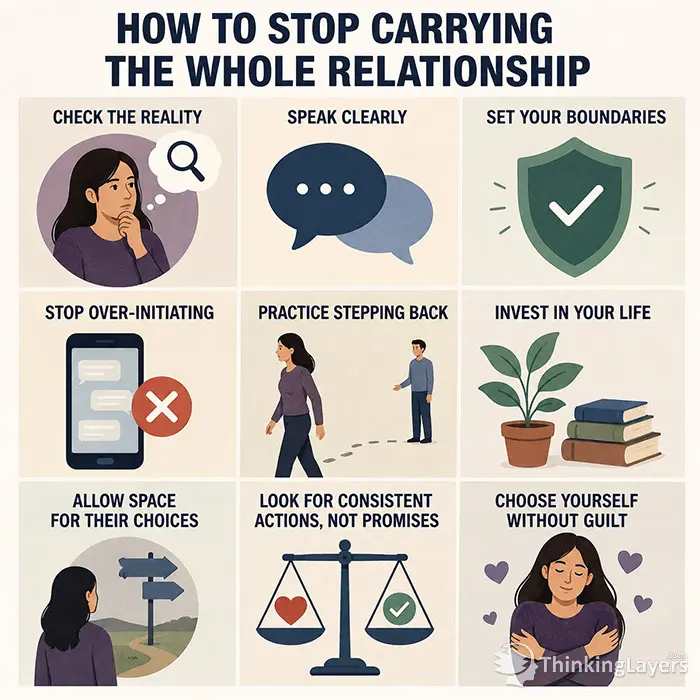
Common forms include:
- Sending another message whenever the conversation becomes quiet.
- Planning every date and creating backup plans after cancellations.
- Explaining the other person’s behavior to yourself and to friends.
- Accepting vague answers and constructing a more hopeful meaning.
- Reminding the person of agreements they repeatedly forget.
- Apologizing first even when responsibility is shared.
- Reducing your needs before the other person has responded to them.
A respectful reset
- Keep your normal warmth: Do not become cold or punitive.
- Stop automatic reminders: Allow the person to remember their own promises.
- Make one clear request: Do not repeat it in several forms.
- Protect existing plans: Do not keep your schedule permanently open for uncertain contact.
- Allow unfinished space to remain visible: Do not immediately repair every silence or disagreement alone.
- Observe without inventing explanations: Notice what the person does when you are no longer directing the process.
Avoid turning the reset into a test: Silent treatment, deliberate jealousy, disappearing, or withholding affection to provoke pursuit will create more confusion. The purpose is to stop compensating, not to manipulate a reaction.
Boundaries when the imbalance continues
A boundary is not a demand that the other person feel more. It is a decision about the kind of relationship you are willing to continue.
Useful boundaries begin by separating preferences, needs, and limits.
Preferences
These are forms of closeness you enjoy but can discuss flexibly:
- How often you text during the day.
- Which activities you do together.
- How much advance planning you prefer.
- Which forms of affection feel most meaningful.
Relationship needs
These are conditions that allow the bond to remain workable:
- Reliable communication.
- Mutual initiative.
- Honest answers about commitment.
- Respect during disagreement.
- Some form of shared planning.
- A willingness to repair after hurt.
Personal limits
These describe what you will no longer continue participating in:
- Indefinite ambiguity.
- Repeated cancellations without repair.
- Partner-level emotional access without partner-level responsibility.
- Contact that happens only when the other person feels lonely.
- A relationship in which expressing a need leads to punishment or disappearance.
Boundary examples
Practical rule: Match the level of your investment to the relationship that is consistently available, not only to the relationship you hope may eventually appear.
Can emotional investment become more balanced?
Yes, but balance does not improve because the more attached person becomes infinitely patient or because the less attached person offers one emotional conversation. It changes when both people participate differently over time.
Balance can improve when:
- The imbalance is acknowledged without mocking or blaming the person who noticed it.
- The less involved partner becomes more proactive rather than waiting for instructions.
- The more involved partner stops compensating for every gap.
- Both people clarify what commitment, contact, and independence mean to them.
- Requests become specific and realistic.
- Agreements are followed without repeated reminders.
- Conflict leads to repair rather than renewed uncertainty.
- Both partners maintain individual lives outside the relationship.
Repeated reliability is central to building trust. Trust grows when each person can increasingly predict that important conversations will be answered, agreements will be respected, and periods of distance will not erase the relationship.
Balance is unlikely to improve when:
- Every conversation ends with comforting words but no behavioral change.
- The more attached person is blamed for noticing the imbalance.
- Effort appears only when separation becomes possible.
- One partner wants the benefits of commitment while keeping all options open.
- Requests for mutuality are repeatedly described as control.
- The relationship works only when one person lowers their needs.
- Timeframes are continually extended without new information.
Signs of healthier relationship mutuality
Mutuality does not mean identical personalities, equal numbers of messages, or a perfectly even division of every task. It means that both people have influence, responsibility, and room to be fully present.
Signs include:
- Both people initiate connection in ways that are recognizable to the other.
- Requests can be discussed without immediate defensiveness or withdrawal.
- One partner can temporarily carry more without becoming the permanent manager.
- Both people make adjustments rather than expecting all flexibility from one side.
- Future plans reflect both people’s priorities.
- Affection and availability broadly support each other.
- Conflict does not leave one person solely responsible for repair.
- Personal space exists without making the relationship feel disposable.
- Neither partner must hide ordinary needs to preserve closeness.
- The relationship becomes easier to understand as it develops.
A monthly mutuality check-in
Each partner can answer four questions:
- When did you feel that I actively chose the relationship this month?
- Where did the effort feel uneven?
- What is one form of care you offered that I may not have recognized?
- What is one practical action we each want to take next month?
End with one small agreement. A specific change is more useful than a broad promise to “try harder.”
Author’s note: Healthy reciprocity often feels less dramatic than unequal attachment. There is less chasing, less guessing, and less emotional proof-seeking because the relationship is repeatedly made visible through ordinary participation.
When additional support may be useful
Friends, reflective writing, and a direct conversation may be enough to understand many relationship imbalances. Outside support can be useful when you repeatedly enter relationships in which you carry most of the emotional work, find it difficult to state a limit, or lose sight of your own life whenever another person becomes distant.
A qualified relationship professional can help separate several questions:
- Is the relationship genuinely unequal, or are styles of expression different?
- Are current reactions connected to the present behavior or to older expectations?
- Which needs can be negotiated?
- Which conditions are necessary for self-respect and emotional safety?
- What keeps you participating after the mismatch has become clear?
Additional perspective may be especially useful when:
- You repeatedly accept ambiguity because separation feels unbearable.
- You cannot stop monitoring the other person’s attention.
- Your friendships, work, or daily routines have become secondary to the relationship.
- You feel responsible for both people’s emotions and communication.
- The relationship repeatedly ends and restarts without structural change.
- You feel unable to say no without fearing punishment or abandonment.
Safety note: Threats, coercion, unwanted monitoring, financial control, humiliation, and deliberate isolation are not ordinary differences in attachment. In those situations, personal safety and appropriate local support take priority over improving reciprocity.
This article offers general information and reflection tools. It does not evaluate a specific relationship or replace individualized professional guidance.
Research lenses used for this article
This article draws on several relationship frameworks that help distinguish emotional intensity, investment, responsiveness, and reciprocity. They are used as practical lenses rather than as tools for ranking who loves more.
- Caryl E. Rusbult: The Investment Model, which examines how satisfaction, alternatives, accumulated investment, and commitment interact in close relationships.
- Harry T. Reis and Phillip R. Shaver: Work on interpersonal intimacy and the importance of feeling understood, accepted, and responded to by another person.
- Margaret S. Clark and Judson Mills: Research on communal relationships, care, and the difference between responsive giving and constant scorekeeping.
- Susan Sprecher: Research on equity, emotional investment, reciprocity, and satisfaction in close relationships.
- Ellen Berscheid and Pamela Regan: The Psychology of Interpersonal Relationships, for a broad view of attraction, attachment, interdependence, and relationship development.
- John Gottman and Nan Silver: The Seven Principles for Making Marriage Work, particularly its practical attention to responsiveness, everyday bids for connection, and repair.
These perspectives do not suggest that a healthy relationship must remain mathematically equal. Their practical value lies in showing that stable closeness depends on more than strong emotion: it also requires responsiveness, voluntary investment, understandable expectations, and the ability to rebalance effort over time.
Frequently asked questions
Does feeling more attached mean I love my partner more?
Not necessarily. You may experience emotions more intensely, think about the relationship more often, or express affection more openly. Your partner may care deeply while showing it through reliability, practical help, shared planning, or a quieter form of presence.
The more useful question is whether both people participate in ways that meet the relationship’s needs. Strong emotion without responsibility is not automatically deeper love, and calm behavior does not automatically mean emotional absence.
Can a relationship work when one person is more attached?
Yes, especially when the difference concerns pace or expression rather than commitment. One partner may be more verbal, need more contact, or become emotionally invested sooner. The relationship is more likely to work when both people understand the difference, respond to each other’s needs, and gradually create a level of commitment that feels acceptable to both. It becomes difficult when one person remains permanently uncertain while the other carries nearly all the relationship work.
How can I tell the difference between a different love style and unequal investment?
Look at responsiveness. A person with a different style may not naturally communicate as you do, but they will usually care that their behavior affects you. They will discuss the difference and make reasonable adjustments.
Unequal investment is more likely when your needs are repeatedly dismissed, initiative remains one-sided, plans require constant reminders, and the person expects you to accept uncertainty without meaningful change.
Why do I always become the more attached person?
You may invest quickly, make relationships central, or begin carrying emotional and practical responsibilities before mutual commitment is clear. You may also be especially drawn to people whose inconsistent availability intensifies your attention. Notice when investment begins. Ask whether the other person is matching your participation before giving more time, flexibility, or emotional access. The goal is not to become detached; it is to allow reciprocity to develop before building your life around the bond.
Should I stop initiating contact to see whether my partner cares?
It can be useful to stop doing more than your share, but do not turn the change into a secret test. Sudden coldness or deliberate disappearance creates confusion and may not reveal anything reliable.
Tell your partner that the effort feels one-sided, ask for more mutual initiation, and then leave enough space for them to act. Observe the resulting pattern rather than waiting for one dramatic pursuit.
Can the less attached partner become more invested?
Yes. Investment can deepen as trust, shared experience, and commitment grow. A person may also become more active after understanding that their quiet participation has been difficult to recognize.
However, potential should not replace present evidence indefinitely. Look for self-initiated change, reliable follow-through, and greater clarity—not only promises made when the relationship is at risk.
Is it unreasonable to need more contact than my partner?
No. Preferences for contact differ, and wanting regular connection is not inherently excessive. The question is whether both people can find a rhythm that respects closeness and individual space.
A workable compromise should not require one partner to remain chronically disconnected or the other to remain permanently available. Both needs should remain visible in the final arrangement.
Should I tell my partner that I feel more attached?
Yes, but describe the observable imbalance rather than presenting your feeling as a verdict. Saying, “I initiate nearly all our plans and feel alone in maintaining contact” creates a clearer discussion than saying, “I love you more.”
Ask what the relationship means to them, what level of involvement they want, and what they are willing to initiate. Their answer and subsequent behavior will give you more useful information than a debate about emotional intensity.
When is unequal attachment a reason to leave?
Consider stepping away when the mismatch remains clear after direct conversations, important needs continue to be dismissed, and the relationship works only when you lower expectations or carry the connection alone.
You do not need to prove that the other person is uncaring. Two decent people can want different levels of closeness and commitment. A relationship can contain genuine affection and still be unable to offer the mutuality you need.