Feeling Emotionally Numb Without a Clear Reason

 Emotional numbness can appear suddenly and without a clear cause. This article explores why people may feel emotionally disconnected, empty, or detached, what psychological factors can contribute to this state, and how to better understand these feelings.
- What Emotional Numbness Feels Like
- Why Numbness Can Happen Without a Clear Reason
- Common Psychological Triggers
- Stress, Burnout, and Emotional Overload
- Avoidance, Detachment, and Protective Numbing
- Signs It Might Be a Pattern, Not a Phase
- What Can Help You Reconnect With Feelings
- When to Consider Professional Support
- Quick Self-Check Questions
- FAQs
What Emotional Numbness Feels Like
This experience is often described as feeling emotionally “flat” — like the volume on your inner reactions has been turned down. You can understand what is happening around you, but the usual inner response feels weaker, delayed, or absent.
It can also feel oddly confusing: you might look fine on the outside, keep working, keep replying to messages, keep doing daily tasks — yet something inside feels distant or unreachable.
How it can show up in everyday life
- Muted reactions — good news and bad news land with the same calm, almost neutral feeling.
- Emotions that arrive late — you process events intellectually, but the feelings come much later (or not at all).
- Disconnection from enjoyment — hobbies, music, food, or achievements feel less rewarding than they used to.
- Social “autopilot” — conversations feel scripted, and deeper connection feels harder.
- Hard-to-name inner state — when asked how you feel, the answer becomes “fine,” “tired,” or “nothing.”
This is not the same as having no emotions at all. In many cases, feelings are still there, but they are harder to access — as if your system is protecting you from something overwhelming, distracting, or unresolved.
Why Numbness Can Happen Without a Clear Reason
It is natural to search for one clear cause — a breakup, a conflict, a loss, a major failure — and feel frustrated when nothing obvious explains the shift. But this state often builds quietly through accumulation rather than a single dramatic moment.
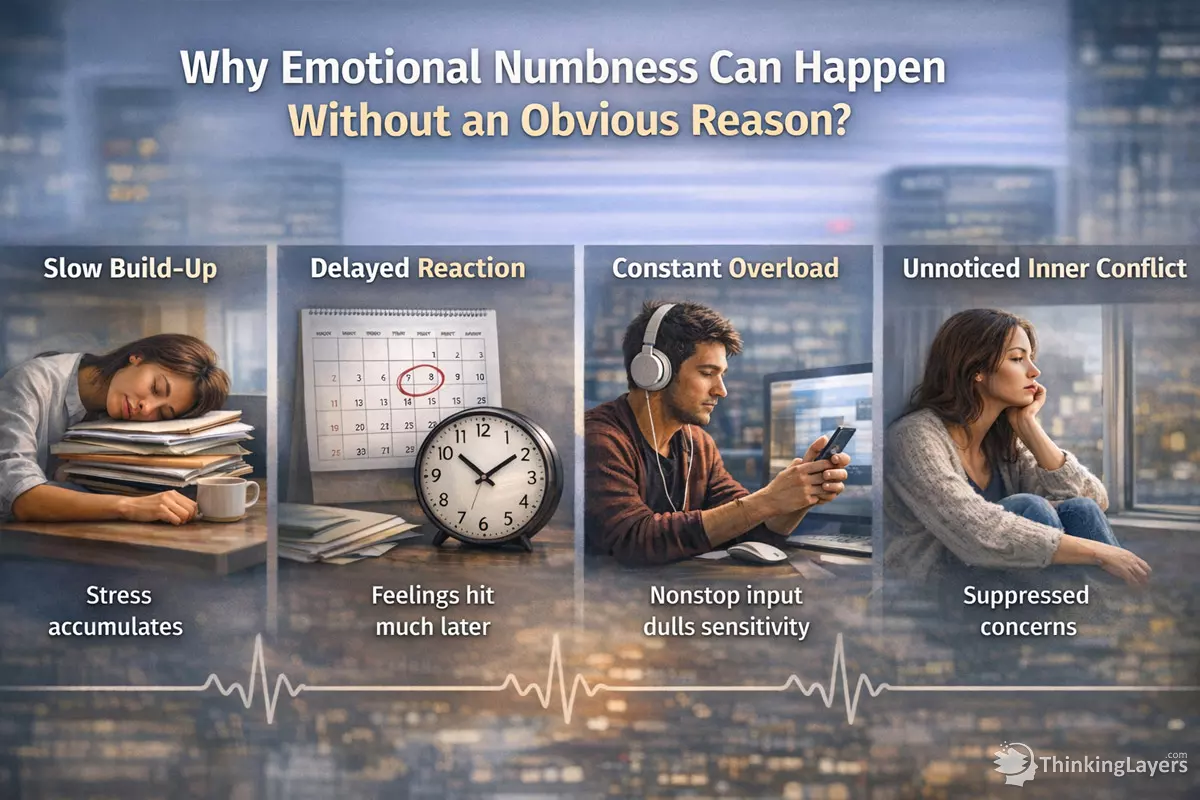
Sometimes it is a form of emotional “energy saving.” When life feels like constant demand, the mind may reduce intensity so you can keep functioning. From the outside, you look stable. Inside, you feel less connected.
Why it can feel “random”
- Slow buildup — stress piles up until your system downshifts without warning.
- Delayed processing — the emotional impact of something may arrive weeks later, when you finally have space.
- Constant stimulation — nonstop input (work, screens, noise, multitasking) can dull sensitivity over time.
- Unnoticed inner conflict — you may be pushing through something you have not fully admitted you care about.
| Possible driver | How it can create disconnection | Common sign |
|---|---|---|
| Chronic stress | Your attention narrows to tasks and survival mode, leaving less space for inner response. | You stay productive but feel little satisfaction afterward. |
| Overload and pressure | When demands feel never-ending, emotional shutdown can prevent overwhelm. | You feel drained even on “quiet” days. |
| Habitual suppression | Regularly pushing feelings aside can make them harder to access later. | You automatically say “it’s fine” and move on. |
| Avoidance of discomfort | If certain emotions feel unsafe, your mind may mute the entire range to avoid them. | You distract yourself the moment feelings rise. |
| Ignoring needs | When rest, boundaries, or meaning are missing, emotional signals can fade into numbness. | It is hard to answer “What do I actually want?” |
Seen this way, numbness is not a flaw — it is often a signal. It may be pointing to overload, long-term strain, or feelings that have not had a chance to be processed in a safe, honest way.
Common Psychological Triggers
This state rarely appears out of nowhere. More often, it is linked to specific inner patterns or life situations that quietly push emotions into the background. These triggers are not always dramatic — many are subtle and easy to overlook.
Triggers that often go unnoticed
- Unresolved disappointment — when something important did not work out, but you told yourself to “move on” too quickly.
- Chronic self-control — constantly monitoring your reactions, words, or behavior to avoid conflict or judgment.
- Emotional mismatch — living according to expectations that do not align with what you actually value.
- Accumulated micro-stress — many small pressures that feel “not serious enough” to complain about.
- Loss of meaning — continuing routines that once made sense, but no longer feel personally relevant.
For example, someone may stay in a job that feels emotionally empty but stable. There is no crisis, no clear drama — just a quiet sense of detachment that grows over time.
| Trigger | What happens internally | Everyday example |
|---|---|---|
| Suppressed disappointment | Emotions are pushed aside to stay functional. | You say “it’s fine” about a missed opportunity, but feel flat weeks later. |
| Constant self-monitoring | Spontaneous reactions are filtered out. | You carefully choose words in every conversation. |
| Value conflict | Motivation fades when actions don’t match inner priorities. | You achieve goals that don’t bring satisfaction. |
| Ongoing low-level stress | Emotional sensitivity decreases to conserve energy. | You feel tired even on days without problems. |
| Lack of emotional expression | Feelings lose intensity when never expressed. | You rarely talk about what truly bothers you. |
These triggers do not mean something is “wrong” with you. They usually reflect adaptation — a way of coping that worked at first, but now has side effects.
Stress, Burnout, and Emotional Overload
One of the most common backgrounds for emotional detachment is prolonged stress. When pressure becomes constant, the mind often shifts into efficiency mode — prioritizing tasks and decisions while reducing emotional input.
Over time, this can feel like running on autopilot. You keep going, but the inner response that once gave life texture starts to fade.
How overload affects emotional response
- Short-term focus — attention narrows to what must be done next.
- Reduced reflection — there is little space to process experiences emotionally.
- Emotional blunting — intensity is turned down to avoid exhaustion.
- Delayed reactions — feelings surface only when pressure drops.
A common example is someone who holds everything together during a demanding period — deadlines, family responsibilities, constant availability — and only later notices that joy, excitement, or sadness feel strangely distant.
This does not mean stress has “broken” your emotions. It usually means your system has been prioritizing survival and stability. Reconnection often starts not with forcing feelings, but with reducing overload and allowing space for them to return.
Avoidance, Detachment, and Protective Numbing
Sometimes emotional distance is not accidental. It develops as a form of protection. When certain feelings feel too uncomfortable, unsafe, or disruptive, the mind may reduce emotional access altogether to maintain stability.
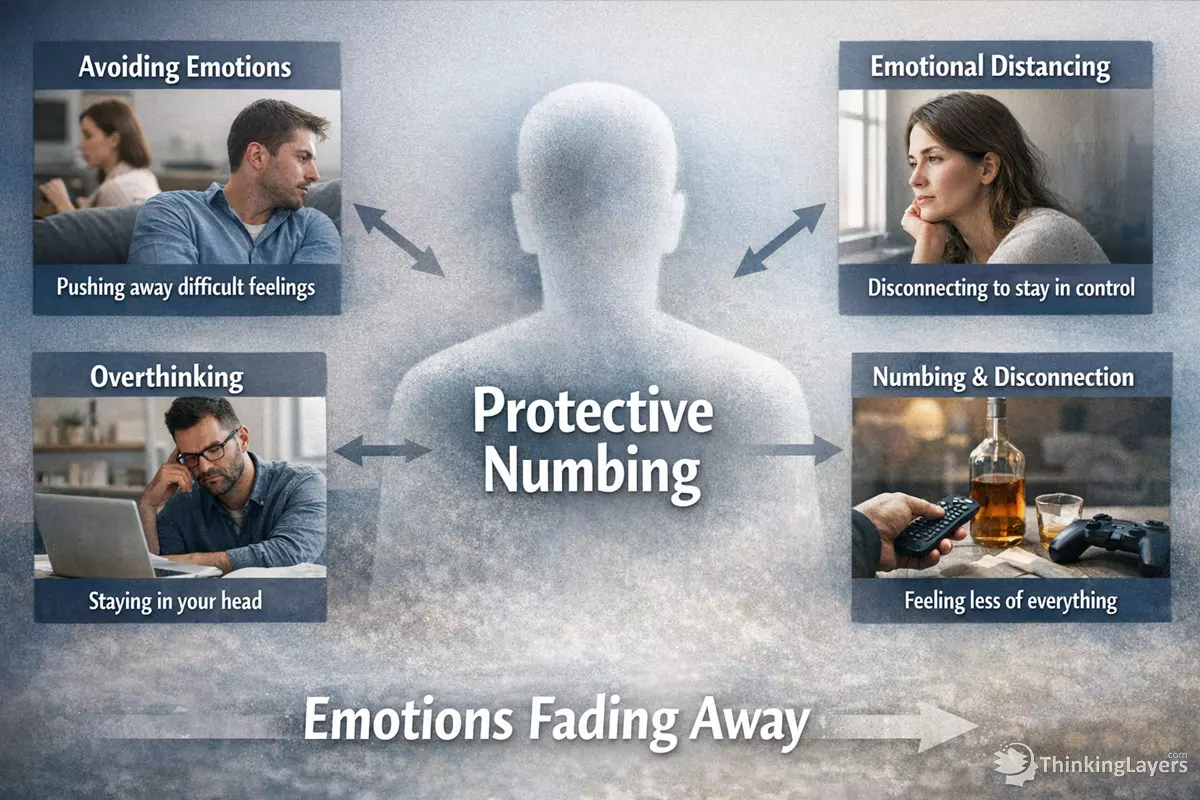
This does not usually happen through a conscious decision. More often, it forms gradually through repeated avoidance — changing the subject, staying busy, distracting yourself, or intellectualizing experiences instead of feeling them.
How protective numbing develops
- Avoidance of discomfort — emotions linked to fear, shame, or vulnerability are pushed away.
- Emotional distancing — stepping back internally to stay in control.
- Over-reliance on thinking — analyzing situations instead of sensing emotional reactions.
- Generalization — numbing spreads from one emotion to many.
For example, someone who learned that expressing sadness or anger leads to conflict may stop feeling those emotions consciously. Over time, joy and excitement may also feel muted, even though nothing “bad” is happening in the present.
| Protective habit | Short-term benefit | Long-term effect |
|---|---|---|
| Emotional avoidance | Less discomfort in the moment. | Reduced emotional range over time. |
| Constant distraction | Temporary relief from inner tension. | Difficulty staying present with feelings. |
| Intellectualizing emotions | Sense of control and clarity. | Emotions feel distant or abstract. |
| Emotional self-protection | Stability during stressful periods. | Persistent sense of detachment. |
Protective numbing often begins as a helpful strategy. It becomes a problem only when it continues long after the original need for protection has passed.
Signs It Might Be a Pattern, Not a Phase
Many people experience emotional dullness occasionally, especially during stressful periods. The key question is not whether it happens, but how long it lasts and how deeply it affects daily life.
When this state becomes familiar rather than temporary, it may signal an ongoing pattern rather than a short-term response.
Clues that it is more than a passing phase
- Duration — the feeling persists for months rather than days or weeks.
- Consistency — emotional distance shows up across many areas of life.
- Loss of contrast — highs and lows feel equally muted.
- Reduced motivation — goals feel logical but emotionally unengaging.
- Disconnection from meaning — activities feel empty even when successful.
For instance, you might look back and realize that joy, excitement, or deep sadness have been absent for so long that you no longer remember when they faded.
Recognizing a pattern is not about labeling yourself. It is about noticing signals early, before emotional distance becomes the default way of relating to yourself and the world.
What Can Help You Reconnect With Feelings
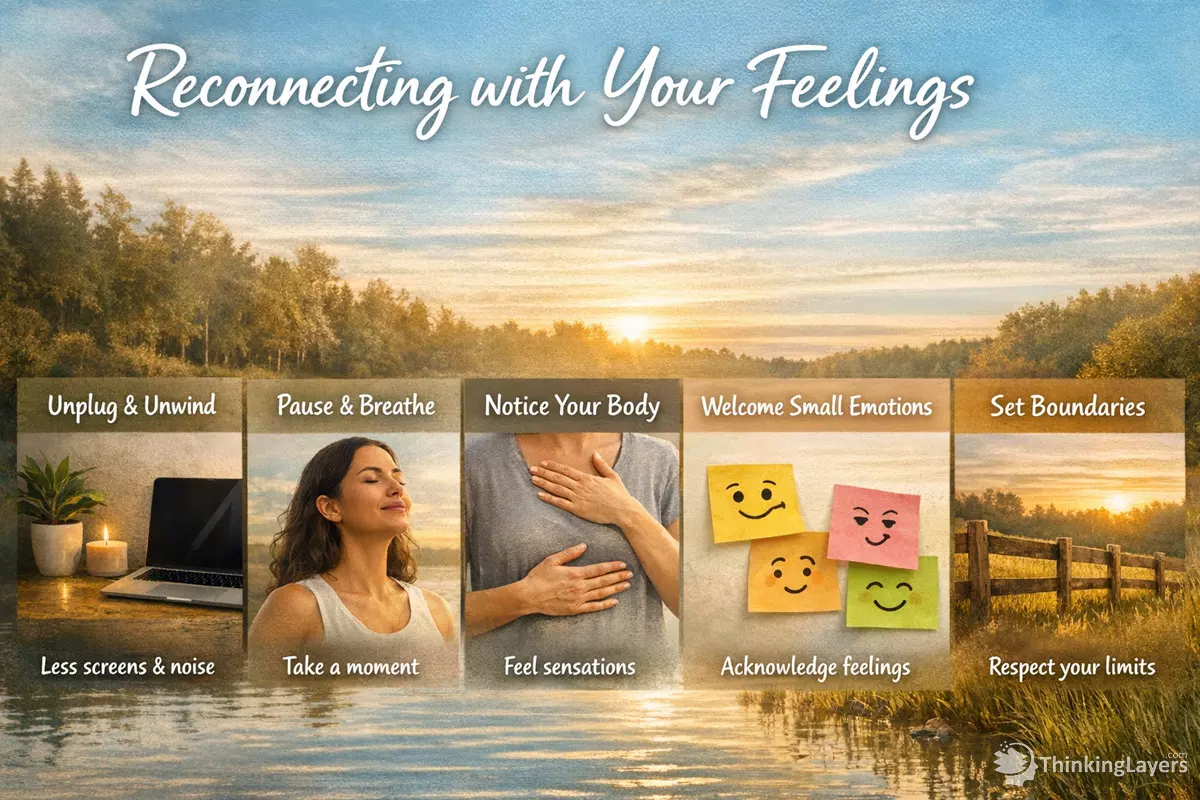
Reconnecting with emotions is usually not about forcing yourself to feel something stronger. In many cases, pressure only deepens distance. What helps more is creating conditions where feelings can safely return on their own.
Approaches that often support reconnection
- Reducing constant stimulation — fewer screens, less multitasking, more quiet moments where inner signals can surface.
- Slowing down reactions — pausing before distracting yourself when discomfort appears.
- Rebuilding body awareness — noticing physical sensations, tension, breathing, or fatigue can reopen emotional channels.
- Allowing small emotions — paying attention to mild irritation, curiosity, or comfort instead of waiting for something intense.
- Restoring boundaries — emotional access often returns when personal limits are respected.
For example, someone who feels emotionally flat may notice subtle signals first: a slight sense of relief after saying no, irritation during certain conversations, or calm during solitude. These small reactions matter — they are often the doorway back to fuller emotional range.
| Helpful shift | What it changes | Why it matters |
|---|---|---|
| Less distraction | More attention to internal states | Emotions need space to become noticeable |
| Slower pace | Reduced pressure to perform | Feelings surface when urgency drops |
| Body awareness | Reconnects sensation and emotion | Emotions often appear as physical signals first |
| Honest boundaries | Less internal conflict | Suppressed needs often block emotional access |
Progress is rarely dramatic. Reconnection usually happens gradually, through noticing, allowing, and responding to what is already there.
When to Consider Professional Support
There is no strict rule for when outside support becomes appropriate. However, certain signs suggest that trying to handle emotional disconnection entirely on your own may not be effective anymore.
Situations where support may be useful
- Persistence — emotional distance has lasted a long time with little change.
- Impact on daily life — relationships, motivation, or work satisfaction are noticeably affected.
- Loss of emotional contrast — both positive and negative feelings feel equally muted.
- Difficulty accessing inner experience — reflection alone leads to analysis, not clarity.
Seeking support does not mean something is “wrong” with you. Often, an outside perspective helps identify patterns that are hard to see from the inside — especially habits of avoidance, over-control, or long-term emotional suppression.
Even brief conversations can help create language for what feels vague and unformed. In many cases, understanding comes before feeling — and that understanding can make space for emotions to return naturally.
Quick Self-Check Questions
These questions are not a diagnosis — they are a practical way to spot patterns. Answer quickly and honestly. If you want, write 1–2 sentences under each one and look for repeats.

- When did this start?
Was it sudden, or did it build slowly over weeks or months? - What changed around that time?
New responsibilities, less sleep, more screen time, less social contact, a conflict you brushed off? - What emotions feel most “blocked”?
Is it mainly joy, sadness, anger, excitement, affection — or everything equally? - Where do you still feel something?
Do you feel more alive when alone, in nature, in movement, with one specific person, while creating something? - What do you avoid thinking about?
Is there a topic you quickly distract yourself from because it feels uncomfortable or messy? - Are you in constant “function mode”?
Do you run on tasks and routines without real pauses, even on days off? - What does your body say?
Tension, headaches, shallow breathing, heavy fatigue, restlessness — any repeating signals? - What needs have been ignored?
Rest, boundaries, meaning, connection, creativity, play, time alone — which one is missing most? - What would you feel if you stopped being “strong” for a day?
Relief, fear, guilt, sadness, anger — which one shows up first?
Look at your answers and underline what repeats. Repetition usually points to the real driver: overload, avoidance, long-term suppression, or a life setup that no longer fits your values.
FAQs
Below are common questions people search for when they feel emotionally disconnected. Use these answers to clarify what may be happening and what to do next.
1) Is feeling emotionally numb the same as depression?
Not necessarily. Emotional flatness can happen in many situations — chronic stress, burnout, prolonged pressure, emotional suppression, or major life transitions. Some people experience numbness without feeling “sad.” The most useful approach is to look at the broader picture: changes in sleep, motivation, meaning, social connection, and how long the state lasts. If numbness persists and starts affecting daily life, it can be helpful to get an outside perspective rather than trying to “push through” indefinitely.
2) Why do I feel numb when nothing is wrong?
Often “nothing is wrong” means “nothing is dramatically wrong.” Numbness can build from many small, normal pressures: constant availability, mental load, low recovery, unresolved disappointment, or living in a way that does not match what you value. When your system runs on endurance for too long, it may reduce emotional intensity to keep you functional. The cause can be cumulative rather than obvious.
3) Can stress alone make emotions shut down?
Yes, prolonged stress is one of the most common backgrounds. Under constant demand, your attention narrows to tasks, decisions, and problem-solving. Feelings become “less useful” in that mode, so your mind may mute them. Many people notice emotions returning during vacations or after pressure drops — sometimes with a delay. That delay is a clue that the system has been in survival mode.
4) Why do I feel detached from people I care about?
Detachment can appear when you are overloaded, emotionally guarded, or silently resentful about unmet needs. It can also happen when conversations feel repetitive or shallow, or when you have been playing a “role” for too long. A practical step is to notice where connection still happens: with certain people, in specific settings, or in certain topics. That tells you what kind of interaction helps you feel real rather than performative.
5) Can emotional numbness be a defense mechanism?
It can function like one. If certain emotions feel unsafe, overwhelming, or likely to cause conflict, your system may reduce access to them. Over time, the muting can spread beyond one feeling and flatten the whole range. This is why reconnection often starts with safety and space — not with forcing emotion, but by reducing avoidance and allowing small feelings to show up without immediately shutting them down.
6) Why do I sometimes feel numb and then suddenly feel everything at once?
This swing often happens when pressure finally drops. While you are busy and holding it together, emotions stay “on pause.” When you get downtime, your system has room to process, and the backlog arrives all at once — tears, irritability, anxiety, or a wave of sadness. It can feel random, but it is often delayed processing rather than instability. Gentle structure helps: rest, routines, and small moments of reflection instead of waiting for a crash.
7) How long is “normal” before I should worry?
There is no universal timeline. A few days or weeks during a stressful period can be a normal short-term response. What matters more is the trend: is it improving when stress reduces, or staying the same regardless of changes? If the state becomes your default for months, affects relationships or functioning, or you feel stuck in the same loop, it is reasonable to treat it as a pattern worth addressing rather than a phase.
8) Can constant scrolling and screen time contribute to feeling numb?
For many people, yes. High stimulation trains the brain to expect fast input and quick rewards. Subtle feelings can become harder to notice because they are quieter than a feed. When you reduce stimulation — even modestly — you often regain sensitivity: boredom appears first, then curiosity, then stronger emotional responses. A simple experiment is a daily “low-input window” (for example, 30–60 minutes with no feeds, no multitasking) and noticing what returns.
9) What is the fastest practical thing I can do today?
Pick one small action that creates space for internal signals. Examples:
- One quiet walk (no podcast, no phone) and notice what thoughts you avoid.
- One boundary (say no, postpone, or reduce one commitment) and observe any emotional reaction.
- One honest check-in: write “Right now I feel…” and allow imperfect words (flat, tense, foggy, irritated).
The goal is not to “fix” the feeling immediately, but to restart contact with your inner state.
10) How do I tell if I am avoiding emotions without realizing it?
Look for automatic escape moves: grabbing the phone the moment silence appears, staying busy even when you could rest, changing the subject when feelings come up, or turning everything into analysis. Another sign is language: if your internal talk is mostly “I should,” “I must,” “it doesn’t matter,” you may be overriding needs. The opposite of avoidance is not intensity — it is willingness to stay with mild discomfort long enough to understand what it is pointing to.
11) Does it help to talk to friends, or can that make it worse?
It depends on the kind of conversation. Small talk often does not help, and can increase the sense of disconnection. What helps more is specific and real contact: one trusted person, one honest sentence, one concrete topic (“I feel flat lately and I don’t know why”). You do not need to overshare. The aim is to reduce isolation and stop carrying everything internally without any reflection.
12) When is professional support worth considering?
Support can be useful when you feel stuck, when numbness keeps returning, or when it affects your relationships, motivation, or sense of meaning. It is also worth considering if you notice strong avoidance patterns you cannot shift alone, or if you cannot access feelings even when stress decreases. The key idea is practical: an outside perspective can help you identify patterns faster, name what feels vague, and build a plan to reconnect with your emotional life in a steady way.