Romantic vs Non-Romantic Attachment

 This article explains how attachment works in romance, friendship, and family, where these bonds overlap, and why romantic love can feel stronger. It also covers exclusivity, attachment patterns, secure bonds, and balancing love with other close ties.
- What attachment means beyond romantic relationships
- How romantic and non-romantic bonds overlap
- Key differences in expectations and exclusivity
- Emotional closeness in friendships and family bonds
- Why romantic attachment often feels more intense
- How attachment patterns appear across different bonds
- When one relationship begins replacing other connections
- Balancing romantic love with other close relationships
- Recognizing secure attachment across different bonds
- Frequently asked questions
The difference between romantic and platonic bonds can seem clear in theory, but it often feels blurred when you miss someone, need reassurance, or wonder why one relationship steadies you more than another. Attachment appears in small choices: who you text first, whose silence hurts, and where you feel safest being unguarded. Noticing these patterns can help you understand your needs and care for each connection with less confusion, more honesty, and greater self-compassion.
What attachment means beyond romantic relationships
Attachment is not limited to dating, marriage, or romantic partnership. In everyday life, attachment describes the emotional bond that makes certain people feel important to us. These are the people whose presence can calm us, whose opinion can affect us, whose absence we notice, and whose support we may seek when life feels uncertain.
Many adults associate attachment mainly with romantic love because romantic relationships often bring together affection, attraction, future planning, vulnerability, and daily companionship. But attachment also appears in friendships, sibling relationships, parent-adult child relationships, chosen family, mentoring bonds, and long-standing communities. A close friend who knows your emotional history, a sibling who understands your family background, or a parent whose approval still matters can all be attachment figures in meaningful ways.
At its simplest, attachment answers several everyday questions:
- Who do I turn to when I feel overwhelmed?
- Whose emotional availability matters to me?
- Who helps me feel more grounded, seen, or safe?
- Whose distance, silence, or disapproval affects me deeply?
- With whom do I feel I can be more fully myself?
These questions do not always point to a romantic partner. For some people, a best friend is the person who provides the most reliable comfort. For others, a sibling or older relative may be the person who helps them feel rooted. Romantic attachment is one important form of attachment, but it is not the only form that shapes emotional life.
Psychologist’s note: It can be useful to separate attachment from intensity. A bond does not need to feel dramatic to be important. Some of the most secure attachments are quiet, steady, and easy to underestimate because they do not create constant emotional highs and lows.
Understanding attachment beyond romance can also reduce unnecessary pressure on one relationship. No single person can reasonably meet every emotional, social, intellectual, and practical need. A healthy adult life usually includes several meaningful bonds, even if one romantic relationship is central.
How romantic and non-romantic bonds overlap
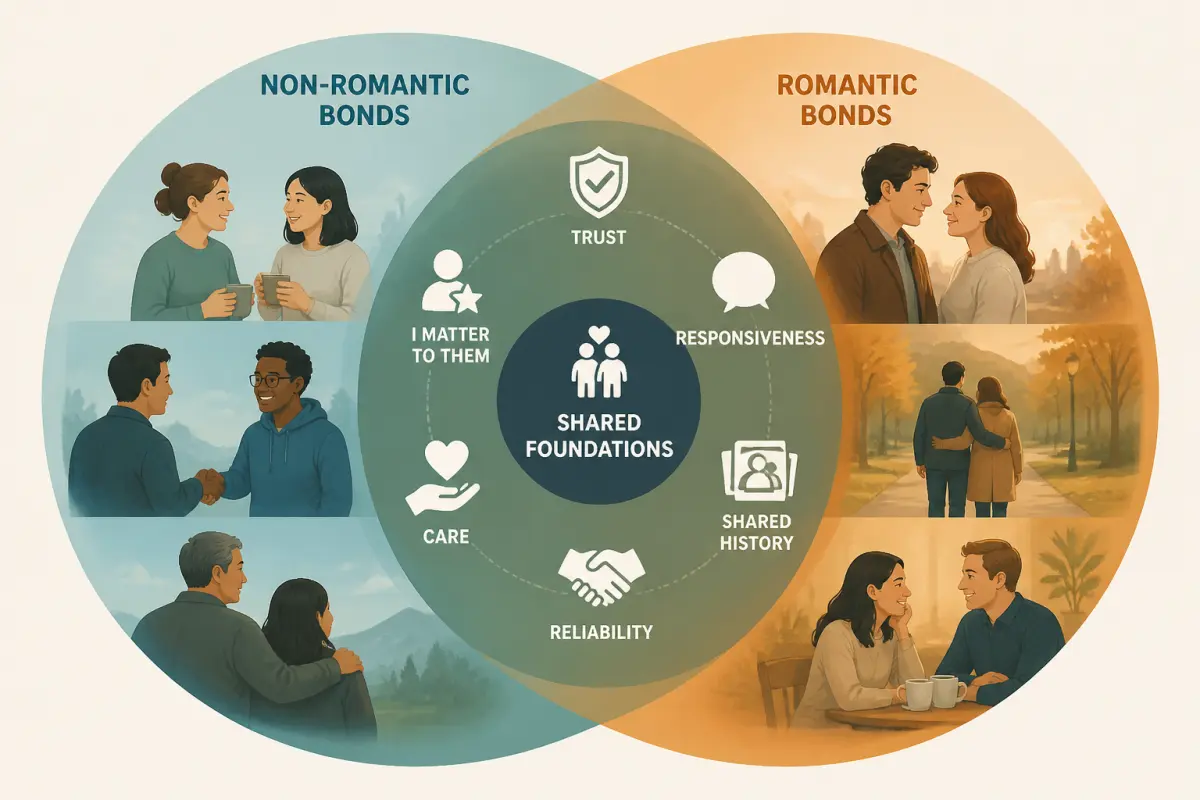
Romantic and non-romantic bonds overlap because close relationships often rely on the same basic emotional ingredients: trust, responsiveness, shared history, reliability, care, and the feeling that another person matters. Whether the bond is with a partner, friend, sibling, or parent, people tend to feel safer when the other person is reasonably consistent and emotionally available.
In both romantic and non-romantic relationships, attachment may show up in simple daily behaviors. You may send a message when something important happens. You may want reassurance after a misunderstanding. You may feel hurt if the other person repeatedly forgets what matters to you. You may feel comforted by their familiar voice, humor, or way of understanding your life.
The overlap is especially clear in moments of stress. When people are tired, grieving, embarrassed, or uncertain, they often reach for the relationships that feel emotionally anchoring. Sometimes that person is a romantic partner. Sometimes it is a close friend who can listen without making the situation about themselves. Sometimes it is a family member who knows the deeper context behind your reaction.
Both types of bonds also require repair. Misunderstandings, disappointment, changed expectations, and periods of distance happen in every close connection. A strong bond is not one where conflict never occurs; it is one where both people can return to respect, honesty, and care after difficulty. This is one reason building trust matters across many kinds of relationships, not only romantic ones.
Another overlap is the need for emotional recognition. Most adults want to feel that their inner world is taken seriously. This does not mean constant agreement. It means that your feelings, limits, preferences, and vulnerabilities are not treated as inconvenient or foolish. In romance, friendship, and family bonds alike, people tend to relax when they feel emotionally understood.
Key differences in expectations and exclusivity
The main differences between romantic and non-romantic attachment usually involve expectations. Romantic relationships often carry stronger assumptions about exclusivity, sexual or physical intimacy, public identity as a couple, future planning, financial decisions, household life, and loyalty in the face of outside attraction. Non-romantic bonds can be deeply intimate, but they are usually organized around different agreements.
Friendships, for example, may allow more flexibility. A friend can have several other close friends without this necessarily feeling like betrayal. Family relationships may be lifelong but not chosen in the same way romantic relationships are. A sibling bond may contain loyalty and shared history, yet not require daily emotional availability. A parent-adult child bond may remain significant while also needing clearer boundaries as both people age.
These distinctions are not rigid, and every culture, family, and personal history shapes what people expect. Still, the following comparison captures common differences that often affect adult relationships:
| Area of relationship | Romantic attachment often involves | Non-romantic attachment often involves |
|---|---|---|
| Exclusivity | Clearer expectations about romantic and sexual exclusivity, depending on the relationship agreement. | More room for multiple close bonds without the same assumption of betrayal. |
| Daily availability | Often includes frequent contact, shared routines, or an expectation of being emotionally reachable. | May remain close even with less frequent contact, especially in long-standing friendships or family bonds. |
| Future planning | May include decisions about living together, marriage, children, finances, or long-term partnership. | May include loyalty and support, but usually with less shared decision-making about daily life structure. |
| Physical intimacy | Often includes affection, sexuality, or touch that has romantic meaning. | May include warmth and physical affection, but usually without romantic or sexual expectation. |
| Social identity | Partners are often recognized publicly as a unit or primary relationship. | Friends and family may be central, but the bond is usually not socially treated as a couple identity. |
| Boundary sensitivity | Boundaries around attraction, privacy, time, and commitment may be highly charged. | Boundaries often center on emotional labor, family roles, personal autonomy, and respect for separate lives. |
| Conflict meaning | Conflict may feel tied to questions of commitment, desire, or the future of the relationship. | Conflict may feel tied to respect, loyalty, reciprocity, or unresolved family and friendship patterns. |
Because expectations differ, problems often arise when two people silently assume different rules. One person may view frequent texting as basic care, while another sees it as unnecessary pressure. One friend may expect emotional priority during a crisis, while another assumes that a romantic partner should come first. A family member may interpret independence as rejection, while the adult child experiences it as healthy growth.
Clear communication helps because it makes the invisible rules more visible. This does not mean every relationship needs a formal conversation about every expectation. It means paying attention when resentment builds. Resentment often points to an unspoken expectation that has not been acknowledged, negotiated, or updated.
Emotional closeness in friendships and family bonds
Friendships and family bonds can carry profound emotional weight. A close friendship may provide a kind of honesty, humor, and acceptance that is difficult to find elsewhere. A family relationship may hold memories, identity, cultural belonging, and a sense of continuity across time. These bonds can be protective, nourishing, complicated, or all of these at once.
In adult friendships, closeness often develops through chosen presence. Unlike many family bonds, friendship is usually maintained because both people continue to invest. This can make friendship feel especially affirming: the person is there not because of obligation, but because the connection matters. At the same time, adult friendship requires flexibility. Careers, caregiving, health, distance, and romantic commitments can change how often people see each other without necessarily reducing the value of the bond.
Family closeness is often shaped by shared history. Relatives may understand parts of your life that others need explained. They may remember earlier versions of you, family losses, childhood dynamics, or cultural traditions. This shared context can create comfort, but it can also create tension when old roles persist. An adult may still feel treated like “the irresponsible one,” “the peacemaker,” or “the sensitive one,” even after years of growth.
Healthy emotional closeness does not require constant access. It is possible to love someone deeply and still need privacy, separate friendships, different opinions, or time alone. In fact, many friendships and family relationships become more stable when closeness is not confused with total availability.
One of the quiet strengths of non-romantic attachment is that it can offer emotional variety. A partner may know one part of you deeply, while a friend understands another part. A sibling may help you laugh at family patterns. A mentor may help you think clearly about work or identity. These different forms of closeness can make life feel more emotionally spacious.
Why romantic attachment often feels more intense
Romantic attachment often feels more intense because it combines several powerful dimensions at once. Romantic partners may become sources of comfort, desire, companionship, validation, physical affection, future hopes, and daily routine. When one relationship carries many layers of meaning, changes in that bond can feel especially activating.
Early romantic attachment can be particularly vivid. The uncertainty of mutual interest, the pleasure of being chosen, sexual attraction, and the wish to feel special can heighten emotional focus. A delayed reply may feel unusually important. A warm gesture may lift the entire day. Small signs can become charged with meaning because the relationship is still being defined.
Romance also tends to activate questions of replaceability. In many friendships, it is understood that people can have several close connections. In romantic relationships, especially monogamous ones, people often want to feel uniquely chosen. This desire is not inherently immature or unreasonable. It becomes difficult when the need to feel special turns into constant monitoring, comparison, or fear.
Another reason romance feels intense is that it often involves future imagination. People may begin to picture shared homes, travel, family life, aging together, or emotional security. When the bond feels uncertain, it is not only the present relationship that feels threatened; the imagined future may feel threatened too.
Intensity, however, should not automatically be mistaken for depth. Some deeply loving relationships feel calm rather than dramatic. Some intense relationships are fueled by uncertainty, mixed signals, or cycles of closeness and withdrawal. The emotional volume of a bond is important information, but it is not the only measure of its health.
Practical distinction: Ask whether the intensity leaves you feeling more yourself or less yourself over time. Healthy passion can be energizing and tender. Unsteady intensity often narrows your world, makes you preoccupied with reassurance, or causes you to neglect other important parts of life.
This distinction matters because many people have been taught to equate emotional urgency with love. In reality, secure romantic attachment may feel warm, alive, and committed without requiring constant anxiety. A relationship can be meaningful even when it is not consuming.
How attachment patterns appear across different bonds
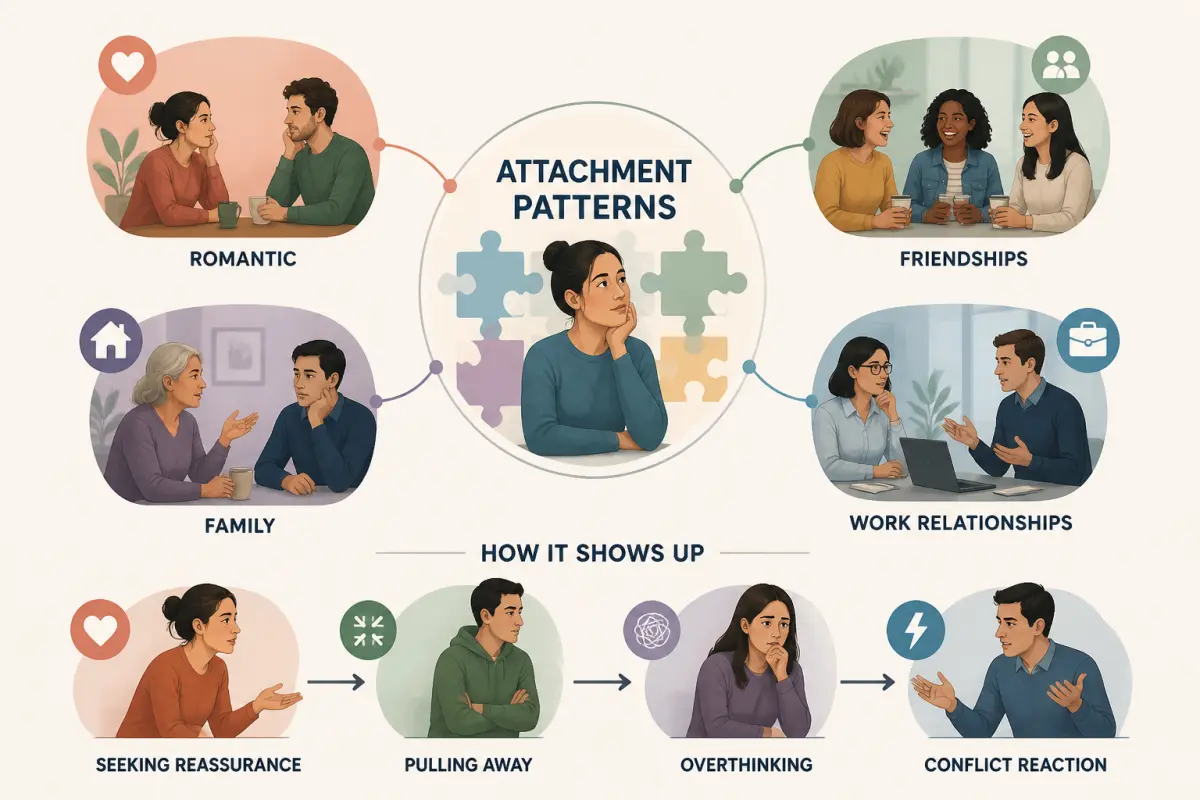
People often have recognizable ways of managing closeness, distance, reassurance, and conflict. These patterns may appear in romance, friendship, family relationships, and work-adjacent bonds, although they do not always look identical in every context. A person may feel secure with friends but anxious in dating, or confident with a partner but easily triggered by a parent’s criticism.
Common attachment-related patterns in everyday life include moving toward others for reassurance, pulling away when closeness feels too demanding, trying to handle everything alone, becoming highly sensitive to changes in tone, or feeling uncomfortable depending on anyone. These are not character flaws. They are often learned strategies for managing emotional risk.
In romantic relationships, an anxious pattern might look like worrying that a partner’s quiet mood means loss of interest. In friendship, it may look like feeling replaced when a friend becomes close to someone else. In family relationships, it may look like feeling intensely distressed when a parent or sibling seems disappointed.
A more avoidant pattern may look like needing a great deal of independence after emotional closeness. In romance, this may appear as discomfort with commitment conversations. In friendship, it may appear as disappearing when someone asks for more emotional availability. In family life, it may appear as keeping conversations practical to avoid vulnerability.
Some people show mixed patterns. They may crave closeness but mistrust it, seek reassurance but feel exposed when they receive it, or choose unavailable people while longing for dependable care. These long-term patterns can become easier to understand when you look across several relationships rather than focusing only on one difficult bond.
It is also important to remember that relationships are interactive. A person’s pattern may become stronger in response to another person’s behavior. For example, someone who is usually calm may become anxious with a partner who is inconsistent. Someone who values closeness may withdraw from a friend who repeatedly criticizes them. Patterns belong to people, but they are also shaped by the emotional climate of the relationship.
Rather than using attachment language as a label, it is often more helpful to ask practical questions:
- What tends to happen inside me when someone important becomes distant?
- Do I ask directly for what I need, or do I test the other person?
- Do I assume closeness means losing freedom?
- Do I confuse someone’s boundary with rejection?
- Do I choose relationships where I have to earn basic care?
- Can I repair conflict without collapsing, attacking, or disappearing?
These questions encourage self-awareness without turning attachment into a fixed identity. Adults can develop new ways of relating, especially when they practice noticing their reactions before acting on them automatically.
When one relationship begins replacing other connections
It is natural for a new romantic relationship to take up more time and attention at first. Many people temporarily see friends less often, spend more evenings with a partner, or feel preoccupied during the early stages of falling in love. This shift is common and not automatically unhealthy.
Concern begins when one relationship gradually replaces nearly all other meaningful connections. A person may stop confiding in friends, withdraw from family, give up independent interests, or feel guilty for spending time with anyone else. The romantic bond becomes the main source of comfort, identity, entertainment, reassurance, and decision-making. Over time, this can create pressure on both partners.
When one person becomes the entire emotional support system, normal disappointments can feel catastrophic. A partner’s tiredness may feel like abandonment. A disagreement may feel like losing the only safe place. The relationship may become less flexible because there are fewer outside supports to help each person regain perspective.
This is where the difference between attachment and emotional dependence becomes important. Attachment allows closeness while preserving a sense of self. Dependence, in the problematic sense, often narrows life until one person’s availability determines your emotional stability, choices, and self-worth.
If a partner pressures you to cut off friends or family, monitors your communication, punishes you for having independent support, or frames isolation as proof of love, take the behavior seriously. Isolation can make it harder to think clearly, ask for help, or leave an unsafe situation. Personal safety, trusted support, and appropriate professional or community resources should take priority over preserving the appearance of harmony.
Replacement can also happen without obvious control. Sometimes two people mutually retreat from the wider world because the relationship feels soothing or exciting. Even then, it is worth asking whether the bond is expanding life or shrinking it. A loving relationship can be central without becoming the only meaningful connection.
Small signs that balance may be slipping include:
- You repeatedly cancel plans with others to avoid upsetting your partner.
- You no longer share important feelings with anyone outside the relationship.
- You feel anxious or disloyal when you enjoy time away from your partner.
- Your friends or family express that they rarely see the real you anymore.
- You have stopped doing activities that once helped you feel grounded.
- Every conflict with your partner feels emotionally overwhelming because there is nowhere else to turn.
Noticing these signs is not a reason for shame. It is an invitation to gently rebuild a wider emotional base.
Balancing romantic love with other close relationships
Balancing romantic love with other close relationships is less about dividing time perfectly and more about keeping your emotional life broad enough to stay healthy. A partner may be your primary person, but primary does not have to mean only. Friendships, family bonds, solitude, hobbies, community, and meaningful work all help maintain a stable sense of self.
Balance often requires intentional habits. Many adults do not drift into a rich relational life by accident; schedules are busy, energy is limited, and romantic routines can become default. The goal is not to treat relationships like obligations on a checklist, but to keep investing in the people and practices that make life emotionally resilient.
Some useful ways to maintain balance include:
- Protect recurring contact. A monthly dinner with a friend, a weekly call with a sibling, or a regular walk with a neighbor can keep bonds alive without constant planning.
- Name your needs clearly. Instead of saying, “You never let me see my friends,” try, “I feel better when I maintain my friendships, and I want us to support that for each other.”
- Avoid making one person your only processor. It is healthy to have more than one trusted person or outlet for emotions, especially during stressful periods.
- Respect different social needs. One partner may need more time with friends; the other may need more quiet. Difference does not automatically mean rejection.
- Keep some independent identity. Interests, values, and relationships that are yours alone can strengthen rather than threaten romantic closeness.
Healthy balance also depends on boundaries. A close relationship should leave room for personal space, not as a punishment or withdrawal, but as a normal part of adult intimacy. People usually return to each other more freely when separateness is respected.
Helpful practice: Notice whether your relationships support one another or compete unnecessarily. A secure partner does not need to love every friend or relative in your life, but they should generally respect that other bonds help you remain connected, supported, and whole.
There will be seasons when balance changes. A newborn, illness, grief, relocation, or demanding work period may temporarily reduce social contact. The question is not whether life is always evenly balanced. The question is whether, over time, your important relationships have room to breathe.
Recognizing secure attachment across different bonds
Secure attachment is often quieter than people expect. It may not look like constant reassurance, effortless harmony, or never feeling insecure. Instead, it tends to show up as a reliable sense that the relationship can handle ordinary human realities: need, difference, disappointment, repair, independence, and change.
In a romantic relationship, secure attachment may look like trusting that a partner’s need for an evening alone is not a loss of love. It may look like discussing conflict without threatening the entire relationship. It may involve affection, commitment, and emotional responsiveness without constant monitoring.
In friendship, secure attachment may look like understanding that closeness can survive busy seasons. You can miss each other without accusing. You can celebrate the other person’s new relationships without feeling erased. You can ask for support directly and accept that the friend may sometimes have limits.
In family relationships, secure attachment may look like warmth combined with adult boundaries. A person can love a parent while making independent choices. Siblings can remain connected without staying trapped in childhood roles. Relatives can disagree without requiring emotional exile.
Secure bonds are not perfect, but they tend to include several recognizable qualities:
- Both people can express needs without immediate defensiveness or punishment.
- Apologies and repairs are possible after hurtful moments.
- Closeness does not require giving up all independence.
- Time apart does not automatically create panic or resentment.
- Care is shown through consistent behavior, not only emotional declarations.
- Differences are handled with curiosity more often than control.
- Each person can grow without the bond becoming threatened by every change.
One of the clearest signs of security is that the relationship helps you return to yourself. You may feel loved, challenged, comforted, or understood, but not chronically diminished. You do not have to constantly perform, chase, appease, or protect yourself from emotional unpredictability.
Security can also be built gradually. Some relationships become safer as people learn each other’s rhythms, repair old misunderstandings, and communicate with more honesty. Others may remain limited, not because anyone is bad, but because the relationship does not have enough mutual respect or emotional capacity to become deeply secure. Recognizing the difference can help you invest your energy wisely.
Frequently asked questions
Can a friendship be as important as a romantic relationship?
Yes. A friendship can be one of the most important attachment bonds in a person’s life. Some friends provide long-term loyalty, emotional honesty, shared history, and practical support that deeply shape well-being. The difference is not necessarily depth, but the expectations attached to the bond. Romantic relationships often include exclusivity, physical intimacy, and future planning in ways friendships usually do not.
Is it unhealthy to rely mostly on a romantic partner?
Not always. Many people rely heavily on a partner during certain seasons, especially during illness, grief, parenting, or major transitions. It becomes more concerning when your partner is your only source of emotional support, when you feel unable to function without their reassurance, or when other relationships and parts of your identity disappear over time.
Can family attachment affect romantic relationships?
Yes. Family experiences can influence what closeness feels like, how conflict is handled, and what a person expects from love. For example, someone who grew up managing a parent’s emotions may become overly responsible for a partner’s mood. Someone who experienced criticism may be highly sensitive to disapproval. These patterns can change with awareness, practice, and supportive relationships.
Why do I feel more jealous in romance than in friendship?
Romantic jealousy often involves the wish to feel uniquely chosen. In many romantic relationships, especially monogamous ones, attraction and exclusivity carry strong emotional meaning. Friendship jealousy can happen too, but romantic jealousy may feel sharper because it touches desire, commitment, comparison, and fear of replacement all at once.
Can non-romantic relationships have attachment problems?
Yes. Friends, siblings, parents, and adult children can experience anxious pursuit, withdrawal, control, resentment, emotional over-reliance, or difficulty with boundaries. Attachment dynamics are not limited to couples. Any bond that matters deeply can activate fear, longing, protectiveness, or old relational habits.
How do I know whether closeness is healthy or too much?
Healthy closeness usually leaves room for honesty, choice, respect, and separateness. It helps you feel supported without erasing your autonomy. Closeness may be too much when you feel monitored, guilty for having other relationships, unable to make independent decisions, or responsible for keeping another person emotionally stable at all times.
Can a romantic partner also be my best friend?
Yes, and many people value that combination. A partner can be a best friend in the sense of being trusted, enjoyed, and deeply known. Still, it is helpful to maintain other meaningful connections. Even a very loving partner cannot realistically meet every emotional and social need across an entire adult life.
What if my partner dislikes my close friends or family?
Occasional discomfort or personality mismatch is not unusual. The important question is how your partner handles it. Respectful concern can be discussed calmly, especially if a relationship truly affects your well-being. But pressure to isolate, control who you see, or make you feel guilty for having outside support is different and should be taken seriously.
Can attachment style change depending on the relationship?
Yes. Many people respond differently in different bonds. You may feel relaxed with friends but insecure with romantic partners, or steady in romance but tense around family. This does not make your reactions fake or inconsistent. It reflects how each relationship activates different memories, expectations, fears, and needs.
What is a simple way to strengthen secure attachment in any bond?
Practice being both clear and responsive. Say what you need without accusation, listen when the other person expresses limits, repair when you cause hurt, and notice whether care is mutual over time. Secure attachment grows through repeated experiences of respect, reliability, and emotional honesty.