Why Asking for Support Feels So Difficult

 This article explains why asking for support can feel difficult, from early expectations and fear of burdening others to control concerns and attachment patterns. It covers hidden needs, unclear requests, and how to ask, receive, and build mutual support without guilt.
- What makes asking for support feel so difficult
- How early relationship expectations shape self-reliance
- Fear of burdening or disappointing other people
- Support, dependence, and loss of control
- Signs you hide your needs until you feel overwhelmed
- Why indirect requests for help create misunderstandings
- How attachment patterns affect help-seeking
- How to ask for support clearly and specifically
- How to receive help without guilt or obligation
- Building mutual support without overdependence
- Frequently asked questions
Needing help can feel surprisingly heavy, even when the people around us would gladly step in. We may hesitate in ordinary moments, downplay our stress, or wait until we are overwhelmed before speaking up. Often this reluctance is not stubbornness, but vulnerability: fear of being a burden, losing control, or admitting we cannot manage everything alone. Recognizing that tension can help us meet ourselves with more patience and ask for support sooner.
What makes asking for support feel so difficult
Asking for support can look simple from the outside: you need something, another person may be able to help, so you ask. In real life, it often feels much more complicated. The moment you consider saying, “Could you help me?” you may notice hesitation, embarrassment, irritation, guilt, or even a sudden urge to handle everything alone.
This difficulty is not usually about one single trait, such as being “too proud” or “too sensitive.” More often, it comes from a mixture of learned expectations, past experiences, self-protection, and everyday social pressures. Many capable adults struggle with support because asking makes several vulnerable truths visible at once:
- You cannot do everything alone.
- You have limits, needs, and feelings.
- Another person may say yes, say no, misunderstand, disappoint you, or respond unpredictably.
- The relationship may feel slightly different after your need is known.
For some people, the hardest part is not the practical request. It is the exposure. Saying “I need help” can feel like admitting weakness, losing dignity, or giving someone else power over your emotional state. Even a small request, such as asking a colleague to clarify a task or asking a partner for comfort after a difficult day, can stir up old expectations about rejection, criticism, or obligation.
There is also a cultural layer. Many adults have absorbed the idea that maturity means self-sufficiency, calm competence, and emotional containment. Being independent is valuable, but when independence becomes the only acceptable mode, support starts to feel like failure rather than a normal part of human life.
Psychologist’s note: Difficulty asking for support is often not a sign that someone lacks social skills. It may mean they learned to monitor other people’s reactions very carefully. The request itself may be simple, while the emotional risk around the request feels large.
A useful starting point is to separate the need from the fear attached to it. You may genuinely need practical help, reassurance, information, rest, company, or emotional presence. Alongside that need, you may also fear being judged, ignored, indebted, or seen differently. Both can be true. Recognizing this helps you respond to yourself with less criticism and more precision.
How early relationship expectations shape self-reliance

People do not arrive at adulthood with a neutral view of support. Most of us develop expectations through repeated experiences: who noticed when we were upset, who became irritated, who offered help freely, who made us feel guilty for needing anything, and who was emotionally unavailable even when physically present.
If support was reliable and given without excessive drama, asking may feel relatively natural. You may still dislike inconvenience, but you assume that needs are part of relationships. If support was inconsistent, conditional, or shaming, asking may feel risky. You might have learned to stay alert to mood changes, keep requests small, or avoid asking altogether until there is no other option.
Self-reliance can then become both a strength and a shield. It may help you function under pressure, solve problems independently, and avoid unnecessary dependence. At the same time, it can make it difficult to let others know when you are tired, lonely, confused, or overloaded.
Common early messages that affect help-seeking
- “Don’t be dramatic.” You may learn to minimize distress and present yourself as fine even when you are not.
- “Other people have it worse.” You may feel you must justify every need before it counts.
- “You’re so independent.” Praise for coping alone can become pressure to never need care.
- “I’ll help you, but now you owe me.” Support may become associated with debt rather than generosity.
- “Why didn’t you know how to do this?” Asking may become linked with shame or incompetence.
Some people respond to early disappointment by creating protective distance. They may be warm and responsible in many ways, but when their own needs appear, they retreat into self-management. This is not necessarily coldness. Often, it is a learned way of staying emotionally safe.
The important point is not to blame the past for every current pattern. Rather, it is to understand why your nervous system may treat a present-day request as more dangerous than it objectively is. A friend offering to help with errands is not the same as a caregiver who responded with criticism. A partner listening to your worries is not the same as someone who once dismissed your feelings. But the body and mind sometimes react as if the old rule still applies.
Fear of burdening or disappointing other people
One of the most common reasons people avoid asking for support is the fear of becoming a burden. This fear can be especially strong in people who are thoughtful, conscientious, or used to being the responsible one. They may notice everyone else’s stress and decide, often silently, that their own needs should wait.
The fear usually has several layers:
- Practical concern: “They are busy; I do not want to add more.”
- Emotional concern: “They may feel pressured, guilty, or annoyed.”
- Identity concern: “If I need help, I am no longer the capable person they think I am.”
- Relational concern: “If I ask too much, they may pull away.”
There is kindness in not wanting to overload others. But there is also a hidden assumption: that other people cannot decide their own limits. When you avoid asking because you are trying to protect someone from the burden of choice, you may unintentionally remove their opportunity to care, contribute, or say an honest no.
Healthy support does not require you to guess perfectly what another person can handle. It requires enough respect to ask clearly and enough maturity to accept the answer. “Would you have capacity to talk for ten minutes tonight?” gives the other person room. “Never mind, you’re probably too busy” closes the door before they can respond.
Fear of disappointing others can also make support feel dangerous. If you are used to being steady, useful, or low-maintenance, revealing a need may feel like changing the role you occupy in relationships. You may worry that people value you mainly because you do not ask for much. That fear deserves attention, because relationships built only around your usefulness can become lonely, even if they look harmonious from the outside.
Support, dependence, and loss of control
For many adults, the word “support” quietly raises another word: dependence. If you have spent years proving that you can manage, needing someone else may feel like stepping onto unstable ground. You may wonder: What if I rely on them and they are not there? What if they help once and then expect access to parts of my life I want to keep private? What if I become too needy?
These concerns are understandable. Not all help is helpful. Some people offer support in ways that are intrusive, controlling, unreliable, or full of hidden conditions. If you have experienced that, you may associate accepting help with losing control.
It can be useful to distinguish several forms of support:
| Type of support | What it may look like | Healthy boundary to keep |
|---|---|---|
| Practical support | Help with transport, tasks, childcare, paperwork, meals, or errands. | Clarify exactly what is needed, when it is needed, and what is not being requested. |
| Emotional support | Listening, comfort, reassurance, presence, or empathy during a stressful moment. | Ask whether the person has the time and emotional capacity to listen. |
| Informational support | Advice, feedback, instructions, explanations, or shared experience. | Specify whether you want advice, perspective, or simply help understanding options. |
| Companionship | Having someone sit with you, walk with you, accompany you, or check in. | Allow closeness without turning every interaction into crisis management. |
| Advocacy | Someone helping you communicate, prepare, or speak up in a difficult situation. | Stay involved in decisions so the support does not replace your voice. |
| Temporary relief | Someone taking over a task briefly so you can rest or recover. | Agree on duration and expectations so relief does not become confusion or resentment. |
Dependence becomes concerning when a person feels unable to function, choose, or regulate their life without constant reassurance or permission from someone else. Support, by contrast, can strengthen autonomy. A friend helping you move house does not make you dependent. A partner listening while you process a hard day does not mean you cannot cope. A colleague explaining a confusing process does not erase your competence.
The distinction matters because fear of emotional dependence can lead people to refuse ordinary care. In trying not to need “too much,” they may end up isolated, exhausted, and less able to make grounded decisions.
Receiving support does involve allowing some uncertainty. You cannot fully control how another person responds. But you can control how clearly you ask, whom you choose, what boundaries you set, and how you respond if the support offered does not fit.
Signs you hide your needs until you feel overwhelmed
Some people do not experience themselves as “hiding” their needs. They simply keep going. They adapt, postpone, solve, absorb, and reassure others that everything is fine. The problem becomes visible only when the emotional cost has already grown high.
You may be postponing support until overwhelm if you recognize several of these patterns:
- You say “I’m fine” automatically, then feel resentful that no one notices you are not fine.
- You help others quickly but feel uncomfortable when attention turns toward you.
- You wait until you are exhausted, tearful, angry, or numb before mentioning what you need.
- You drop hints instead of making direct requests, then feel hurt when people miss them.
- You tell yourself the problem is not serious enough to deserve help.
- You secretly test whether people will notice your distress without being told.
- You feel irritated by offers of help because accepting them feels exposing.
- You often think, “It would be easier to do it myself,” even when doing it yourself is clearly too much.
- You become very efficient in public and collapse privately.
These patterns are not character flaws. They are often attempts to preserve dignity, avoid disappointment, and remain acceptable to others. But over time, hidden needs can create exactly the relationship strain you were trying to prevent. Others may not realize how much you are carrying. You may feel unseen. Small frustrations may accumulate into resentment.
The overwhelm cycle
- You notice a need. It may be small at first: rest, clarity, comfort, practical help.
- You dismiss it. You tell yourself it is not important, not urgent, or not fair to ask.
- You compensate. You work harder, stay quiet, or manage the problem alone.
- You become depleted. Your patience, focus, and emotional flexibility shrink.
- The need comes out intensely. You may cry, snap, withdraw, or make a desperate request.
- You feel ashamed afterward. The shame reinforces the belief that needs are dangerous.
Practical distinction: Asking early is usually less demanding than asking late. A small, timely request often gives others a clear way to help. A delayed request may arrive wrapped in exhaustion, urgency, or resentment, making it harder for everyone to respond calmly.
A helpful question is: “What would I ask for if I did not have to prove that I deserve it?” The answer may reveal a modest need that could be expressed before it becomes a crisis.
Why indirect requests for help create misunderstandings
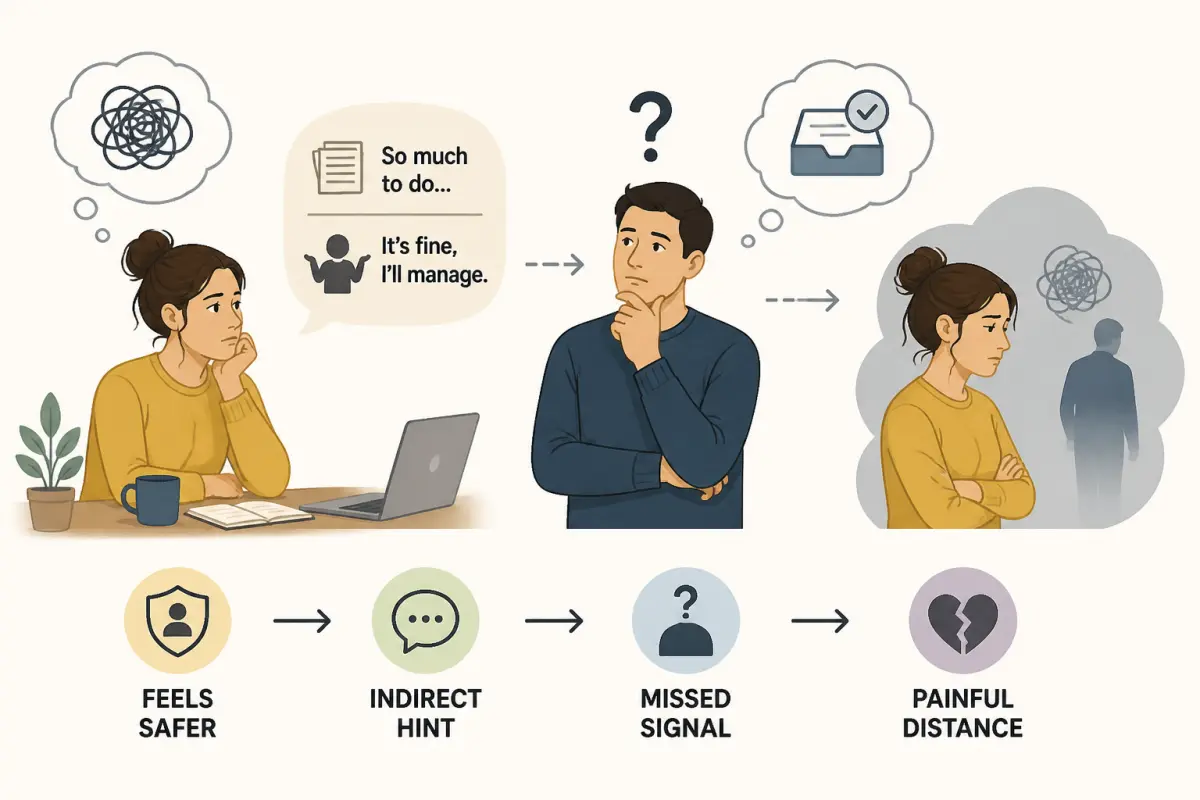
Indirect requests are common because they feel safer. Instead of saying, “Can you help me with this?” you might say, “I have so much to do,” or “It’s fine, I’ll manage,” while hoping the other person understands the real message. Sometimes they do. Often they do not.
Indirect communication protects you from the immediate vulnerability of asking directly. If the person does not respond, you can tell yourself you never really asked. But it also creates a painful ambiguity: you may feel rejected even though the other person did not realize a request was being made.
This is where misunderstandings often begin. One person thinks, “If they cared, they would notice.” The other thinks, “If they needed help, they would ask.” Both may be acting in good faith, but they are operating with different assumptions.
Common indirect requests and what they may communicate
| Indirect message | Possible hidden request | Why it may be missed | Clearer version |
|---|---|---|---|
| “I guess I’ll do everything myself.” | “Please notice that I am overloaded and offer help.” | It may sound like criticism rather than a request. | “Could you take care of dinner tonight? I’m at capacity.” |
| “Don’t worry about me.” | “I want reassurance, but I am afraid to ask for it.” | The other person may believe you genuinely want space. | “I don’t need solutions, but I would appreciate a check-in later.” |
| “It must be nice to have free time.” | “I feel unsupported and need more shared responsibility.” | It can sound like blame, inviting defensiveness. | “Can we look at how we’re dividing tasks this week?” |
| “Never mind.” | “I feel hurt that you did not understand immediately.” | It ends the conversation before clarification is possible. | “I’m finding it hard to ask, but I do need help with this.” |
| “You probably have better things to do.” | “I want help but fear being a burden.” | It pressures the other person to prove they care. | “Do you have capacity to help me for half an hour?” |
| Silence or withdrawal | “I am overwhelmed and want someone to come closer.” | Others may interpret distance as a wish to be left alone. | “I’m quiet because I’m struggling. Could you sit with me?” |
Indirect requests can also intensify sensitivity to perceived rejection. When the request is hidden, every missed cue may feel like evidence that you do not matter, even if the other person simply lacked information.
This does not mean every need must be expressed perfectly. Human communication is imperfect. But clarity reduces the amount of mind-reading required. It gives the other person a fair chance to respond to what is actually needed rather than to what they are expected to infer.
How attachment patterns affect help-seeking
Attachment patterns describe common ways people manage closeness, uncertainty, and emotional need in relationships. They are not labels to use casually or diagnoses to assign to yourself or others. They are better understood as familiar patterns of expectation: What do I expect will happen if I need someone?
These patterns can strongly influence how a person asks for support, avoids support, or reacts after receiving it.
Different help-seeking tendencies
- More secure patterns: You may find it relatively natural to ask for help, accept limits, and trust that one disappointing response does not define the entire relationship.
- More anxious patterns: You may ask with urgency, fear the other person’s hesitation, or interpret delayed responses as signs that you are not important.
- More avoidant patterns: You may minimize needs, prefer solving things alone, and feel uncomfortable when someone comes emotionally close.
- Mixed or disorganized patterns: You may want support intensely and fear it at the same time, moving between reaching out and pulling away.
For someone with anxious expectations, asking may feel like risking abandonment. A delayed reply, distracted tone, or unavailable friend can stir intense worry, especially when there is already a strong fear of abandonment. The request may become emotionally loaded: “If you help me, I matter; if you do not, I am alone.”
For someone with avoidant expectations, asking may feel like surrendering independence. Even when support is available, they may distrust it or feel irritated by it. They might prefer to appear unaffected because emotional openness feels too costly.
Many people do not fit neatly into one style. You may be direct at work but guarded in romantic relationships. You may accept practical help but struggle with comfort. You may ask close friends for advice but hide distress from family. Context matters.
Useful reflection: Instead of asking, “What attachment style am I?” try asking, “What do I expect will happen when I show a need?” This question keeps the focus on the pattern you can observe and gently change, rather than on a fixed identity.
The goal is not to become someone who needs nothing or someone who asks constantly. The goal is flexibility: being able to notice a need, evaluate whom to ask, express the request clearly, tolerate the other person’s response, and remain connected to your own worth regardless of the outcome.
How to ask for support clearly and specifically
Clear requests are easier to answer. They reduce guesswork, lower defensiveness, and help the other person understand what kind of support would actually help. A clear request does not have to be elegant. It simply needs to be understandable.
Many people avoid directness because they worry it sounds demanding. In practice, vague distress can feel more confusing to others than a respectful, specific ask. Directness can be warm, modest, and considerate.
A simple structure for asking
- Name the situation briefly. “I’m having a difficult week with work deadlines.”
- Name the kind of support you need. “I could use practical help,” or “I need someone to listen.”
- Make the request specific. “Could you pick up groceries tomorrow?” or “Could we talk for twenty minutes tonight?”
- Give room for choice. “If tonight does not work, another time is okay.”
- Clarify what you do not need, if useful. “I’m not looking for advice yet; I just need to say it out loud.”
Specificity is not selfish. It is considerate. If you say, “I need help,” the other person may not know whether you need advice, comfort, money, time, company, or a concrete task. If you say, “Could you help me look over this email before I send it?” the path is clearer.
Examples of clear support requests
- “I’m overwhelmed by the housework today. Could you handle the laundry before dinner?”
- “I’m nervous about the appointment. Would you be willing to come with me and wait outside?”
- “I don’t need solutions right now. Could you listen for a few minutes?”
- “I’m confused about the instructions. Could you show me the first step?”
- “I need some encouragement. Could you remind me that one difficult day does not mean I’m failing?”
- “I want to talk, but I know it is late. Do you have the energy for a short conversation?”
Clear requests are closely connected to clear communication. The more honestly you can describe the type of support you need, the less the relationship depends on guessing, testing, or interpreting silence.
If the person says no, pauses, or offers something different, try not to automatically treat that as rejection. A no may mean they are tired, unavailable, unsure, or not the right person for that particular need. You can respond with dignity: “Thanks for letting me know,” or “I appreciate you being honest. I’ll ask someone else.”
How to receive help without guilt or obligation
For some people, asking is hard; for others, receiving is even harder. Once help is offered, guilt may appear quickly: “I should not need this,” “Now I owe them,” “They probably resent me,” or “I must repay this immediately.”
Guilt can be useful when it alerts us that we have crossed a boundary or taken advantage of someone. But many people feel guilt simply because someone was kind. This kind of guilt does not always mean you did something wrong. It may mean receiving care is unfamiliar.
Ways to receive without over-apologizing
- Say “Thank you” instead of repeatedly saying “I’m sorry.”
- Accept the specific help offered without expanding it beyond what was agreed.
- Let the other person be generous without immediately arguing against it.
- Notice the urge to repay instantly, and ask whether repayment is actually needed.
- Respect their limits if they clarify what they can and cannot do.
A simple “Thank you, this really helps” is often enough. Over-apologizing can accidentally make the helper responsible for soothing your guilt. Gratitude acknowledges their effort without turning the moment into a debate about whether you deserved support.
It is also healthy to remember that relationships are not accounting systems. Mutual care usually balances over time, not in identical transactions. One month you may need more help. Another month you may be the one with more capacity. Mature support allows for changing seasons of need.
If someone uses help to control you, shame you, isolate you, demand access to your private life, or pressure you into choices that feel unsafe, that is not ordinary support. Personal safety and appropriate outside help take priority over preserving the appearance of gratitude.
Receiving well includes discernment. You do not have to accept help that comes with manipulation, contempt, or strings you did not agree to. Healthy support leaves you with more steadiness, not less freedom.
Building mutual support without overdependence
Mutual support is not built by one dramatic conversation. It develops through repeated experiences of asking, responding, respecting limits, and repairing misunderstandings. The aim is not to become perfectly available to each other at all times. It is to create relationships where needs can be spoken without panic and boundaries can be stated without punishment.
Overdependence can happen when one person becomes the only source of emotional regulation, decision-making, reassurance, or practical rescue. Underdependence can happen when a person refuses support so consistently that closeness has little room to grow. Healthy mutuality sits between these extremes.
Principles of balanced support
- Use more than one source of support. Partners, friends, family, colleagues, community resources, and professionals may all serve different roles.
- Match the request to the relationship. Not every person is suited for every kind of support.
- Ask before unloading emotionally. “Do you have space to hear something difficult?” protects both people.
- Respect no as information, not necessarily rejection. A boundary can preserve trust.
- Offer support without keeping score. Generosity becomes safer when it is not used as leverage later.
- Repair quickly when support misses the mark. “I think I was unclear,” or “I felt hurt, but I want to explain rather than blame.”
- Keep your own coping skills active. Support should add to your stability, not replace your self-trust.
Balanced support also requires realistic expectations. No one person can always respond at the right time, in the right tone, with the right words. Even loving people get tired, distracted, or uncertain. The strength of a supportive relationship is not that disappointment never happens; it is that disappointment can be talked about without destroying the bond.
Memorable guideline: A supportive relationship should help you feel both connected and capable. If support creates closeness but slowly removes your confidence, boundaries need attention. If independence protects your confidence but leaves you lonely, openness needs attention.
Start small if asking feels unfamiliar. Request a manageable favor. Share one honest sentence instead of the entire story. Let someone know what would help before you reach your limit. Each small experience can update the belief that needs must be hidden to keep relationships safe.
Frequently asked questions
Why do I feel ashamed when I ask for help?
Shame often appears when a need conflicts with the image you believe you must maintain. If you see yourself as capable, easygoing, strong, or low-maintenance, asking for help may feel like violating that identity. Shame may also come from earlier experiences where needing support was met with criticism, impatience, or dismissal.
It can help to remind yourself that needing support is not the opposite of competence. Competent people still need information, rest, encouragement, collaboration, and care.
Is it selfish to ask for support when other people are busy?
Not necessarily. It depends on how you ask and whether you allow the other person to choose. A respectful request acknowledges their capacity: “I know you have a lot going on, so please tell me if this is not possible. Could you help me with this tomorrow?”
Selfishness ignores the other person’s limits. A clear request gives them room to respond honestly.
What if people say no?
A no can hurt, especially if asking already felt vulnerable. But a no is not always a statement about your worth or the relationship. It may reflect timing, energy, skill, availability, or the nature of the request.
If the need remains important, you can ask someone else, adjust the request, seek another kind of support, or return to the conversation later. The goal is not to avoid every no; it is to survive a no without deciding you should never ask again.
How can I stop waiting until I am overwhelmed?
Begin noticing earlier signals: irritability, fatigue, resentment, mental fog, withdrawing, or fantasizing that someone will rescue you without being asked. These may be signs that a need is present before it becomes urgent.
Try naming one small request earlier than usual. For example: “Can you take over this task today?” or “I need ten minutes to talk through something.” Early requests are often easier for others to meet and easier for you to make calmly.
What if I do not know what kind of support I need?
You can say that. A request does not have to be perfectly formed. Try: “I’m not sure what I need yet, but I don’t want to be alone with this,” or “Could you help me think through what would be useful?”
Sometimes the first layer of support is simply having another steady person present while you sort out the need.
How do I ask without sounding needy?
Needing something is not the same as being “needy.” A grounded request is specific, respectful, and open to the other person’s limits. For example: “Could you call me after work? I had a hard day and would appreciate hearing your voice.”
What often sounds more intense is not the need itself, but the fear around it: testing, hinting, apologizing repeatedly, or becoming angry when the other person cannot guess. Clear wording usually feels calmer than indirect pressure.
Should I always accept help when it is offered?
No. You are allowed to consider whether the help is useful, respectful, and appropriate. Some offers do not fit. Some people may help in ways that create stress or control. A polite refusal can be healthy: “Thank you for offering, but that is not what I need right now.”
Can asking for support improve relationships?
Yes, when it is done with clarity and respect. Allowing others to know your needs can create more honesty and closeness. It gives people the chance to care for you in real ways, rather than only knowing the composed version of you.
At the same time, support works best when it is mutual, bounded, and realistic. Strong relationships make room for both care and autonomy.