How to Calm Attachment Reactions

 Here we what attachment reactions feel like, why they get so intense, common triggers, and ways to pause before reacting. It explains how to separate facts from fear, calm your body, use reassurance wisely, communicate after, and build steadier responses.
- What an attachment reaction feels like
- Why attachment reactions become so intense
- Common triggers that activate the pattern
- How to pause before reacting
- Separating facts from feared meanings
- Calming the body and slowing the mind
- When reassurance helps and when it maintains the cycle
- How to communicate after the reaction passes
- Building steadier attachment responses over time
- Frequently asked questions
When your attachment alarm flares, a delayed reply, distracted partner, or subtle shift in tone can suddenly feel urgent and personal. This does not mean you are too needy or broken. It is your nervous system trying to protect you with old strategies. If you can steady yourself before you reach, withdraw, protest, or spiral, you create space to respond to what is happening now rather than to the fear.
What an attachment reaction feels like
An attachment reaction is the sudden surge of emotion that can happen when a close relationship feels threatened, uncertain, distant, or unsafe. It may arrive before you have had time to think clearly. One moment you are reading a message, noticing a change in tone, or waiting for a reply; the next, your body is tense, your mind is racing, and the relationship feels as if it has become urgent.
For some people, the reaction feels like panic: a strong need to reach out, clarify, ask what is wrong, or repair the connection immediately. For others, it feels like shutdown: numbness, irritation, silence, or a strong desire to withdraw before they can be hurt. Many people move between both patterns depending on the relationship, the context, and how tired or stressed they are.
Common signs include:
- Racing thoughts: replaying small details, searching for hidden meanings, or imagining what the other person really meant.
- Body activation: tight chest, stomach drop, restlessness, heat in the face, shallow breathing, or difficulty sleeping.
- Urgency: feeling that you must send a message, get an answer, explain yourself, or make a decision right now.
- Protective impulses: accusing, pleading, withdrawing, testing, checking, over-explaining, or pretending not to care.
- Narrowed perception: seeing the situation mainly through the lens of “I am being left,” “I am too much,” “I do not matter,” or “I cannot trust this.”
These reactions are not signs that you are weak, dramatic, or incapable of healthy relationships. They are signs that your attachment system is trying to protect you from disconnection. The difficulty is that this protective system can sometimes respond to uncertainty as if it were danger, even when the situation is still unclear.
Why attachment reactions become so intense
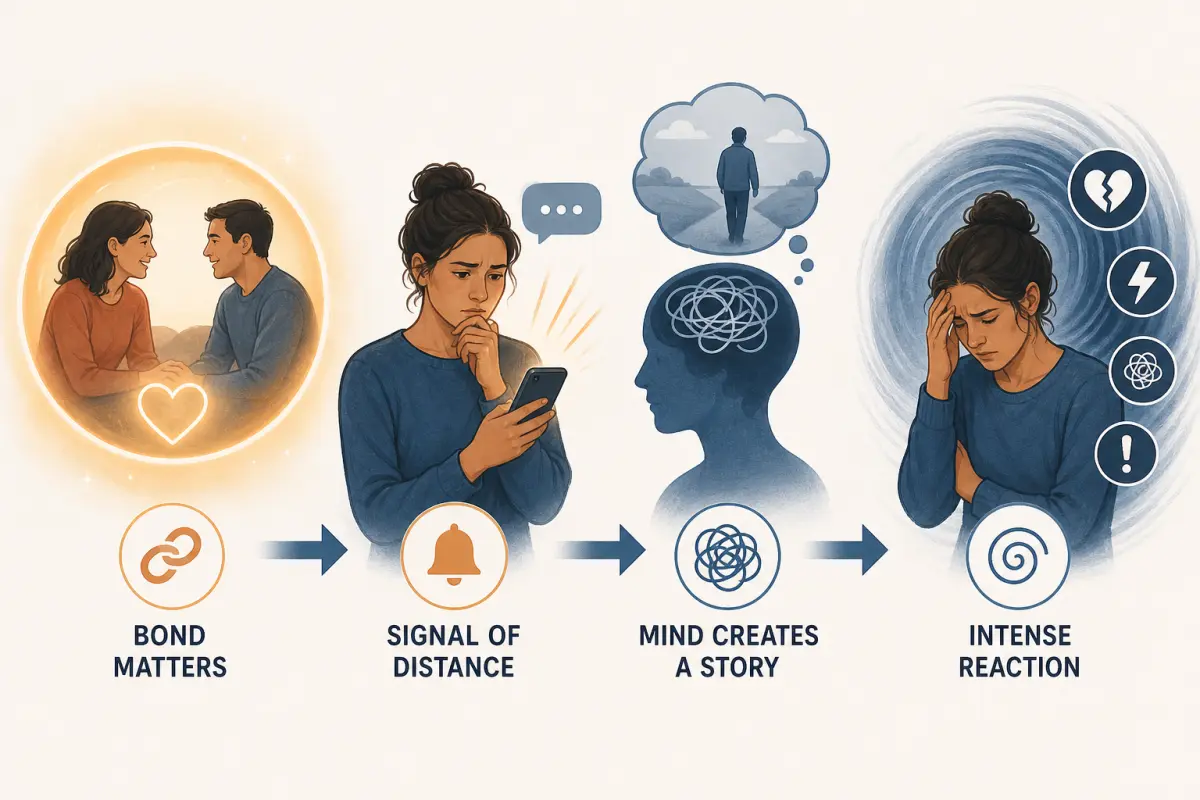
Attachment reactions become intense because close relationships are not neutral to the nervous system. Humans are wired to care about belonging, responsiveness, and emotional safety. When a bond matters, signs of distance can register quickly and powerfully, especially if past experiences taught you that distance often led to rejection, criticism, abandonment, conflict, or emotional unpredictability.
The mind may try to solve the discomfort by creating a story. Unfortunately, in an activated state, the story is often built from fear rather than evidence. A delayed reply becomes “They are losing interest.” A quieter evening becomes “Something is wrong.” A partner needing space becomes “I am about to be abandoned.” The emotional conclusion can feel convincing because the body is already reacting as if it is true.
This is why relationship uncertainty can feel so uncomfortable. Uncertainty leaves room for hope, fear, memory, and imagination to compete. If your system has learned to scan for signs of relational danger, not knowing can feel worse than knowing something definite.
Intensity also grows when several layers stack together:
- The present moment: what actually happened, such as a missed call or a tense conversation.
- The emotional memory: what this situation resembles from earlier relationships or family dynamics.
- The meaning assigned: what your mind decides the event says about you or the relationship.
- The action urge: what you feel driven to do to reduce the discomfort.
When these layers blend together, a small moment can feel enormous. The goal is not to shame yourself for the reaction, but to create enough space to separate the layers.
Common triggers that activate the pattern
Attachment reactions are often triggered by ordinary moments that carry relational meaning. The trigger may look small from the outside, but internally it touches a deeper fear: being forgotten, replaced, controlled, dismissed, criticized, or left alone with distress.
Many triggers involve perceived rejection, which means the pain comes not only from what happened, but from what the moment appears to imply. A person can feel rejected by a lack of warmth, a short reply, a change in routine, or a partner’s distraction, even before any actual rejection has occurred.
| Trigger | How it may be interpreted during activation | A steadier way to frame it |
|---|---|---|
| A delayed text or unanswered call | “I am being ignored. They do not care as much as I do.” | There may be many reasons for the delay. I can wait before deciding what it means. |
| A change in tone | “They are angry with me or pulling away.” | Tone is information, but not a full explanation. I can ask gently when the time is right. |
| A partner needing space | “Space means rejection. I am about to lose them.” | Space can be a regulation need, not a loss of care. The details matter. |
| A disagreement | “Conflict means the relationship is unsafe or failing.” | Disagreement can be handled without abandonment, punishment, or collapse. |
| Seeing the other person happy without you | “I am not important. They do not need me.” | Someone can enjoy other connections and still value this relationship. |
| Plans changing unexpectedly | “I cannot rely on them. I am not a priority.” | The reason, pattern, and repair matter more than one change alone. |
| Receiving criticism or feedback | “I have failed. They see me as too much or not enough.” | Feedback may be uncomfortable without defining my worth or the whole bond. |
| Emotional ambiguity | “If I do not know where I stand, something bad is happening.” | Ambiguity is uncomfortable, but I can gather information slowly instead of reacting from fear. |
The key is to notice your personal pattern. Some people are most activated by silence. Others are most activated by criticism, inconsistency, emotional distance, or feeling controlled. The more precisely you can name your trigger, the less mysterious the reaction becomes.
How to pause before reacting
The pause is not about suppressing your feelings or pretending you are fine. It is about creating a small gap between activation and action. Even a few minutes can help you avoid sending the message, making the accusation, shutting down, or making a relationship decision from the most alarmed part of your mind.
A useful pause has three parts: notice, name, and delay.
1. Notice the reaction as a state, not a command
Try saying to yourself: “I am activated right now.” This simple sentence helps you recognize that you are in a temporary emotional state. It does not mean your concerns are false. It means your system is charged, and charged states tend to reduce nuance.
2. Name the urge without obeying it immediately
You might notice an urge to text repeatedly, ask for reassurance, cancel plans, become cold, check social media, demand clarity, or end the conversation before the other person can. Naming the urge gives you more room: “I am having the urge to test whether they care,” or “I am having the urge to disappear so I do not feel exposed.”
3. Delay the first reaction
Choose a short, realistic delay. Ten minutes is often more useful than promising yourself you will not react for a whole day. During the delay, do something that changes your state rather than feeding the fear.
- Put the phone down and move to another room.
- Drink water, eat something simple, or step outside.
- Write the message in a notes app, but do not send it yet.
- Set a timer before deciding whether a response is needed.
- Ask, “What would I do if I knew I was safe enough for the next ten minutes?”
Practical distinction: Pausing is not the same as avoidance. Avoidance says, “I will not deal with this.” A pause says, “I will deal with this when I can respond with more accuracy and less alarm.” The difference is important because healthy restraint still allows the issue to be addressed later.
If the situation genuinely requires a response, keep it brief and non-escalating: “I want to talk about this, but I need a little time to settle so I can be clear.” This protects the conversation from the sharpest edge of the reaction.
Separating facts from feared meanings
During activation, the mind often treats interpretations as facts. “They did not reply” is a fact. “They are tired of me” is a feared meaning. The feared meaning may be possible, but it is not automatically true. Separating the two helps you think more clearly without dismissing your feelings.
A helpful exercise is to write three columns: facts, feared meanings, and other possible explanations. This does not require forced optimism. It simply widens the frame.
| Fact | Feared meaning | Other possible explanations |
|---|---|---|
| They replied with fewer words than usual. | They are becoming distant or annoyed. | They may be busy, distracted, tired, stressed, or unsure how to respond. |
| They asked to talk later. | They are avoiding me because the relationship is in trouble. | They may want to be more present, need time to think, or be managing another obligation. |
| We disagreed about something important. | We are incompatible, and this will not work. | Important differences can require negotiation, not immediate catastrophe. |
| They spent time with other people. | I am less important than everyone else. | Healthy relationships usually include separate friendships, interests, and time apart. |
| They seemed quiet after I shared something vulnerable. | I was too much, and now they regret being close to me. | They may be processing, unsure what to say, emotionally moved, or dealing with their own discomfort. |
| They forgot a small detail I mentioned. | They do not listen and I do not matter. | Forgetting may reflect attention, stress, or memory limits rather than lack of care. |
After separating the layers, ask yourself:
- What do I know for certain?
- What am I assuming?
- What past experience might this be reminding me of?
- What information would help me understand the situation better?
- What response would preserve my dignity and the relationship, if the relationship is healthy enough to preserve?
This process does not mean you should ignore patterns. If someone repeatedly dismisses you, lies, disappears, or uses silence as punishment, that matters. Separating facts from feared meanings is not about excusing behavior; it is about seeing clearly enough to respond wisely.
Calming the body and slowing the mind
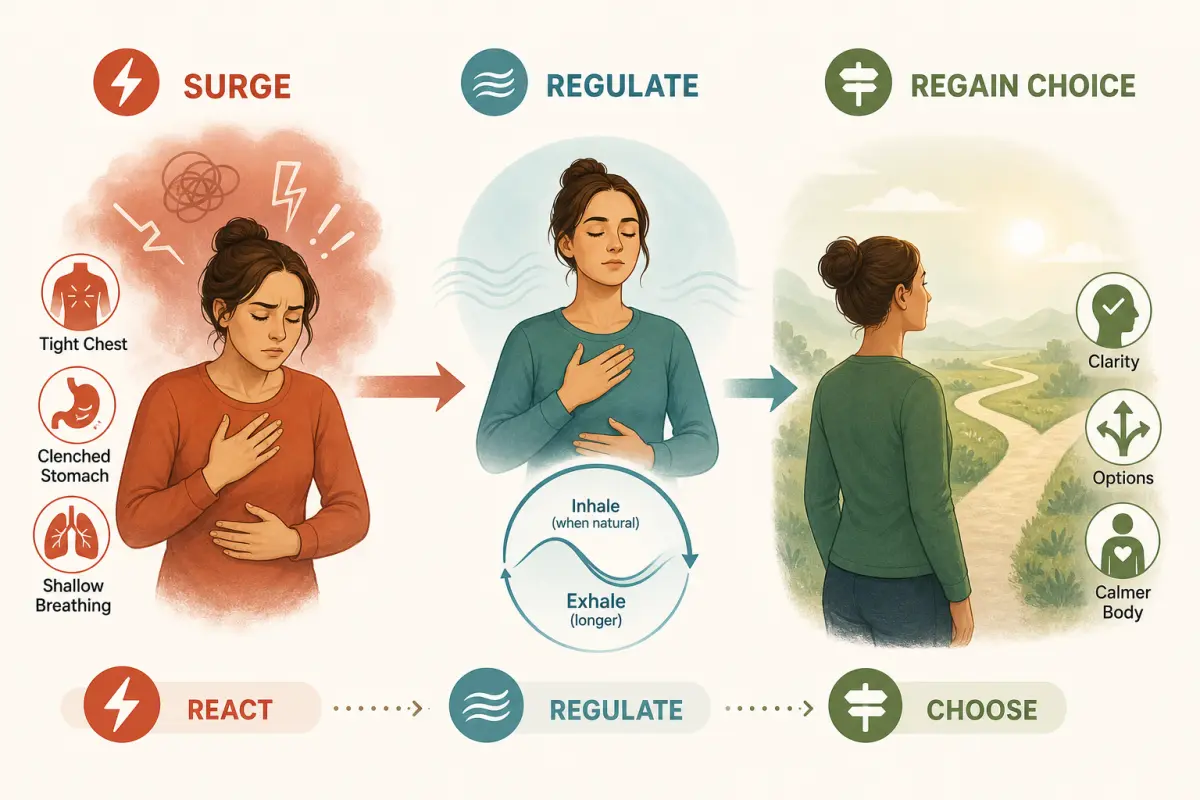
Attachment reactions are not only thoughts. They are bodily states. If your chest is tight, your stomach is clenched, and your breathing is shallow, trying to reason with yourself may have limited effect. The body needs cues that the immediate moment is survivable.
Start with simple regulation rather than complicated self-analysis. The aim is not to become perfectly calm. The aim is to come down enough to regain choice.
Body-based ways to reduce the surge
- Lengthen the exhale: breathe in normally, then exhale slowly. A longer exhale can signal to the body that it does not need to stay fully mobilized.
- Orient to the room: look around and name five neutral objects. This helps your attention return to the present rather than the feared future.
- Use temperature: hold a cool glass of water, splash your face, or step into fresh air. Physical sensation can interrupt spiraling thoughts.
- Move gently: walk, stretch, tidy a small area, or shake out your hands. Movement helps discharge activation without turning it into relational action.
- Soften the jaw and shoulders: these areas often hold defensive tension. Releasing them slightly can reduce the feeling of threat.
Mind-based ways to slow the spiral
- Use a grounding sentence: “This is a difficult moment, not the whole story.”
- Limit mental replay by setting a five-minute writing window.
- Avoid checking behaviors that intensify uncertainty, such as repeatedly looking for online activity.
- Ask what your future self would want you to do in the next half hour.
- Choose one stabilizing action before returning to the relationship issue.
Psychologist’s note: A calmer body does not automatically tell you what decision to make, but it improves the quality of your decision-making. Many people try to solve the relationship first so they can feel calm. Often, it works better to calm the body first so the relationship can be approached with more steadiness.
If your thoughts keep accelerating, reduce the task. Do not try to understand the entire relationship. Focus on the next regulated step: eat, breathe, walk, wait, sleep, or write one clear sentence. Attachment alarm becomes more manageable when the next step is small enough to complete.
When reassurance helps and when it maintains the cycle
Reassurance is not inherently unhealthy. In close relationships, it is normal to want comfort, clarification, affection, and signs of care. A secure bond often includes the ability to say, “I felt unsettled earlier; could you remind me where we stand?” When offered freely and received openly, reassurance can repair small ruptures and strengthen trust.
The difficulty begins when reassurance becomes the only way to regulate. If each wave of anxiety requires immediate confirmation from the other person, the relief may be real but short-lived. Soon the mind asks another question: “But did they mean it?” “What if they only said that because I asked?” “What if they change their mind tomorrow?” This is how seeking reassurance can become a cycle rather than a comfort.
Reassurance is more likely to help when:
- the request is specific and respectful;
- you have already tried some self-soothing first;
- the other person is willing and emotionally safe enough to respond;
- you can take in the answer without immediately cross-examining it;
- the conversation leads to clearer understanding, not repeated testing.
Reassurance may maintain the cycle when:
- you ask the same question many times but never feel settled;
- you monitor the person’s wording, timing, facial expression, or punctuation for proof;
- you feel compelled to confess every anxious thought to get relief;
- the other person becomes responsible for calming every surge;
- you feel better only until the next ambiguous moment appears.
A balanced approach is to combine internal and relational reassurance. Internal reassurance might sound like: “I can tolerate this uncertainty for now,” or “I do not have to solve the whole relationship tonight.” Relational reassurance might sound like: “I felt a little disconnected after our conversation. Could we check in later when you have time?”
This balance matters because adult closeness includes both self-regulation and co-regulation. You do not have to handle everything alone, and another person cannot become the only source of emotional steadiness.
How to communicate after the reaction passes
The best time to talk about an attachment reaction is usually after the sharpest intensity has passed. This does not mean waiting until you feel nothing. It means waiting until you can speak with enough clarity to describe your experience without attacking, pleading, or making the other person responsible for your entire emotional state.
Many relationship difficulties escalate because people communicate from the reaction rather than about the reaction. During activation, a sentence may come out as: “You never care about me.” After settling, the same underlying need might be expressed as: “When I did not hear back, I noticed I felt unimportant. I know there may be other explanations, but I would like to talk about how we handle delays in communication.”
This is where clear communication becomes important. Clear does not mean harsh. It means specific, honest, and connected to a request that the other person can realistically understand.
A useful structure for the conversation
- Describe the moment: “When our plans changed at the last minute...”
- Name your internal reaction: “I noticed I felt unsettled and started assuming I was not important.”
- Take responsibility for your interpretation: “I know that may not be what you meant.”
- Ask for clarification or collaboration: “Can we talk about how to handle changes so both of us feel considered?”
- Listen for their reality: allow the other person to explain without immediately turning their explanation into proof for or against your fear.
It can also help to discuss patterns when you are both calm. For example: “When conflict starts, I tend to get urgent, and you tend to get quiet. I wonder if we can slow things down before we both feel worse.” This kind of conversation can reduce repetitive conflict reactions because it names the cycle instead of blaming one person as the entire problem.
If a relationship includes intimidation, threats, coercive control, physical harm, sexual pressure, stalking, repeated humiliation, or punishment for expressing needs, the priority is safety rather than better wording. Calming an attachment reaction should never mean talking yourself into tolerating harmful behavior. In unsafe situations, appropriate support from trusted people, local services, or emergency resources may be necessary.
In healthier relationships, communication after the reaction can become a repair process. You are not asking the other person to erase all discomfort. You are inviting a more accurate conversation about what happened, what was triggered, and what would help both people respond better next time.
Building steadier attachment responses over time
Steadier attachment responses are built through repetition, not through one perfect insight. The nervous system learns from experience: “I can feel alarm and not act immediately,” “I can ask for what I need without attacking,” “I can tolerate some uncertainty,” “I can notice a trigger without treating it as the whole truth.”
Over time, small practices can change the pattern:
- Track your early signs: notice the first physical cues that you are becoming activated, such as checking, tightening, rehearsing, or withdrawing.
- Create a personal pause plan: decide in advance what you will do for the first ten minutes of activation.
- Practice tolerating ordinary uncertainty: delay checking, wait before asking, and remind yourself that not knowing immediately is uncomfortable but survivable.
- Repair instead of proving: aim to understand what happened rather than win the case that your fear is justified.
- Choose reliable people when possible: steadiness is easier to build in relationships where care, respect, and accountability are present.
- Strengthen your non-relationship anchors: friendships, routines, work, interests, rest, movement, and self-respect all reduce the feeling that one bond must carry your entire sense of safety.
It is also useful to review reactions after they pass. Not with self-criticism, but with curiosity:
- What triggered me?
- What did I fear it meant?
- What did I do that helped?
- What made the reaction stronger?
- What would I like to try next time?
Progress often looks modest from the outside. You still feel the surge, but you send one fewer message. You still feel afraid, but you ask a clearer question. You still want to withdraw, but you say, “I need a little time, and I do want to come back to this.” These moments matter because they teach your system that connection can be handled with more choice.
Memorable takeaway: The aim is not to become someone who never needs reassurance, never feels vulnerable, or never reacts. The aim is to become someone who can notice relational alarm, care for it, question it, and respond in a way that protects both self-respect and genuine connection.
Frequently asked questions
Are attachment reactions always irrational?
No. Sometimes your reaction is pointing to something real: inconsistency, emotional distance, disrespect, broken trust, or a mismatch in needs. The reaction may be intense, but that does not automatically make it meaningless. The useful question is not “Is my feeling irrational?” but “What part is signal, what part is fear, and what response would help me see clearly?”
How long should I wait before responding?
There is no universal time. A good rule is to wait until you can describe the issue without escalating it. For some situations, that may take ten minutes. For others, it may require sleeping on it. If waiting becomes avoidance, set a specific time to return to the conversation.
What if the other person really is pulling away?
Then calming the reaction is still useful. A regulated state helps you ask direct questions, notice the answer, and make decisions based on the relationship as it is rather than only on fear. Calm does not mean denial; it means you are better able to face reality.
Is it wrong to ask for reassurance?
No. Reassurance is part of many caring relationships. It becomes less helpful when it is repeated compulsively, when it replaces self-soothing entirely, or when no answer can be trusted for more than a few minutes. A healthy request is usually specific, respectful, and paired with your own effort to regulate.
Why do I react more strongly in romantic relationships than friendships?
Romantic relationships often involve more vulnerability, dependency, future expectation, physical closeness, and fear of replacement. They may also echo earlier experiences of longing, rejection, inconsistency, or emotional availability. This does not mean friendships are unimportant; it means romantic bonds can activate particularly sensitive attachment themes.
Can avoidant withdrawal be an attachment reaction too?
Yes. Attachment reactions are not always anxious pursuit. Withdrawal, emotional numbing, sudden irritation, dismissing your own needs, or convincing yourself you do not care can also be protective responses. The surface behavior looks different, but the underlying aim may still be to reduce vulnerability.
When should someone consider professional support?
Professional support can be helpful if reactions feel unmanageable, repeatedly damage relationships, lead to panic or shutdown, connect with trauma history, or make it difficult to function. Support may also be important if you feel trapped in unsafe relational patterns. General information can guide reflection, but it cannot replace individualized care when distress is significant.