Why You Feel Drawn to Unavailable People

 This article explains what emotional unavailability looks like, why inconsistency can feel addictive, and how familiar patterns, chemistry, longing, and chasing potential affect self-worth. It also covers breaking the cycle and choosing available people.
- What emotional unavailability looks like in real life
- Why unpredictability can make attraction stronger
- Familiar relationship patterns and emotional recognition
- Chemistry, longing, and the hope of being chosen
- Signs you are attached to potential rather than reality
- How unavailable relationships affect self-worth
- Why trying harder rarely creates emotional availability
- Breaking the attraction and disappointment cycle
- Choosing available people without losing emotional depth
- Frequently asked questions
Feeling drawn to someone who cannot fully meet you can be unsettling, especially when you already sense the pattern is painful. This attraction often comes from familiar emotional rhythms: hoping to be chosen, feeling energized by distance, or believing love has to be earned. Understanding it is not about self-blame. It is about noticing what your heart learned to pursue, and recognizing what it may now be ready to accept.
What emotional unavailability looks like in real life
Emotional unavailability is not always dramatic, cold, or obvious. In everyday life, it often appears as a confusing mixture of warmth and distance. Someone may be affectionate in certain moments, share personal stories, flirt, text often for a while, or say they care about you — yet remain unable or unwilling to build a steady emotional connection.
This is what makes emotionally unavailable people so difficult to read. They may not seem indifferent. In fact, they may seem intense, charming, sensitive, or deeply wounded. The problem is not that they never show feeling. The problem is that their availability is inconsistent, limited, or dependent on circumstances that keep real intimacy out of reach.
Common signs of emotional unavailability include:
- Inconsistent contact: they are present and engaged one week, then distant or vague the next.
- Avoidance of direct conversations: they change the subject when commitment, feelings, or expectations are discussed.
- Emotional intensity without follow-through: they create closeness in private moments but do not act consistently afterward.
- Unclear relationship status: they resist labels, future planning, or mutual agreements.
- Limited vulnerability: they may talk about pain or past experiences but avoid being emotionally accountable in the present.
- Availability only on their terms: they reach out when lonely, stressed, bored, or in need of comfort, but disappear when you need reassurance.
- Competing attachments: they may be emotionally tied to an ex, unavailable because of another relationship, or preoccupied with unresolved life circumstances.
Sometimes emotional unavailability is protective rather than malicious. A person may fear dependence, loss of control, rejection, or being truly known. Patterns such as avoiding emotional closeness can develop when intimacy feels more threatening than comforting. Still, understanding why someone is unavailable does not mean you have to organize your emotional life around their limitations.
Psychologist’s note: A useful distinction is the difference between someone who is temporarily overwhelmed and someone who repeatedly avoids emotional responsibility. Everyone can become withdrawn during stress. But if distance, ambiguity, and lack of follow-through are the stable pattern, it is reasonable to take that pattern seriously rather than waiting for a hidden version of the person to appear.
Being drawn to unavailable people does not mean you are foolish or “too needy.” It often means that certain emotional cues — distance, inconsistency, mystery, or the possibility of being chosen — have become unusually powerful for you. The attraction may feel personal and romantic, but it is also shaped by learning, nervous system responses, memory, hope, and self-protection.
Why unpredictability can make attraction stronger
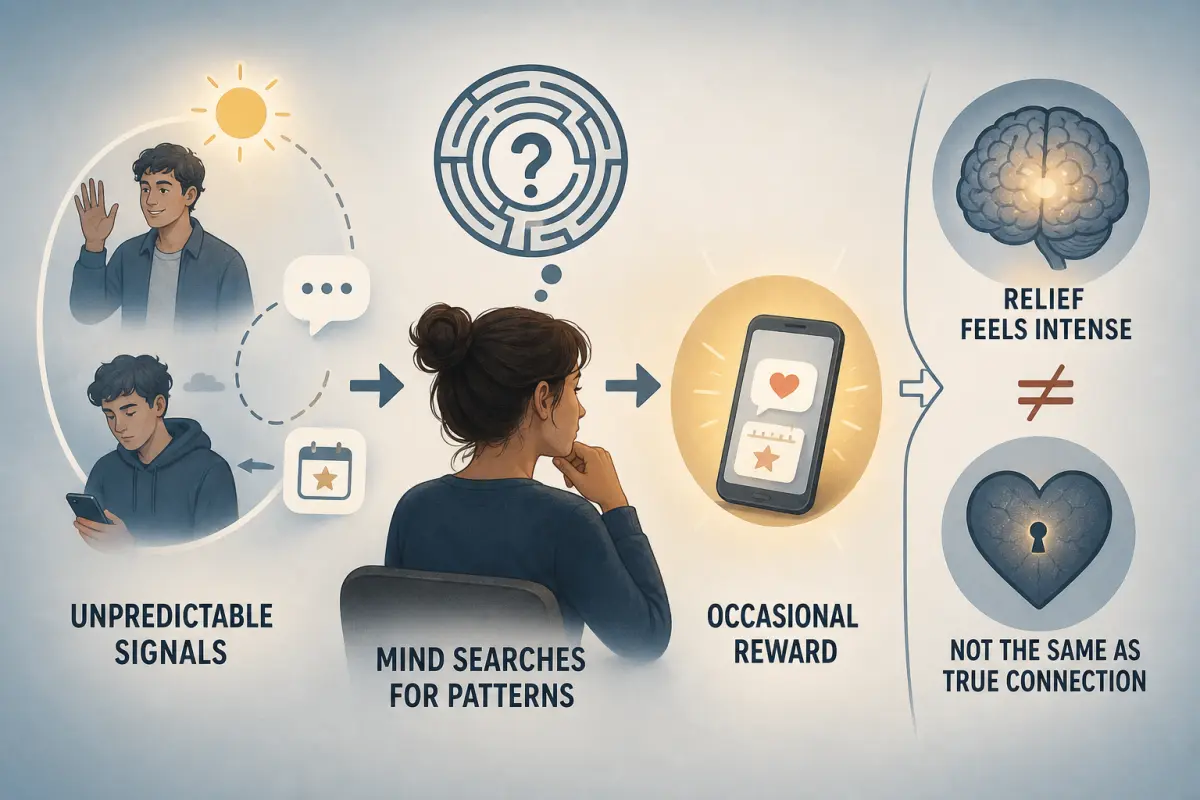
Unpredictability can intensify attraction because it keeps the mind searching for patterns. When someone is sometimes warm and sometimes distant, your attention may become focused on predicting the next sign of affection. A short message, a softened tone, or a sudden invitation can feel unusually rewarding because it arrives after uncertainty.
This does not mean the connection is healthier or deeper. It means the emotional system is responding to contrast. Relief can be mistaken for love. A person who disappears and then returns may create a surge of comfort simply because the tension finally drops. Over time, the body may begin to associate anxiety followed by relief with chemistry.
In daily life, this can look like:
- checking your phone more often than you want to;
- replaying conversations to understand whether they care;
- feeling calm only after receiving reassurance;
- interpreting small gestures as major evidence of hope;
- feeling more attached when the person becomes distant;
- confusing longing with compatibility.
Uncertainty is especially powerful when there is enough affection to keep hope alive, but not enough consistency to feel secure. This is why relationship uncertainty can feel so intense: the mind tries to solve the ambiguity, while the heart waits for confirmation that the bond is real.
The “almost” effect
Emotionally unavailable relationships often contain many “almost” moments. The person almost opens up. They almost choose you. They almost make plans. They almost become the partner you sense they could be. These near-moments can be more gripping than clear rejection because they leave the door open.
Instead of grieving what is not available, you may find yourself investing in what might happen if the timing improves, if they heal, if they become less afraid, if they finally understand your value. Hope becomes emotionally expensive when it keeps you attached to a future that the present does not support.
Familiar relationship patterns and emotional recognition
People are often drawn not only to what feels good, but to what feels familiar. Familiar does not always mean healthy. It may simply mean emotionally recognizable. If earlier relationships taught you that love came with waiting, proving yourself, managing someone’s moods, or accepting partial attention, then an unavailable person may feel strangely compelling.
This does not require a dramatic childhood story. Many people grow up in ordinary homes where affection was present but inconsistent, emotional needs were minimized, conflict was avoided, or closeness felt unpredictable. Later in life, the nervous system may recognize uncertainty as part of connection.
Familiar patterns can include:
- feeling responsible for drawing someone out emotionally;
- being more comfortable giving care than receiving it;
- interpreting distance as a challenge rather than a warning sign;
- feeling bored or suspicious when someone is consistently kind;
- believing love must be earned through patience, loyalty, or exceptional understanding;
- confusing emotional tension with depth.
For some people, steady affection can initially feel unfamiliar or even exposed. If closeness has previously been linked with disappointment, criticism, engulfment, or loss, then safe connection may not immediately feel safe. This helps explain why unsettling emotional closeness can appear even when you genuinely want love.
Emotional recognition can be powerful because it creates a sense of “I know this.” You may instinctively understand how to behave around distance: wait, soften, give space, be patient, try to be less demanding. But familiarity is not the same as emotional nourishment. A pattern can feel natural and still cost you peace.
Chemistry, longing, and the hope of being chosen
Chemistry with an unavailable person can feel unusually strong because it often contains longing. Longing creates focus. When you cannot fully have someone, the mind may magnify their importance. You imagine what closeness would feel like, what they would be like if they were fully present, and how meaningful it would be if they chose you despite their fear, confusion, or resistance.
The hope of being chosen is not superficial. It can touch very deep places: the wish to be special, irreplaceable, finally seen, or powerful enough to change someone’s emotional direction. If someone is hard to reach, their attention may feel like proof of your worth. If they choose you, perhaps that means you are different from everyone else. Perhaps you are the one who was worth opening for.
Why longing can feel like depth
Longing slows time down. It encourages fantasy, analysis, and emotional rehearsal. You may have long internal conversations with the person, imagine future repair, or remember the most tender moments as evidence of what the relationship “really” is. Because so much emotional energy is involved, the connection can feel profound.
But emotional intensity is not the same as mutual intimacy. Intimacy requires more than wanting, missing, imagining, or suffering. It requires two people who can participate in reality: communicating, repairing, choosing, and showing up with enough consistency that both people can breathe.
It can help to separate chemistry into different ingredients:
- Physical attraction: genuine desire and sensory pull.
- Emotional recognition: a sense that this pattern is familiar or important.
- Uncertainty: not knowing where you stand, which heightens attention.
- Fantasy: attachment to who the person could become.
- Validation seeking: wanting their choice to confirm your value.
- Actual compatibility: shared values, reliability, emotional reciprocity, and mutual care.
When these ingredients are blended together, it can be hard to tell whether you are experiencing love, anxiety, attraction, hope, or a mixture of all four. Slowing down helps. Instead of asking, “Why do I feel so much?” ask, “What conditions are creating this feeling?”
Signs you are attached to potential rather than reality
Being attached to potential means your emotional investment is based more on what could happen than on what is consistently happening. You may see real qualities in the person — warmth, intelligence, tenderness, humor, sensitivity — but the relationship itself does not provide enough stability, reciprocity, or care.
This distinction matters because potential can be genuine and still not be available to you. Someone may truly have a good heart, deep feelings, or capacity for growth. But if those qualities do not translate into present behavior, you are left relating to possibility rather than partnership.
| Attachment to potential | Connection with reality |
|---|---|
| You focus on who they become during rare tender moments. | You consider how they treat you across ordinary days, stress, conflict, and routine communication. |
| You explain repeated distance by emphasizing their fear, past pain, or difficult circumstances. | You acknowledge context while still noticing whether they take responsibility for their behavior. |
| You wait for a future version of them to be ready. | You ask whether the current relationship can meet your emotional needs now. |
| You treat small signs of affection as proof that the whole relationship is changing. | You look for sustained patterns rather than isolated moments of warmth. |
| You feel you must be patient enough, understanding enough, or low-maintenance enough. | You recognize that mutual care should not require you to disappear emotionally. |
| You avoid asking direct questions because the answer might end the fantasy. | You allow clarity to matter, even when it is disappointing. |
| You feel most connected when imagining what the relationship could become. | You feel connected through actual shared effort, trust, and emotional presence. |
A painful sign of attachment to potential is that you may defend the relationship more than you feel nourished by it. You can explain why they are distant, why they cannot commit, why they send mixed messages, and why the timing is difficult — yet your own emotional experience remains lonely.
A helpful question is: “If nothing changed for the next six months, would I still choose this?” This brings attention back to the relationship as it exists, not as it might become after enough waiting, hoping, or emotional labor.
How unavailable relationships affect self-worth
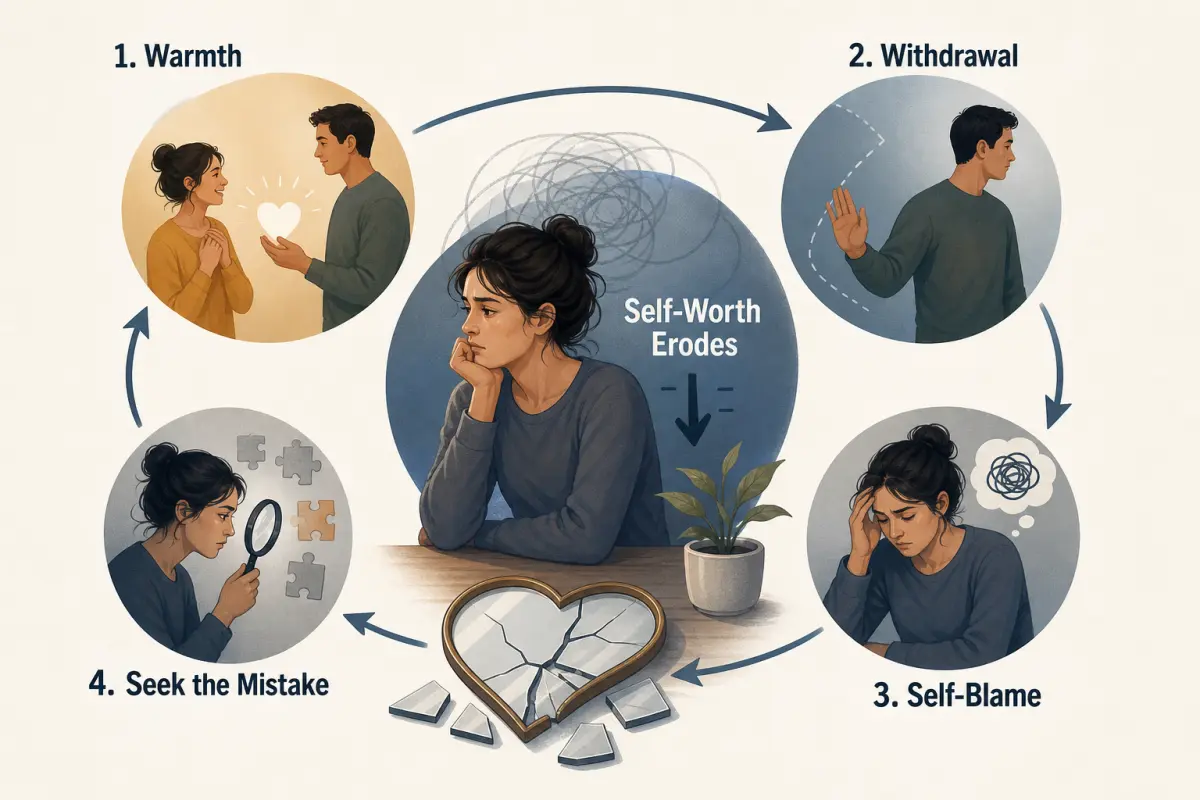
Unavailable relationships can quietly shift the way you see yourself. At first, you may simply feel confused. Over time, you may begin to wonder whether you are asking for too much, feeling too deeply, or failing to be interesting enough to keep someone close.
This is one of the most damaging effects of inconsistent connection: it can make a reasonable need for reciprocity feel like a personal flaw. If someone gives you affection and then withdraws, you may start looking for the mistake you made. Did you text too soon? Did you sound too emotional? Did you ask for too much clarity? Did you show too much interest?
When the pattern continues, self-worth can become tied to the other person’s availability. A reply feels like relief. Silence feels like rejection. A warm evening restores confidence. A distant week collapses it again. This emotional rhythm can create unequal attachment, where one person becomes increasingly preoccupied while the other remains comparatively detached.
Common self-worth shifts
- You become more careful, edited, or strategic in how you express needs.
- You feel grateful for basic attention rather than expecting mutual effort.
- You compare yourself to people they chose before or might choose later.
- You interpret their emotional limitations as evidence of your inadequacy.
- You tolerate ambiguity that you would not advise a friend to tolerate.
- You feel embarrassed by how much the relationship affects your mood.
If emotional unavailability is mixed with intimidation, coercion, threats, stalking, humiliation, sexual pressure, financial control, or fear of the person’s reaction, the issue is no longer only attachment pain or mixed signals. Personal safety and appropriate support take priority. In those circumstances, it is important to involve trusted people or local professional resources rather than trying to manage the relationship through more patience or better communication.
Healthy self-worth does not mean you never feel hurt by rejection or inconsistency. It means you can feel hurt without concluding that you are unlovable. The goal is not to become unaffected. The goal is to stop using someone else’s limited capacity as the measure of your value.
Why trying harder rarely creates emotional availability
When someone is unavailable, it is natural to try harder. You may become more understanding, more attractive, more patient, more flexible, more interesting, or less demanding. You may study their fears, accommodate their schedule, avoid sensitive topics, and offer reassurance they have not asked for. The hope is that if you can make the relationship feel safe enough, they will finally come closer.
The difficulty is that emotional availability cannot be produced by one person’s effort alone. You can create conditions that are respectful and honest. You can communicate clearly. You can avoid unnecessary pressure. But you cannot do another person’s emotional work for them.
Trying harder often fails because:
- It rewards ambiguity. If they receive care, access, and patience without offering clarity, the pattern may continue.
- It hides your real needs. You may become so focused on not overwhelming them that you abandon your own emotional truth.
- It turns love into a performance. You begin trying to be the version of yourself most likely to be chosen.
- It prevents accurate information. If you never express expectations, you cannot see whether they are willing to meet you honestly.
- It creates resentment. Over-giving often leads to quiet anger when the hoped-for closeness does not arrive.
There is a difference between patience and self-erasure. Patience allows room for a real person to move at a human pace. Self-erasure requires you to silence your needs so the relationship can continue without discomfort. One supports intimacy; the other protects avoidance.
Practical distinction: Before offering more understanding, ask yourself whether understanding is leading to mutual honesty or simply making you more tolerant of emotional neglect. Compassion is healthiest when it includes both people: their wounds matter, and so do your needs.
If someone becomes more distant whenever you ask for basic clarity, that is information. If they value the connection but cannot discuss its reality, that is also information. Availability is not proven by emotion alone; it is shown through the willingness to participate in the relationship with care, consistency, and accountability.
Breaking the attraction and disappointment cycle
Breaking the cycle is not usually a single dramatic decision. It is a series of smaller acts of honesty. You begin to notice what pulls you in, what keeps you waiting, what you minimize, and what you call “chemistry” when it may also be anxiety.
A useful first step is to map the cycle without judging yourself. Many people repeat a pattern like this:
- You meet someone who is intriguing, intense, distant, or hard to read.
- The uncertainty increases your focus and emotional investment.
- Moments of warmth feel especially meaningful because they interrupt the distance.
- You begin to hope that patience will lead to being chosen.
- Your needs become harder to express because you fear pushing them away.
- The relationship remains unclear or inconsistent.
- You feel disappointed, anxious, or diminished.
- After a return of affection, the hope begins again.
Seeing the pattern clearly helps you interrupt it earlier. Instead of waiting until you are deeply attached, you can begin asking better questions at the first signs of inconsistency.
Ways to interrupt the cycle
- Name the pattern privately. “I feel more interested because they are uncertain” is a powerful observation.
- Slow down fantasy. When imagining the future, return to what has actually been demonstrated.
- Ask direct but calm questions. Clarity does not have to be aggressive: “What kind of connection are you available for?”
- Watch behavior after the conversation. A reassuring talk matters less than whether anything changes afterward.
- Keep your routines intact. Do not let someone’s inconsistency reorganize your sleep, work, friendships, or self-care.
- Let disappointment inform you. Pain is not always a sign to try harder; sometimes it is a sign to step back.
- Practice receiving steadiness elsewhere. Spend time with friends, family members, or partners who respond consistently and respectfully.
If you notice that your mood, choices, and sense of identity are becoming organized around another person’s responses, it may help to reflect on the line between attachment and emotional dependence. The point is not to shame strong feelings, but to recognize when a bond has started to shrink your life.
Breaking the cycle also means tolerating the quiet that follows. Unavailable relationships often create emotional noise: anticipation, analysis, hope, confusion, relief. When you step away, calm may initially feel empty. That does not mean you made the wrong choice. It may mean your nervous system is adjusting to the absence of constant uncertainty.
Choosing available people without losing emotional depth
One fear many people have is that choosing emotional availability will mean settling for something flat, predictable, or passionless. If you are used to intensity, steadiness may at first feel less exciting. But emotional availability is not the absence of depth. It is the condition that allows depth to become safer, fuller, and more mutual.
An available person is not perfect. They may have fears, limits, busy periods, and imperfect communication. The difference is that they can usually engage with the relationship honestly. They do not require you to guess constantly. They can repair after conflict. They are able to consider your feelings without treating them as a burden.
What availability can look like
- They communicate interest without keeping you in prolonged ambiguity.
- Their actions are reasonably aligned with their words.
- They can discuss expectations without disappearing or becoming contemptuous.
- They show curiosity about your inner life, not only your role in theirs.
- They make room for mutual needs, not just their comfort level.
- They can move slowly without keeping you emotionally suspended.
- They are willing to repair misunderstandings rather than punish you with distance.
Learning to choose available people may require retraining your sense of attraction. This does not mean forcing yourself to want someone you do not want. It means giving steadiness enough time to register. Sometimes the nervous system needs repeated experiences of consistency before it stops interpreting calm as boredom.
Helpful reframe: Depth does not have to be proven through suffering. A relationship can be emotionally rich because two people are honest, responsive, playful, thoughtful, and brave enough to be known — not because one person is always waiting for the other to arrive.
You can still value passion, mystery, growth, and emotional complexity. The shift is that these qualities no longer need to come packaged with chronic uncertainty. The more you experience attraction alongside respect and reliability, the less compelling emotional unavailability becomes.
Frequently asked questions
Why am I attracted to people who cannot fully choose me?
You may be responding to a mix of chemistry, familiarity, uncertainty, and the hope of validation. Being chosen by someone hard to reach can feel especially meaningful, but that does not mean the connection is good for you. Attraction is information, not an instruction.
Does being drawn to unavailable people mean something is wrong with me?
No. It means there is a pattern worth understanding. Many intelligent, emotionally aware people find themselves pulled toward inconsistent partners. The goal is not self-blame; it is learning to recognize the pull before it becomes a painful attachment.
Can an emotionally unavailable person become available?
Sometimes, but only if they recognize the pattern, want to change it, and take consistent responsibility for doing so. Your patience alone cannot create their readiness. Look for sustained behavior change, not only emotional conversations or promises made during moments of closeness.
How do I know whether I should wait or walk away?
Ask what is happening now, not only what might happen later. Are they honest about their capacity? Are they making real efforts? Do you feel respected while waiting? Is there a clear direction, or are you living on hope? Waiting becomes harmful when it requires you to abandon your needs indefinitely.
Why do available people sometimes feel less exciting?
If your emotional system associates love with uncertainty, then consistency can initially feel unfamiliar. Excitement may have been linked with pursuit, anxiety, or relief. Over time, available connection can become more attractive as your body learns that calm does not mean lack of chemistry.
What should I do when I feel the urge to chase?
Pause before acting. Notice what triggered the urge: silence, ambiguity, jealousy, fear of loss, or a sudden warm moment. Then choose one grounding action before contacting them — speak with a trusted friend, write down the facts, take a walk, or wait until your nervous system settles. Decisions made from panic often reinforce the cycle.
Can I have compassion for someone unavailable and still leave?
Yes. Compassion does not require continued access to you. You can understand that someone has fears, wounds, or limitations while also recognizing that the relationship is not healthy for you. Leaving does not mean you deny their humanity; it means you include your own.
What is the healthiest sign that my pattern is changing?
You begin to value consistency as much as intensity. You notice mixed signals earlier. You ask clearer questions. You feel less tempted to audition for love. Most importantly, you stop treating someone’s inability to choose you as proof that you need to become more worthy.