Why Some People Avoid Naming Their Feelings

 This article explains why people avoid clear feeling words, from vague language and attachment expectations to fear of vulnerability. It also covers how actions stand in for emotions, how this affects closeness, and how to ask gently while building a more honest vocabulary.
- What avoiding emotional labels looks like
- Why vague emotional language can feel safer
- Difficulty recognizing feelings versus expressing them
- How attachment expectations shape emotional language
- Fear of vulnerability and being misunderstood
- When actions replace direct emotional statements
- How emotional avoidance affects close relationships
- How to ask about feelings without creating pressure
- Building a clearer and more honest emotional vocabulary
- Frequently asked questions
Some people avoid putting their emotions into words, not because they are cold or unaware, but because language can make an inner experience feel suddenly real. In everyday life, this may appear as changing the subject, joking, staying busy, or insisting they are fine when something more complex is happening. Approaching this habit with patience can reveal how self-protection, upbringing, fear of burdening others, or simple overwhelm shape the way people share what hurts.
What avoiding emotional labels looks like
Avoiding emotional labels does not always look dramatic. Often it appears in small, ordinary moments: someone says they are “fine” when they are clearly tense, “tired” when they seem hurt, or “busy” when they are actually overwhelmed. They may describe the situation in detail while carefully stepping around the feeling itself.
Instead of saying, “I felt rejected when you left without telling me,” they might say, “It was just weird that you left.” Instead of “I’m anxious about tomorrow,” they may say, “There’s a lot going on.” The words stay close to facts, logistics, or general discomfort, but avoid naming the inner experience directly.
This pattern can show up as:
- using broad words such as “bad,” “off,” “weird,” “stressed,” or “annoyed” for many different feelings;
- describing body sensations instead of emotions, such as “my chest feels tight” or “I feel heavy”;
- focusing on what another person did rather than how it affected them;
- changing the subject when asked, “How did that make you feel?”;
- making jokes, intellectual explanations, or practical plans instead of naming sadness, fear, shame, longing, or disappointment;
- using silence or withdrawal to communicate distress indirectly.
For many people, this is not a deliberate attempt to be difficult. Emotional labeling can feel strangely exposing. A person may know something is happening inside them but not have easy access to the words. Or they may have the words but feel unsafe saying them aloud.
Psychologist’s note: Emotional vagueness is often a protective habit before it becomes a communication problem. If a person learned that naming feelings led to dismissal, criticism, teasing, or conflict, staying vague may once have been a sensible way to remain composed and avoid escalation.
It helps to distinguish between avoiding emotion and avoiding emotional language. Some people feel a great deal but have little practice naming it. Others have learned to manage life by moving quickly into problem-solving, performance, caretaking, or self-control. The feeling may still be present, but it does not get a clear name.
Why vague emotional language can feel safer
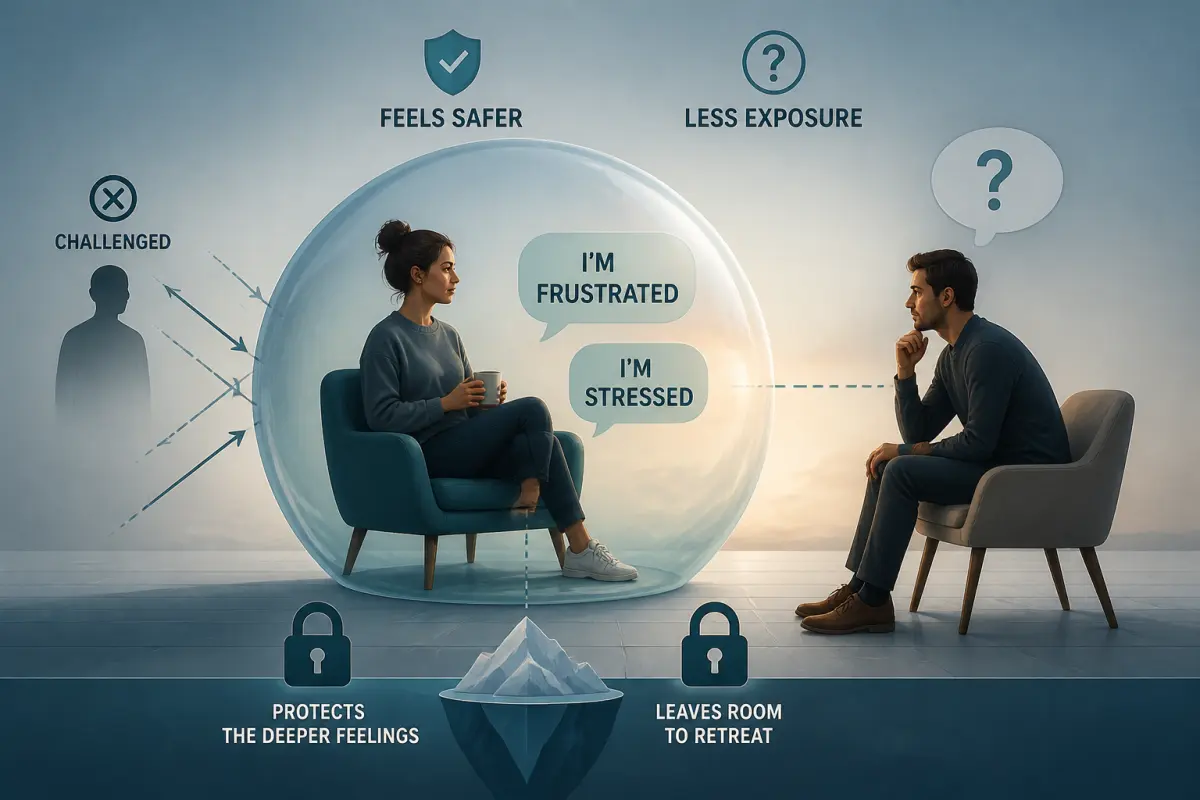
Vague emotional language creates distance. Saying “I’m frustrated” is less exposing than saying “I felt unwanted.” Saying “I’m stressed” is safer than saying “I’m scared I’m failing.” General words leave room to retreat. They allow the person to communicate that something is wrong without revealing the more tender layer underneath.
This can feel safer for several reasons. First, vague language reduces the risk of being challenged. If someone says, “I’m upset,” another person may ask why. But if they say, “I’m just tired,” the conversation may end there. Second, broad labels are easier to defend. “I’m stressed” is socially acceptable in many settings, while “I feel lonely” may feel much more personal.
Vagueness also protects against the possibility of being seen too clearly. A precise emotional word can feel like handing someone a map of one’s softest places. For people who are cautious about dependence, closeness, or conflict, that may feel risky even in a safe relationship.
There is also the fear that once a feeling is named, it becomes more real. A person may sense that saying “I’m grieving,” “I’m jealous,” or “I feel ashamed” will make the feeling harder to ignore. Language can bring a private experience into focus. That focus can be useful, but it can also feel intense at first.
Everyday life often rewards vagueness. Many workplaces, families, and social groups prefer quick functioning over emotional accuracy. People may learn to say “It’s fine” because the environment does not really make space for a fuller answer. Over time, that answer can become automatic even when a more honest conversation would be possible.
Difficulty recognizing feelings versus expressing them
Not everyone who avoids naming feelings is doing the same thing internally. One person may genuinely struggle to identify what they feel. Another person may know exactly what they feel but be reluctant to say it. These are different patterns, and confusing them can create unnecessary frustration.
Difficulty recognizing feelings often shows up as uncertainty: “I don’t know what I feel,” “I can tell something is wrong, but I can’t name it,” or “It all feels mixed together.” The person may notice bodily signals, thoughts, urges, or mood changes without being able to connect them to a specific emotional word.
Difficulty expressing feelings is different. The person may think, “I’m hurt,” but say, “Whatever.” They may know they are afraid but present as irritated. They may understand their sadness privately but feel embarrassed or unsafe showing it to someone else.
Many emotional states are layered. Anger may sit on top of fear. Irritation may cover disappointment. Numbness may follow overwhelm. When emotions arrive in clusters, precise language becomes harder. This is especially true with hard-to-explain emotions, where the experience is real but does not fit neatly into one familiar word.
| What may be happening | How it can sound | What may help |
|---|---|---|
| The person cannot yet identify the feeling clearly. | “I don’t know. I just feel off.” | Start with body sensations, recent events, and simple emotional families such as sad, scared, angry, ashamed, or relieved. |
| The person knows the feeling but fears the reaction. | “It’s nothing. Forget it.” | Reduce pressure and make room for partial honesty, such as “You do not have to explain everything right now.” |
| Several feelings are present at once. | “I’m angry, but also not angry. I don’t know.” | Allow mixed feelings to coexist instead of forcing one final label. |
| The person is used to analyzing rather than feeling. | “The issue is that the timing was inefficient.” | Gently ask what the situation meant to them personally, not only what happened externally. |
| The emotion is present but muted by shutdown or fatigue. | “I feel blank.” | Give time, rest, and low-demand space before expecting emotional clarity. |
| The person has learned that some emotions are unacceptable. | “I shouldn’t be upset about this.” | Separate having a feeling from acting on it; feelings can be acknowledged without being obeyed. |
When someone says they do not know what they feel, it is usually more helpful to believe the uncertainty than to insist they must know. Emotional awareness often develops through patience, curiosity, and repeated low-pressure reflection.
How attachment expectations shape emotional language
The way people talk about feelings is strongly shaped by what they expect from closeness. If someone expects comfort, interest, and steadiness, emotional language may feel like a bridge. If they expect criticism, intrusion, abandonment, or loss of control, emotional language may feel like a risk.
These expectations often form gradually through repeated experiences. A person who was listened to may find it natural to say, “I felt hurt.” A person who was mocked, ignored, rushed, or punished may learn to say less. Not because they have fewer feelings, but because naming feelings did not reliably lead to care.
Some people associate emotional disclosure with being trapped. If they say they are sad, they imagine someone will demand more, question them intensely, or use the information later. Others associate emotional disclosure with being left. If they say they need reassurance, they fear the other person will see them as too much.
In close relationships, these expectations can quietly guide word choice. A person may use practical language to maintain distance: “I’ll handle it,” “It’s not a big deal,” “Let’s just move on.” This can overlap with patterns of avoiding closeness, where emotional independence becomes a protective identity rather than simply a preference.
This does not mean every emotionally reserved person has the same history or the same attachment pattern. Some people are private by temperament. Some come from cultures, families, or communities where restraint is valued. Some are skilled at emotional awareness but selective about where they share it. The important question is not whether a person uses many emotional words, but whether they have enough language to be honest when honesty matters.
Fear of vulnerability and being misunderstood
Naming a feeling can make a person feel vulnerable because it reveals what matters. “I’m disappointed” means there was hope. “I’m jealous” means there is attachment. “I’m embarrassed” means there is a wish to be seen in a certain way. Emotional labels often disclose not only pain but also longing, value, and need.
For some people, the biggest fear is not the feeling itself but what others will do with it. They may worry about being judged as dramatic, needy, weak, irrational, selfish, or difficult. If they have been misunderstood before, they may hesitate to give anyone another opportunity to misread them.
There is also a specific kind of frustration that comes from naming a feeling and then having to defend it. A person says, “I felt dismissed,” and the response is, “That’s not what I meant.” The conversation shifts away from the emotional impact and toward proving whether the feeling is justified. Over time, this can teach people that silence is easier than explanation.
The experience of feeling misunderstood can linger long after the conversation ends. People may replay what they said, imagine what they should have said, or decide that next time they will simply keep the feeling to themselves.
Vulnerability can also be confusing in relationships that are generally loving. Even when the other person is kind, emotional openness may still feel unfamiliar. Some people become uncomfortable precisely when closeness increases. The warmth they want may also feel exposing, and that mix can make direct emotional language difficult. In those moments, unsettling closeness may be part of the background experience.
Useful distinction: Feeling vulnerable is not the same as being unsafe. Vulnerability often comes with openness, uncertainty, and emotional exposure. Unsafety involves patterns such as intimidation, humiliation, coercion, threats, or repeated disregard for boundaries. It is worth learning the difference, because healthy closeness requires some vulnerability, but it should not require tolerating harm.
When a person avoids naming feelings because they fear misunderstanding, reassurance alone may not be enough. What often helps more is a repeated experience of being heard accurately: “I may not fully understand yet, but I want to understand what this felt like for you.”
When actions replace direct emotional statements
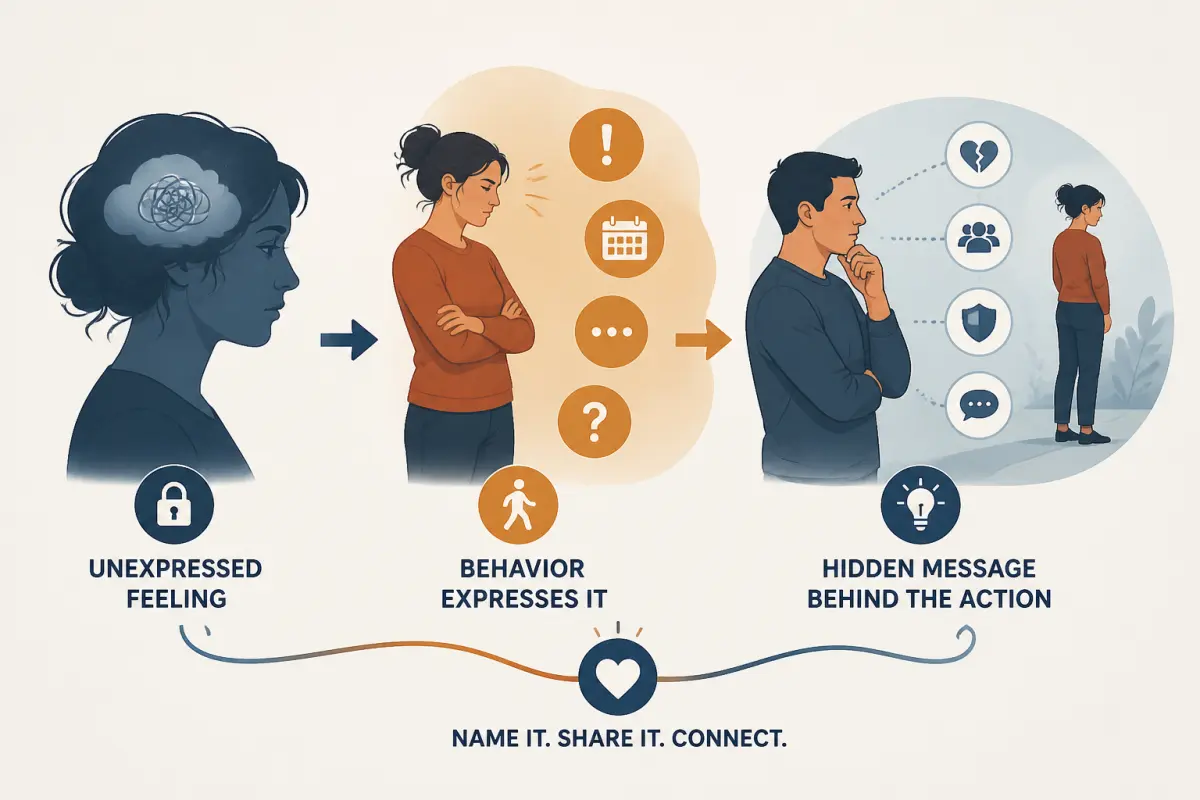
When feelings are not named, they often come out through behavior. This does not mean the behavior is manipulative or intentional. It means the emotional message has found another route.
A person who cannot say “I miss you” may become irritable when plans change. Someone who cannot say “I feel excluded” may withdraw from the group. Someone who cannot say “I need reassurance” may ask repeated practical questions, test the other person’s availability, or become unusually quiet.
Actions can communicate emotional states, but they are often ambiguous. Silence might mean anger, hurt, fatigue, fear, or a need to think. Overworking might mean ambition, anxiety, avoidance, financial pressure, or a wish to feel useful. Without words, others are left guessing, and guesses are often shaped by their own fears.
Common action-based substitutes for emotional statements include:
- withdrawing instead of saying, “I feel overwhelmed” or “I need space”;
- criticizing small details instead of saying, “I feel unimportant”;
- becoming overly helpful instead of saying, “I want to feel needed”;
- delaying replies instead of saying, “I do not know how to respond yet”;
- joking instead of saying, “This is tender for me”;
- acting indifferent instead of saying, “I care more than I want to admit.”
Behavior can be a starting point for understanding, but it should not be treated as a perfect translation. If someone is quiet, it is better to ask gently than to assume. If someone is sharp or distant, it is fair to address the behavior while still being curious about the feeling underneath.
A helpful phrase is: “I notice you got quiet after that conversation. I do not want to assume what it means. Are you upset, tired, needing space, or something else?” This gives options without demanding instant emotional precision.
How emotional avoidance affects close relationships
Close relationships depend on more than affection. They also depend on being able to repair misunderstandings, express needs, and give each other accurate information. When feelings remain unnamed for too long, the relationship may become full of guesswork.
One person may sense distance but not know why. The other may feel hurt that their distress has not been noticed. Both may become frustrated: one feels shut out, the other feels pressured. Without clear emotional language, ordinary tension can grow into a larger story about rejection, control, indifference, or incompatibility.
Emotional avoidance can affect relationships in several ways:
- small disappointments accumulate because they are never directly addressed;
- partners, friends, or relatives begin guessing and often guess incorrectly;
- conflict becomes focused on behavior rather than the feelings driving it;
- one person may feel responsible for extracting emotional truth from the other;
- the reserved person may feel invaded, criticized, or inadequate;
- repair after conflict becomes harder because the real hurt remains unnamed.
This is where clear communication matters. Clarity does not require dramatic confession or perfect wording. It may be as simple as saying, “I am not ready to talk in detail, but I am hurt and I do want us to come back to it.” That sentence gives the other person useful information without forcing full exposure all at once.
If emotional silence is combined with intimidation, punishment, threats, repeated humiliation, monitoring, or making someone afraid to speak honestly, the priority is not better wording; it is safety and appropriate support. No one should be pressured to disclose feelings in a situation where honesty may be used against them or where their physical or emotional safety is at risk.
In healthier dynamics, emotional avoidance can soften when both people reduce blame. The goal is not to force one person to become endlessly expressive. The goal is to create enough shared language that important feelings do not have to be acted out, hidden, or guessed.
How to ask about feelings without creating pressure
Asking someone to name their feelings can be helpful or overwhelming depending on timing, tone, and context. “What are you feeling?” may sound caring to one person and interrogating to another. If someone already feels exposed, a direct question may make them shut down further.
A softer approach often works better. Instead of demanding a precise answer, offer room for uncertainty. The person may need time to move from body sensation to mood, from mood to emotion, and from emotion to words.
Helpful ways to ask include:
- “Do you want to talk about what this brought up, or would you rather have some time first?”
- “Is this more upsetting, disappointing, stressful, or something else?”
- “I am not asking you to explain perfectly. I just want to understand a little better.”
- “Would it help if I listened without trying to solve it?”
- “You seem quieter than usual. I may be wrong, but I wanted to check in.”
- “Do you know what you need right now: space, reassurance, practical help, or just company?”
It is also important to respect “not now.” Emotional honesty cannot be forced into existence. If someone says they need time, the next step is to agree on a realistic return point if the issue matters: “Okay. Let’s pause now, but can we come back to it tonight or tomorrow?”
Practical guidance: When someone struggles to name feelings, multiple-choice questions can be kinder than open-ended ones. “Are you more hurt or overwhelmed?” is often easier to answer than “What exactly are you feeling?” The aim is not to put words in their mouth, but to give them a few possible doors into the conversation.
Listening matters as much as asking. If a person finally says, “I felt embarrassed,” and the immediate response is correction, debate, or advice, they may retreat. A more useful first response is acknowledgment: “That makes sense,” “I can see why that landed that way,” or “Thank you for telling me.” Understanding can come before problem-solving.
Building a clearer and more honest emotional vocabulary
Emotional vocabulary grows through practice, not pressure. The aim is not to become constantly expressive or to analyze every mood. The aim is to have enough words to understand yourself, make thoughtful choices, and communicate what matters when it matters.
A useful first step is to move from vague categories to more specific ones. “Bad” might mean disappointed, lonely, guilty, resentful, afraid, depleted, or embarrassed. “Stressed” might mean pressured, uncertain, overstimulated, responsible, trapped, or unprepared. Specific words make it easier to choose a helpful response.
For example, if the feeling is guilt, the next step may be repair. If it is grief, the next step may be comfort. If it is resentment, the next step may be a boundary. If it is anxiety, the next step may be reassurance, planning, or grounding. A clearer label does not solve everything, but it points in a more useful direction.
| Instead of only saying | Try exploring whether it is closer to | Possible next step |
|---|---|---|
| “I’m fine.” | Guarded, disappointed, tired, resigned, unsure. | Ask yourself what you would say if there were no need to protect anyone’s reaction. |
| “I’m stressed.” | Overloaded, pressured, afraid of failing, rushed, unsupported. | Identify whether you need help, rest, information, or fewer demands. |
| “I’m annoyed.” | Hurt, interrupted, disrespected, overstimulated, powerless. | Look for the boundary, expectation, or need underneath the irritation. |
| “It’s weird.” | Awkward, disappointing, confusing, threatening, unexpectedly intimate. | Name what felt different from what you expected or needed. |
| “I don’t care.” | Protective, rejected, embarrassed, afraid to hope, emotionally tired. | Notice whether indifference appeared before or after feeling exposed. |
| “I’m just tired.” | Drained, sad, numb, discouraged, socially depleted. | Check whether rest alone helps or whether something emotional also needs attention. |
| “Whatever.” | Defeated, angry, unheard, ashamed, unwilling to argue. | Pause before withdrawing and consider one honest sentence about what matters. |
Some people find it helpful to begin privately. After a tense moment, write three sentences:
- “The situation was…”
- “The feeling might have been…”
- “What I needed but did not say was…”
This creates a bridge between experience and language. The first attempts may feel clumsy. That is normal. Emotional vocabulary is like any other form of fluency: it becomes easier when it is used regularly in low-stakes moments, not only during conflict.
It can also help to use layered statements. Instead of trying to produce one perfect label, try: “Part of me feels relieved, and part of me feels sad,” or “I am angry, but underneath that I think I am hurt.” This kind of language is often more honest than forcing a single emotion to represent the whole experience.
When sharing with another person, start small. A clear sentence does not have to be a full emotional history. “I felt left out earlier,” “I was more nervous than I showed,” or “I need a little reassurance” can be enough. Honest language is not measured by length; it is measured by accuracy and usefulness.
Frequently asked questions
Is avoiding emotional labels the same as being emotionally unavailable?
Not necessarily. A person may avoid emotional labels because they lack practice, feel shy, need time to process, or come from an environment where feelings were not discussed openly. Emotional unavailability usually implies a broader difficulty with mutual closeness, responsiveness, or accountability. The two can overlap, but they are not identical.
Why do some people say “I don’t know” when asked how they feel?
Sometimes they truly do not know yet. Emotional awareness can lag behind bodily tension, racing thoughts, or the urge to withdraw. At other times, “I don’t know” means “I do not feel safe enough to say,” “I am afraid this will become an argument,” or “I need more time.” The same phrase can have different meanings depending on the person and the situation.
Can someone be very emotional but still unable to name feelings?
Yes. Emotional intensity and emotional vocabulary are different capacities. A person may feel emotions strongly but experience them as a wave of tension, urgency, tears, anger, numbness, or confusion. Strong feeling does not automatically come with clear language.
Is it helpful to tell someone what they are feeling?
It is usually better to offer a possibility than to declare certainty. “I wonder if you felt hurt” is softer than “You’re hurt.” People are more likely to reflect when they do not feel pinned down. If they correct you, accept the correction; the goal is understanding, not being right.
What if I avoid naming my own feelings because I do not want to burden others?
That concern is common, especially for people who are used to being self-reliant or caretaking others. It may help to remember that sharing a feeling is not the same as demanding that someone fix it. You can say, “I do not need you to solve this, but I want to be honest that I feel sad today.” This gives the other person information without handing them responsibility for your entire emotional state.
Can improving emotional vocabulary reduce conflict?
Often, yes. Clearer emotional language can reduce guessing, defensiveness, and indirect behavior. Saying “I felt ignored when the topic changed” usually gives a relationship more to work with than becoming cold or sarcastic. It does not prevent every conflict, but it can make repair more possible.
When should someone consider getting additional support?
Additional support may be useful if emotional shutdown is persistent, relationships are repeatedly affected, feelings become overwhelming or numb for long periods, or conversations about emotions lead to intense fear, panic, or loss of control. General information can be helpful, but it is not a substitute for personal support when distress is significant or safety is uncertain.