Why You Fear Being Too Much in Relationships

 This article explains what the fear of being too much means, where it can start, and how rejection sensitivity feeds self-doubt. It covers shrinking in relationships, communication and boundaries, unavailable partners, and asking for needs with less apology.
- What the fear of being too much actually means
- Where this relationship fear can begin
- How rejection sensitivity strengthens self-doubt
- The difference between a need and a demand
- Signs you are making yourself smaller in relationships
- How the fear affects communication and boundaries
- Why emotionally unavailable partners intensify the pattern
- How to express needs without excessive apology
- Building confidence in your emotional needs
- Frequently asked questions
The fear that your feelings, needs, or intensity might overwhelm someone you love can make closeness feel unexpectedly risky. You might rewrite messages, soften opinions, apologize for needing reassurance, or pull away just when you most want to be seen. Often, this pattern grows from times when honest emotion was met with distance, criticism, or exhaustion. Understanding it is not self-blame; it is noticing how protection can slowly become self-erasure.
What the fear of being too much actually means
The fear of being “too much” in relationships is the worry that your emotions, needs, preferences, questions, or desire for closeness will overwhelm another person. It often sounds polite on the surface: “I do not want to bother them,” “I should be easier to love,” or “I should not need so much reassurance.” Underneath, it usually carries a more painful belief: “If I show the full size of my inner life, I might be rejected.”
This fear is not simply about being considerate. Consideration respects both people. The fear of being too much tends to erase one person in order to keep the relationship stable. You may monitor your tone, delay asking for support, soften every request, or pretend something did not hurt because you do not want to seem dramatic, needy, sensitive, intense, or difficult.
In everyday life, this fear can appear in small moments:
- You rewrite a simple text message several times so it does not sound “too emotional.”
- You say “no worries” when you are actually disappointed.
- You avoid bringing up a pattern because you do not want to “make it a thing.”
- You feel guilty after asking for comfort, clarity, or time together.
- You assume your feelings are a burden before the other person has even responded.
At its core, this fear is often an attempt to stay connected. You may have learned that connection feels safer when you are low-maintenance, cheerful, flexible, or undemanding. The problem is that closeness built on hiding does not feel secure for long. You may be physically present in the relationship while emotionally bracing yourself.
It is also worth distinguishing this fear from self-awareness. Healthy self-awareness helps you notice your impact on others. Fear-driven self-suppression makes you treat your very normal emotional needs as if they are evidence of failure. One helps relationships become more respectful; the other teaches you to disappear slowly.
Where this relationship fear can begin
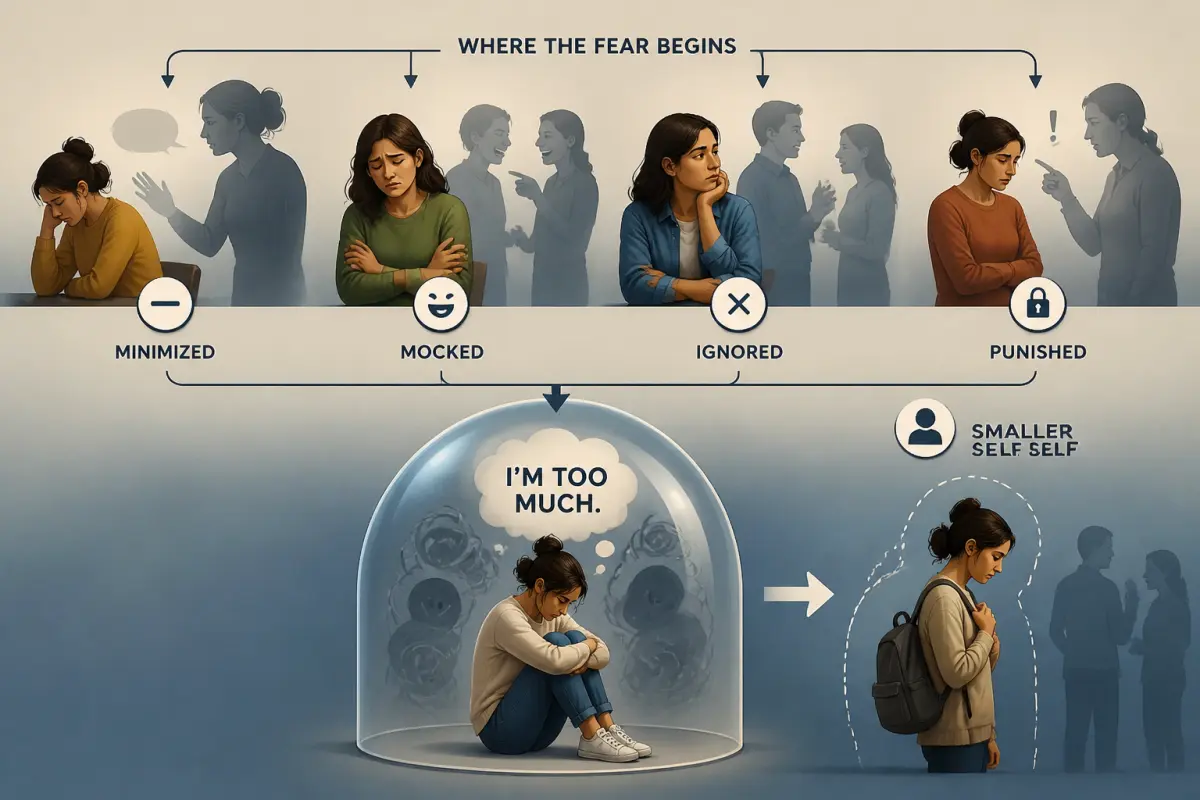
The fear of being too much can begin in many ordinary and painful places. It does not always come from extreme experiences. Sometimes it develops through repeated moments in which your emotional reality was minimized, mocked, ignored, punished, or treated as inconvenient.
For example, you may have grown up around caregivers who were loving in some ways but uncomfortable with strong feelings. Perhaps sadness was met with “do not be so sensitive,” anger was labeled disrespectful, or asking for attention was treated as selfish. Over time, a child can learn that being calm, useful, and agreeable is safer than being honest.
In some families, emotional needs are not rejected directly; they are simply not noticed. A child who repeatedly has to manage alone may become an adult who feels embarrassed by needing comfort. In other families, affection may be inconsistent. Warmth might be available one day and withdrawn the next. This can create a habit of scanning for signs that closeness is about to disappear.
Past friendships and romantic relationships can also shape this fear. If someone called you clingy when you asked for basic communication, accused you of overreacting when you named hurt, or withdrew whenever you expressed disappointment, you may have learned to associate honesty with loss. Even after that relationship ends, your nervous system may still prepare for the same outcome.
Common origins include:
- Emotional minimization: being told your feelings were silly, excessive, or inconvenient.
- Conditional approval: receiving warmth mostly when you were pleasing, successful, quiet, or easy.
- Unpredictable closeness: never knowing whether affection, attention, or patience would be available.
- Role reversal: feeling responsible for other people’s moods at a young age.
- Past rejection: being shamed for wanting reassurance, commitment, consistency, or care.
None of this means you are doomed to repeat the same pattern. It means your fear probably has a history. Once you can see it as a learned protection rather than a personal flaw, it becomes easier to work with it kindly and realistically.
Psychologist’s note: Many people blame themselves for being emotionally “complicated” when they are actually responding to old relational lessons. A useful question is not “Why am I like this?” but “Where did I learn that needing care could cost me connection?” That question creates more room for understanding and change.
It can also help to notice that early lessons about love are often absorbed before we have words for them. You may not remember a specific moment when you decided to become low-maintenance. You may simply recognize the pattern: you feel safer when you ask for less.
How rejection sensitivity strengthens self-doubt
When you fear being too much, you may become highly alert to signs of distance. A delayed reply, a change in tone, a shorter hug, or a distracted expression can start to feel like evidence that you have done something wrong. This is especially true if you are sensitive to perceived rejection, where ambiguous moments are quickly interpreted as emotional danger.
Rejection sensitivity does not mean you are imagining everything. Sometimes people really are distant, careless, or inconsistent. The difficulty is that your mind may move very quickly from “something feels off” to “I am the problem.” That leap can create intense anxiety before you have enough information.
A common inner sequence looks like this:
- You notice a small shift in the other person’s behavior.
- Your body reacts before your thoughts are clear: tight chest, stomach drop, restlessness, urgency.
- You begin searching for what you did wrong.
- You replay recent conversations and judge your words harshly.
- You either over-explain, withdraw, apologize, or seek reassurance urgently.
- Afterward, you feel embarrassed and promise yourself to need less next time.
This cycle strengthens self-doubt because your attention becomes trained on possible evidence against you. You may notice every moment of distance and overlook signs of care. If your partner is tired, you may assume they are losing interest. If a friend is busy, you may assume you have become annoying. If someone sets a normal boundary, you may experience it as proof that your needs were too large.
Over time, the fear of rejection can make your own feelings seem unreliable. You may ask yourself, “Am I upset for a valid reason, or am I just too sensitive?” That question can be useful when asked gently. But when asked with shame, it becomes another way of dismissing yourself.
One practical approach is to slow the interpretation down. Instead of trying to force yourself not to feel anxious, separate observation from meaning:
- Observation: “They replied later than usual.”
- Automatic meaning: “They are annoyed with me.”
- Alternative possibilities: “They may be busy, tired, distracted, or unsure how to respond.”
- Grounded next step: “I can wait, ask directly later, or soothe myself without assuming rejection.”
This does not ask you to ignore your intuition. It asks you to give your intuition more information before treating fear as fact.
The difference between a need and a demand
People who fear being too much often confuse having a need with making a demand. This confusion can make every request feel morally risky. You may think, “If I ask for more communication, am I controlling?” or “If I say I need consistency, am I pressuring them?”
A need is an honest expression of what helps you feel emotionally safe, respected, connected, or cared for. A demand attempts to control another person’s response, choices, or feelings. The difference is not always in the topic; it is often in the stance.
| Relational expression | What it may sound like | Healthy purpose | When it becomes a problem |
|---|---|---|---|
| Need | “I feel more secure when plans are clear.” | To share what supports emotional safety and mutual understanding. | It becomes hidden when you believe you are not allowed to have preferences. |
| Request | “Could we decide by Friday what we are doing this weekend?” | To invite cooperation around a specific behavior. | It becomes ineffective when it is vague, apologetic, or never actually stated. |
| Boundary | “I cannot keep having important conversations when voices are raised.” | To name what you will or will not participate in. | It becomes a threat if it is used to punish rather than protect. |
| Preference | “I like hearing from you during the day, even briefly.” | To let someone know what feels meaningful to you. | It becomes self-erasure when you pretend you do not care. |
| Demand | “You must text me exactly when I want, or you do not love me.” | Usually an attempt to reduce anxiety quickly. | It pressures the other person and makes love feel like compliance. |
| Ultimatum | “If you do not do this right now, I am done.” | Sometimes used when a true limit has been reached. | It becomes harmful when used repeatedly to force reassurance or obedience. |
Many needs are ordinary: reliability, affection, repair after conflict, respect for time, emotional responsiveness, honesty, shared effort, and clarity about commitment. Wanting these things does not automatically make you needy. It makes you someone who is affected by the quality of your relationships.
A helpful test is to ask: “Am I making space for both people’s reality?” A need says, “This matters to me.” A request says, “Would you be willing?” A boundary says, “This is what I can participate in.” A demand says, “You must manage my discomfort exactly the way I want.”
If you tend to silence yourself, you may need practice stating needs before they become urgent. Suppressed needs often come out later as resentment, tears, criticism, or panic. Clear expression earlier in the process is usually kinder to both people.
Signs you are making yourself smaller in relationships
Making yourself smaller means reducing your emotional presence so the relationship feels less at risk. It may look like maturity or flexibility from the outside, but internally it often feels tense, lonely, or resentful. You are not simply choosing your battles; you are abandoning your own experience to preserve approval.
Signs that you may be shrinking yourself include:
- You say “it is fine” before you have checked whether it is actually fine.
- You avoid sharing good news because you do not want to seem attention-seeking.
- You hide disappointment to protect the other person from guilt.
- You ask for very little, then feel hurt that no one notices what you need.
- You edit your personality depending on what seems easiest for the other person.
- You feel anxious after expressing affection, desire, sadness, or frustration.
- You apologize for normal human reactions, such as needing rest, clarity, or comfort.
- You feel proud of being “low-maintenance,” but also secretly unseen.
There is a difference between being considerate and being self-erasing. Consideration might mean choosing a better time for a hard conversation. Self-erasure means deciding the conversation should never happen because the other person might be uncomfortable. Consideration includes your needs in the picture. Self-erasure removes them.
One subtle sign is resentment that feels disproportionate to the current moment. You may feel suddenly angry when someone forgets a small thing, not only because of that event, but because it sits on top of many unspoken accommodations. The relationship may seem peaceful, but only because you are carrying the conflict internally.
Practical distinction: If you often feel calm on the outside and unsettled on the inside, ask whether you are choosing peace or performing peace. Chosen peace usually leaves you feeling grounded. Performed peace often leaves you feeling invisible, tense, or vaguely angry later.
Another sign is that you become overly grateful for basic respect. You may feel touched when someone replies kindly, remembers a plan, or listens without defensiveness. Appreciation is healthy, but if ordinary care feels like a rare gift, it may be worth asking whether you have learned to expect too little.
How the fear affects communication and boundaries
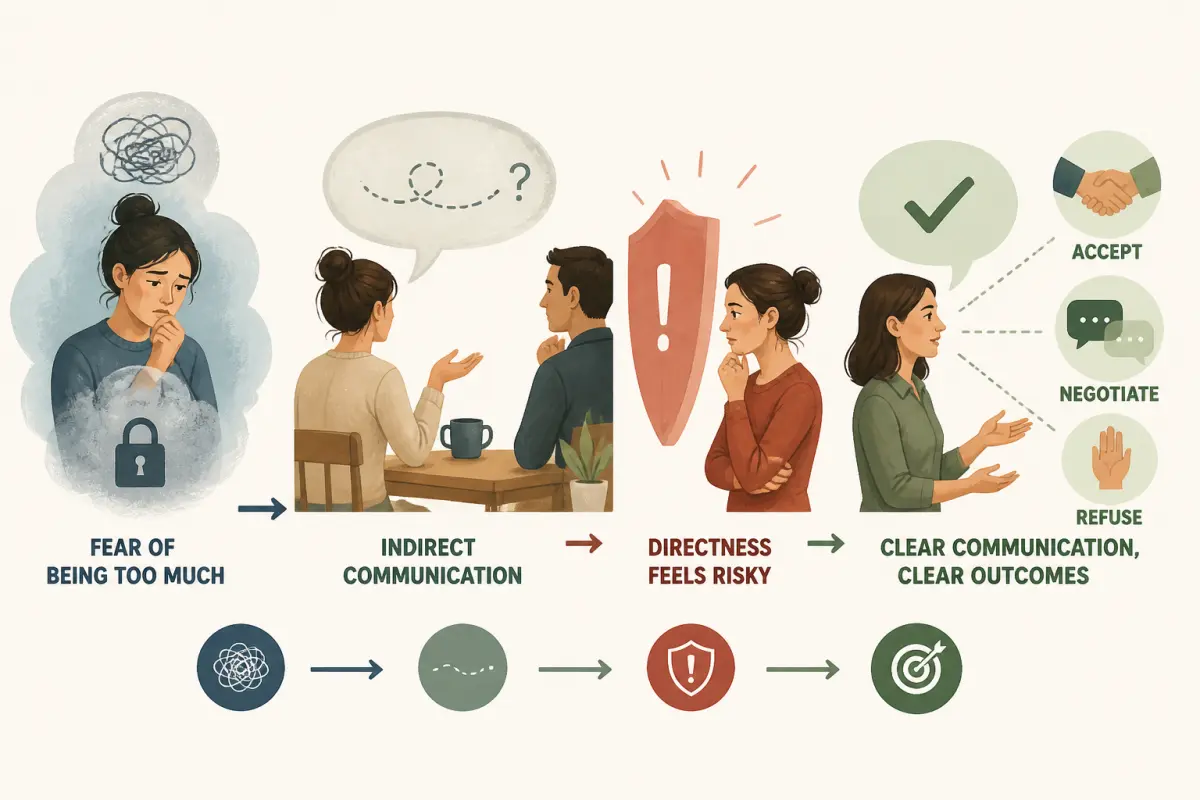
The fear of being too much can make communication indirect. You may hint instead of ask, soften your words until the meaning disappears, or wrap a simple request in long explanations. This often happens because directness feels dangerous. If you clearly state what you want, the other person can clearly accept, negotiate, or refuse it. That possibility may feel exposing.
Common communication patterns include:
- Over-apologizing: “Sorry, this is probably silly, and you do not have to answer, but...”
- Pre-rejecting yourself: “You are probably too busy, so never mind.”
- Testing: hoping the other person will guess what you need without you having to say it.
- Over-explaining: giving a long defense for a reasonable feeling.
- Delayed honesty: saying something is okay, then later becoming upset that it happened.
These patterns are understandable, but they can confuse the relationship. If you present your needs as optional, unimportant, or embarrassing, the other person may not realize how much something matters. If you hide your boundaries until you are overwhelmed, your eventual firmness may come out sharper than intended.
Boundaries are especially affected because boundaries require you to tolerate someone else’s reaction. If you fear being too much, you may treat disappointment, silence, or irritation from the other person as proof that your boundary was wrong. But a boundary can be appropriate even if someone dislikes it.
For example, “I need to sleep instead of continuing this conversation tonight” is not a rejection of the relationship. “I cannot lend money” is not a lack of love. “I need more notice before plans change” is not an attempt to control someone’s entire life. These statements define your limits, not the other person’s worth.
The more you practice clear communication, the less your relationships have to rely on mind-reading. Healthy closeness does not require perfect phrasing. It requires enough honesty that both people can respond to reality rather than guesses.
Why emotionally unavailable partners intensify the pattern
Emotionally unavailable partners can intensify the fear of being too much because they often provide just enough connection to activate hope, but not enough consistency to create security. You may find yourself trying harder to be easy, patient, attractive, understanding, or undemanding, believing that if you get the formula right, they will finally become more present.
This pattern can feel especially powerful when attention is unpredictable. Warmth followed by distance tends to sharpen longing. The mind starts looking for explanations: “Was I too intense?” “Did I ask too soon?” “Should I have waited?” Instead of evaluating whether the relationship meets your needs, you may focus on becoming someone who needs less.
Emotionally unavailable behavior may include avoiding vulnerable conversations, keeping the relationship undefined, withdrawing after intimacy, dismissing your concerns, or offering affection only when you start to pull away. Not every unavailable person is intentionally hurtful. Some people are overwhelmed by closeness, conflict, or emotional responsibility. Still, their limitations affect you.
When one person wants more closeness and the other keeps distance, the dynamic can become a painful form of unequal attachment. The more you reach, the more exposed you feel. The more they withdraw, the more you may question your worth.
This dynamic can also blur into emotional dependence when your sense of stability begins to rely heavily on another person’s availability, mood, or response. That does not mean your attachment is wrong. It means the relationship may be carrying more emotional weight than it can safely hold.
If a partner uses your fear of being too much to control you, shame you, isolate you, threaten abandonment, or make you feel unsafe expressing basic needs, the priority is not to communicate more perfectly. Personal safety, trusted support, and appropriate professional or community resources matter more than preserving the relationship dynamic.
A key question is not only “How can I be less anxious?” but also “Is this relationship structured in a way that keeps me anxious?” Sometimes the fear softens when you build self-trust. Sometimes it softens when you stop trying to get consistent care from someone who repeatedly cannot or will not offer it.
How to express needs without excessive apology
Expressing needs without excessive apology does not mean becoming harsh, entitled, or indifferent to the other person. It means speaking with enough respect for yourself that your message does not collapse before it reaches them.
Excessive apology often appears before any harm has occurred. You may say sorry for asking a question, needing time, wanting clarity, or having a feeling. A genuine apology repairs something. A fear-based apology asks permission to exist.
Instead of beginning with “Sorry, I know I am being annoying,” you might try:
- “I want to check in about something that has been on my mind.”
- “I would like more clarity about our plans.”
- “I felt hurt earlier, and I want to talk about it calmly.”
- “It helps me feel connected when we communicate more directly.”
- “I need some reassurance, and I also want to understand your perspective.”
Notice that these statements are not aggressive. They are simply not self-shaming. They leave room for the other person to respond while making your experience visible.
A useful structure is:
- Name the situation: “When plans change at the last minute...”
- Name the impact: “...I feel unsettled and unsure how to organize my time.”
- Name the need or request: “Could we agree to let each other know earlier when possible?”
- Invite dialogue: “How does that sound to you?”
This approach is direct without being demanding. It avoids the trap of either saying nothing or presenting your need as a crisis.
If you are used to seeking reassurance in anxious bursts, it may help to ask for reassurance in a more grounded way. For example: “I am noticing some anxiety, and I do not want to put it all on you. Could you remind me where we stand, and then I will take some time to settle myself?” This combines connection with self-responsibility.
Useful reframe: Replace “I am sorry I need this” with “Thank you for listening.” The first phrase treats your need as an offense. The second acknowledges the other person’s attention while allowing your need to remain legitimate.
You can still apologize when you have been unkind, unfair, or reactive. The goal is not to remove apology from your relationships. The goal is to stop using apology as an entrance fee for being honest.
Building confidence in your emotional needs
Confidence in your emotional needs develops through repeated experiences of taking yourself seriously. It does not usually arrive as a sudden personality change. It grows when you notice what you feel, name it accurately, express it respectfully, and observe what happens without immediately blaming yourself.
Start by making your needs more specific. “I am too needy” is vague and shaming. “I value consistent communication” is clearer. “I am too sensitive” shuts down reflection. “I feel hurt when conflict is ignored for days” gives you something real to work with.
You can also sort your needs into categories:
- Connection needs: affection, shared time, warmth, emotional presence.
- Clarity needs: honesty, defined expectations, direct communication.
- Respect needs: boundaries, reliability, consideration, follow-through.
- Repair needs: apologies, accountability, willingness to revisit conflict.
- Autonomy needs: personal space, friendships, rest, privacy, independent choices.
Seeing your needs in categories can reduce shame because they become part of ordinary human relating rather than a vague sense of being excessive. Most people need both closeness and space, both reassurance and independence, both tenderness and honesty. The balance varies, but the needs themselves are not strange.
It is also important to watch how people respond when you express yourself. A healthy response is not always immediate agreement. Someone may need time, have a different preference, or offer a compromise. What matters is whether they can engage with your reality respectfully. Dismissal, mockery, chronic defensiveness, or punishment are different from simple disagreement.
If your fear connects strongly to a fear of abandonment, building confidence may involve learning to stay emotionally present with yourself even when another person is temporarily unavailable. This can include grounding your body, contacting supportive friends, journaling what you know to be true, or delaying reactive messages until your nervous system has settled.
Small practices that build self-trust
- Pause before self-blame: When you feel rejected, ask, “What else could be true besides ‘I am too much’?”
- Use clear language: Replace global shame with specific needs, feelings, and requests.
- Track your patterns: Notice whether you become anxious with everyone or mainly with people who are inconsistent.
- Practice tolerating normal discomfort: Let someone be mildly disappointed without immediately reversing your boundary.
- Choose reciprocal relationships: Spend more time with people who can receive your honesty without making you feel burdensome.
Confidence does not mean you will never feel embarrassed after expressing a need. It means embarrassment no longer gets to decide whether the need was valid. You can feel exposed and still be allowed to speak.
Frequently asked questions
Is being afraid of being too much the same as being needy?
No. The fear of being too much is often a fear about how your needs will be received. Being “needy” is a vague label that usually creates shame rather than clarity. It is more useful to ask what the need is, whether it is being expressed respectfully, and whether the relationship has enough capacity for mutual care.
How do I know if my needs are reasonable?
Reasonable needs usually leave room for both people’s humanity. Wanting honesty, consistency, affection, repair after conflict, and respect for boundaries is not excessive. A need becomes harder to work with when it requires another person to constantly manage your emotions, give up their autonomy, or prove love in a rigid and repeated way.
What if someone says I am too much?
Try to understand what they mean before accepting it as truth. Are they saying your communication style felt intense in a specific moment? Are they avoiding accountability by labeling your feelings as excessive? Are your needs incompatible with what they can offer? A painful comment can contain useful information, but it should not automatically become your identity.
Can I ask for reassurance without damaging the relationship?
Yes, reassurance can be healthy when it is honest, occasional, and paired with your own effort to self-soothe. It becomes more strained when reassurance is required constantly, when no answer feels sufficient, or when the other person is expected to remove all uncertainty. A grounded request sounds like, “I am feeling a little insecure today. Could you reassure me, and then I will take care of myself from there?”
Why do I feel guilty after expressing a normal need?
Guilt may appear because your system associates needing something with burdening someone. This can happen even when you expressed yourself respectfully. The guilt does not necessarily mean you did something wrong. It may mean you are practicing a new behavior that conflicts with old rules about being easy, quiet, or self-sufficient.
What should I do if my partner withdraws whenever I bring up feelings?
First, choose a calm time and be specific about the pattern: “When I bring up something emotional and we stop talking for days, I feel alone in the relationship.” If they are willing to reflect and work on it, the pattern may improve. If they repeatedly dismiss, punish, or avoid every emotional conversation, you may need to consider whether the relationship can support the kind of closeness you need.
How can I stop apologizing so much?
Begin by noticing when you apologize before you have caused harm. Replace automatic apologies with clearer phrases such as “I have a question,” “I would like to talk about something,” or “Thank you for hearing me.” Keep genuine apologies for moments when you have acted unfairly, spoken harshly, or crossed a boundary.
Does the right relationship make this fear disappear?
A secure and responsive relationship can help the fear soften, but it may not erase it immediately. Old patterns often continue for a while even with kind people. The difference is that a healthier relationship gives you more room to practice honesty, repair, and self-respect without constantly fearing punishment or abandonment.