Why Consistency Matters More Than Intensity

 Here we consistency in close relationships, why emotional intensity and unpredictable attention can feel compelling, and how they affect attachment. It shows signs of reliable availability, how chemistry can hide mismatch, and how to build steadier trust.
- What consistency means in a close relationship
- Why emotional intensity can feel so compelling
- Consistency versus intermittent closeness
- How unpredictable attention affects attachment
- Signs of reliable emotional availability
- When intense chemistry hides incompatibility
- Why calm connection can initially feel unfamiliar
- Evaluating repeated behavior instead of promises
- Building steadier habits of closeness and trust
- Frequently asked questions
Lasting change usually comes less from dramatic bursts of effort than from the steady choices we repeat when life is ordinary. We often admire intensity because it feels decisive, like the hard workout, the all-night push, or the sudden promise to become someone new. Yet the mind learns through patterns, not grand gestures. Small actions, repeated again and again, build self-trust and make progress feel less like a battle and more like a way of living.
What consistency means in a close relationship
Consistency in a close relationship does not mean being perfectly predictable, always available, or emotionally flawless. Human beings have tired days, distracted moments, changing moods, and competing responsibilities. In real life, consistency means something more practical: a person’s care, respect, and presence remain recognizable over time.
A consistent partner may not answer every message immediately, but they do not leave you chronically guessing where you stand. They may need space after a stressful day, but they come back to the conversation. They may disagree with you, but they do not withdraw affection as punishment. Their behavior forms a pattern you can understand.
This kind of steadiness matters because close relationships are not built only through memorable moments. They are built through repeated experiences: being listened to, being considered, being told the truth, being treated with basic warmth even when life is inconvenient. Over time, those repetitions teach the nervous system that connection is not something that must be constantly earned or protected.
Many people think of emotional closeness as a feeling that appears during deep conversations, physical affection, or intense vulnerability. Those moments can be meaningful, but closeness also depends on what happens afterward. Does the person remain kind when the intensity settles? Do they follow through after expressing affection? Do they show interest when there is no drama to resolve?
Consistency is the ordinary, often quiet evidence that someone’s care is not limited to a mood, a crisis, or a romantic high. It is the difference between being touched by a moment and being supported by a pattern.
For an intelligent adult reader, this distinction is important because intensity can be easy to recognize, while consistency is often noticed only in hindsight. It is visible in small choices: responding with care, repairing misunderstandings, remembering what matters to you, and acting in ways that match stated intentions.
Why emotional intensity can feel so compelling
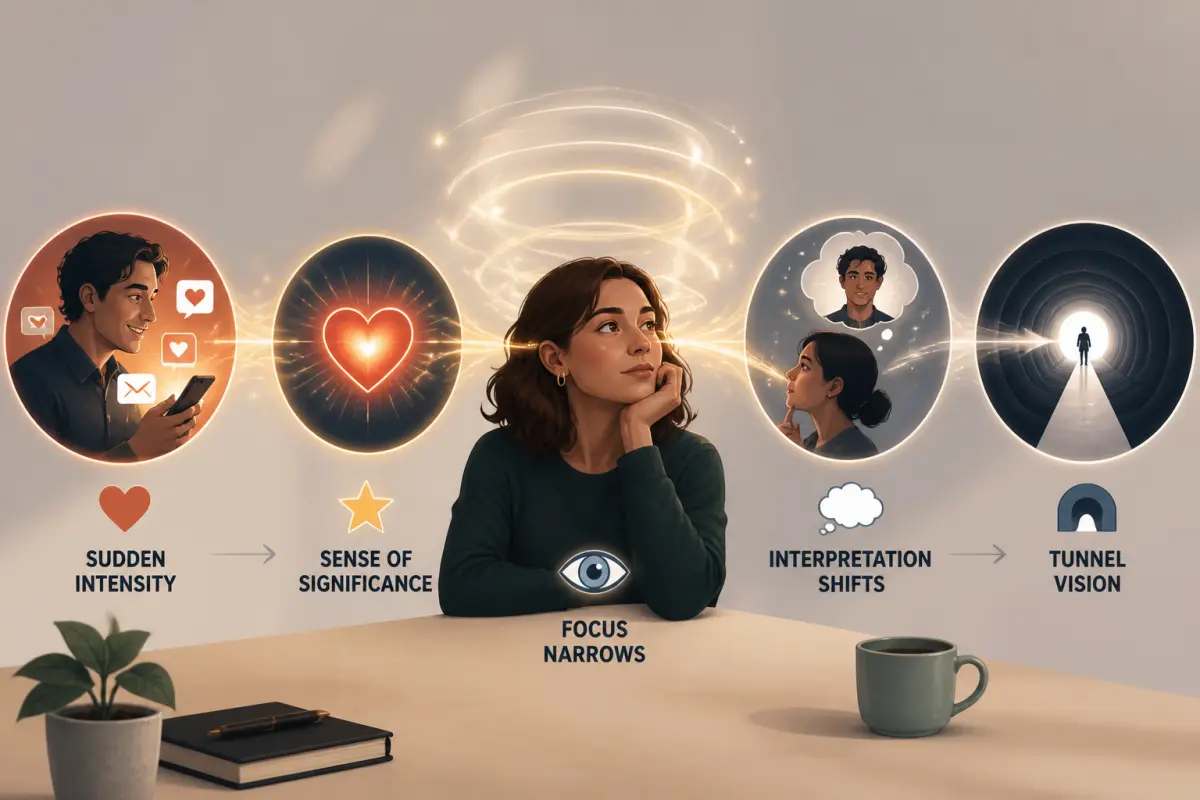
Emotional intensity can feel powerful because it creates a sense of significance. A fast connection, dramatic confession, passionate reunion, or urgent message can make an ordinary day feel charged with meaning. It can seem as if something rare is happening, something that deserves attention and perhaps even sacrifice.
Intensity also narrows focus. When a person gives you sudden affection, strong admiration, or deep disclosure, your attention may move quickly toward them. You may begin to interpret the force of the feeling as proof of compatibility. The mind often says, “If this feels so strong, it must matter.” Sometimes it does matter. But strength of feeling is not the same as reliability, kindness, or readiness for a healthy relationship.
Part of the appeal comes from contrast. If someone is warm one day and distant the next, the warm moments may feel more valuable because they are not guaranteed. A message after silence can feel more thrilling than steady communication because it relieves tension. A reunion after conflict can feel like proof of love, even if the same conflict keeps returning.
This is one reason relationship uncertainty can feel so intense. The uncertainty itself keeps the mind engaged. You may analyze tone, timing, word choice, and small changes in behavior. The relationship becomes not only a connection but also a puzzle.
Intensity can also be compelling because it may temporarily answer emotional needs that have been waiting for attention. Being strongly desired can soothe insecurity. Being pursued can feel validating. Being told “I have never felt this way before” can create a sense of being uniquely seen. These experiences are not wrong to enjoy. The difficulty begins when their emotional force is used as evidence that the relationship is safe, even before enough time has passed to observe the person’s character and habits.
A calm way to think about intensity is this: it gives you information about chemistry, longing, attraction, timing, and emotional activation. It does not, by itself, give you enough information about trustworthiness.
Consistency versus intermittent closeness
Intermittent closeness is connection that appears strongly, then disappears or becomes uncertain. It may include affectionate messages followed by days of distance, deep conversations followed by emotional avoidance, or promises of change followed by the same old pattern. The difficulty is not that someone occasionally needs space. The difficulty is that closeness becomes unpredictable enough that you start monitoring it.
Consistency, by contrast, does not require constant contact. It requires coherence. The person’s behavior makes enough sense over time that you do not have to live in a state of emotional investigation. You may miss them when they are busy, but you are not regularly left wondering whether the relationship still exists in the same way.
| Relational pattern | How it often feels in daily life | What it tends to teach over time |
|---|---|---|
| Steady communication | You do not need constant reassurance because responses are generally respectful and understandable. | Availability can be trusted without being tested repeatedly. |
| Warmth after disagreement | Conflict is uncomfortable, but it does not feel like the entire bond is at risk. | Difference does not have to mean abandonment or punishment. |
| Intermittent affection | Affection feels wonderful when it arrives, but you may become anxious about when it will disappear. | Closeness feels conditional, fragile, or dependent on mood. |
| Unclear intentions | You spend energy interpreting hints instead of receiving direct communication. | Ambiguity becomes normal, even when it is emotionally costly. |
| Repeated repair | Mistakes are acknowledged, discussed, and followed by changed behavior. | Trust can grow because accountability is observable. |
| Repeated rupture without repair | The same hurtful cycle returns, often followed by apologies or affection that do not change the pattern. | Words become less reassuring because experience contradicts them. |
| Respect for ordinary needs | Your sleep, work, friendships, and personal boundaries are treated as part of your life, not as threats. | Love does not require self-neglect. |
Intermittent closeness can be especially confusing because it often contains real warmth. The affectionate moments may not be fake. The person may genuinely feel close when they feel close. But a relationship is shaped by the whole pattern, not only by the most moving moments inside it.
It can help to ask: “Do I feel more secure as time passes, or more preoccupied?” This question moves attention away from isolated highs and toward the lived effect of the relationship.
If unpredictability includes intimidation, threats, coercion, humiliation, monitoring, forced isolation, or fear of how the other person will react, the issue is not simply inconsistency. Personal safety and appropriate support take priority. A relationship should not require you to manage another person’s volatility in order to stay emotionally or physically safe.
How unpredictable attention affects attachment
Unpredictable attention can make attachment feel more urgent. When someone is sometimes deeply available and sometimes absent, your mind may become highly alert to signs of change. You may notice how quickly they reply, whether their tone is warmer or colder, whether they initiate plans, or whether they seem distracted. These observations may feel necessary because the relationship does not provide enough steady reassurance through behavior.
This does not mean you are weak or irrational. Human attention naturally turns toward uncertainty. If a person’s care feels inconsistent, the mind tries to predict what will happen next. It looks for clues, patterns, and explanations. The problem is that this effort can become exhausting, especially when the other person’s behavior remains unclear no matter how carefully you analyze it.
Unpredictable attention can also intensify longing. When closeness returns after distance, the relief can be mistaken for deep compatibility. The body relaxes, the mind feels rewarded, and the relationship may seem suddenly worth all the worry. But relief is not the same as peace. Relief means tension has temporarily dropped. Peace means the relationship does not repeatedly create the same tension in the first place.
In many relationships, the pattern of pulling away becomes central to the emotional rhythm. One person moves closer, the other withdraws, and then the first person may pursue harder, become quieter, or try to prove they are not too much. Over time, the relationship can become organized around managing distance rather than enjoying contact.
A useful everyday sign is how you behave when you are not with the person. Do you feel able to return to your own life, or do you feel suspended, waiting for the next signal? Do you feel basically valued, or do you feel you must solve the relationship every few days? The effect on your attention often reveals more than the intensity of the last conversation.
Practical distinction: Missing someone is not the same as being emotionally destabilized by them. Missing a reliable person usually has softness in it; you can want contact while still feeling grounded. Being destabilized often feels more urgent and consuming, as if your sense of being valued depends on the next response.
Signs of reliable emotional availability
Reliable emotional availability is not measured by grand declarations. It is shown through repeated responses to ordinary relational needs. A person who is emotionally available can usually remain connected without making every need feel like a burden or every disagreement feel like a threat.
Some signs are subtle. They remember what you have told them. They ask follow-up questions. They can hear disappointment without immediately attacking, disappearing, or turning the conversation entirely toward themselves. They do not need to be in a perfect mood to treat you with consideration.
Other signs are more concrete:
- They follow through on reasonable commitments. If they say they will call, make plans, or revisit a conversation, they generally do.
- They communicate changes instead of leaving you to guess. A delay, a stressful week, or a need for quiet is named rather than acted out through unexplained distance.
- They can repair small injuries. They are able to say, “I see why that hurt,” without making you prove your right to feel affected.
- They respect boundaries without treating them as rejection. Your need for rest, time, privacy, or a slower pace is not framed as betrayal.
- They show care outside emotionally heightened moments. Their kindness is present in ordinary routines, not only during conflict, seduction, or apology.
- They are curious about your inner world. They do not assume that closeness means you should automatically think, feel, or want the same things.
Reliable availability also includes emotional proportion. A steady person does not make every disappointment enormous. They can distinguish between a solvable misunderstanding and a major relational crisis. This helps both people feel less afraid of normal friction.
It is worth noting that emotionally available people still have limits. They may need time before responding thoughtfully. They may be stressed, distracted, or unsure. The difference is that their limits are communicated with respect. Their need for space does not require you to tolerate confusion, contempt, or emotional whiplash.
When intense chemistry hides incompatibility

Chemistry can be real and still not be enough. Two people may feel strongly drawn to each other while wanting very different things, handling conflict in incompatible ways, or having life structures that do not support the relationship they imagine. Attraction can open a door, but it cannot do the work of shared values, emotional maturity, timing, and mutual willingness.
Intense chemistry often highlights what is exciting. It may not reveal what is sustainable. In the beginning, difference can even feel intriguing: one person is spontaneous, the other grounded; one is private, the other expressive; one wants closeness quickly, the other prefers independence. Sometimes these differences become complementary. Other times they become the very places where repeated hurt develops.
Incompatibility is not always dramatic. It may look like one person wanting regular communication while the other experiences that as pressure. It may look like one person needing direct repair after conflict while the other prefers to move on without discussion. It may look like different expectations around money, family, parenting, work, social life, or exclusivity.
Because chemistry can be so absorbing, people sometimes postpone practical questions. They may think, “If we feel this much, surely we can work it out.” Sometimes they can. But the ability to work something out depends on behavior: honesty, flexibility, humility, and mutual effort. Feeling strongly does not automatically create those qualities.
A helpful question is not only “Do I feel drawn to this person?” but also “Does being close to this person support the kind of life and self-respect I want to maintain?” That question is not cold or unromantic. It protects love from being asked to survive on intensity alone.
Author’s observation: Strong chemistry can make people unusually generous with explanations. They may explain away inconsistency as stress, fear, past hurt, or bad timing. Compassion is valuable, but it becomes costly when it consistently overrides evidence. Understanding why someone behaves a certain way does not mean the behavior is workable for you.
Why calm connection can initially feel unfamiliar
Calm connection can feel unfamiliar, especially if past relationships taught you to associate love with urgency, pursuit, jealousy, dramatic repair, or emotional highs and lows. When a steadier person shows interest without creating suspense, the relationship may initially seem less exciting. You may even wonder whether something is missing.
This reaction does not necessarily mean the connection lacks depth. It may mean your system is accustomed to activation. If closeness has often arrived with uncertainty, your mind may expect love to feel like anticipation, tension, and relief. A calm relationship can then feel strangely quiet, not because it is empty, but because it is not constantly triggering the need to secure it.
Some people describe steady affection as “too easy” or “not intense enough.” It can be useful to pause before accepting that interpretation. Ease may be unfamiliar if you have spent a long time in relationships where you had to interpret mixed signals, manage someone’s moods, or prove your worth. The absence of anxiety can be mistaken for the absence of attraction.
Of course, calm is not automatically compatibility. A relationship can be peaceful but lack mutual interest, shared values, or physical attraction. The point is not to force yourself to choose anyone simply because they are steady. The point is to give calm connection enough time to show whether it contains warmth, curiosity, humor, respect, and desire that grow rather than explode.
One practical way to evaluate calm connection is to notice how you feel after spending time together. Do you feel more like yourself? Do you feel respected? Do you feel free to speak honestly? Do you feel your body settling rather than bracing? These quieter signals may not be as dramatic as longing, but they often carry important information.
Evaluating repeated behavior instead of promises
Promises matter most when they are followed by behavior. A sincere apology, a loving statement, or a future plan can be meaningful, but it should not be treated as the same thing as change. Repeated behavior is where intentions become visible.
Many people stay attached to potential. They remember the person’s best moments, their tenderness, their insight, their explanation of why things will be different next time. Hope can be generous and human. But hope becomes painful when it repeatedly asks you to ignore the pattern you are living in.
Evaluating repeated behavior means slowing down enough to see what happens across time, especially after conversations about needs. Does the person become more responsive for two days and then return to the old pattern? Do they apologize beautifully but avoid concrete change? Do they agree in the moment, then behave as if the conversation never happened?
Looking at long-term patterns is not pessimistic. It is a mature way of respecting reality. Relationships become safer when both people can tell the truth about what is actually happening, not only what they wish were happening.
Consider these questions when trying to separate promises from patterns:
- When this person says they understand, what changes afterward?
- Are improvements sustained, or do they appear mainly when they fear losing the relationship?
- Can they name their part without shifting all responsibility back to you?
- Do you feel freer to express needs over time, or more careful and edited?
- Does the relationship require repeated emotional arguments to achieve basic consideration?
- Are you making decisions based on who they are consistently, or who they occasionally become?
This kind of evaluation can feel uncomfortable because it may challenge a preferred story. But it can also bring relief. You no longer have to debate every incident separately. You can ask what the pattern is asking of you, and whether that pattern is compatible with your wellbeing.
Building steadier habits of closeness and trust
Consistency is not only something to look for in another person. It is also something two people can practice together. Steadier closeness grows through habits that make the relationship more understandable, more respectful, and less dependent on emotional extremes.
One important habit is clear communication about availability. This does not mean reporting every movement or eliminating privacy. It means not using silence as a substitute for honesty. A simple “I’m overwhelmed today, but I want to talk tomorrow” can prevent unnecessary anxiety. It gives the other person information without requiring them to guess.
Another habit is repairing quickly enough that distance does not harden into resentment. Repair does not require one person to surrender their perspective. It requires both people to care about the effect of the interaction. “I did not mean it that way” may be true, but repair often begins with “I can see how it landed that way.”
Steadier relationships also protect ordinary life. They do not demand that closeness consume every other source of meaning. Friendships, work, solitude, health, creativity, and family responsibilities all need room. A relationship becomes more secure when love is integrated into life rather than used to replace it.
If you are interested in building trust, pay attention to small agreements. Trust often grows less from dramatic proof and more from repeated alignment: saying what you mean, doing what you said, admitting when you cannot, and returning to the conversation when something has gone wrong.
Practical habits that support steadiness include:
- Use specific requests. “Can we plan our next conversation before we end this one?” is easier to respond to than “You never make me feel secure.”
- Separate reassurance from control. It is reasonable to ask for clarity; it is not healthy to require constant proof that eliminates all uncertainty.
- Notice repair, not just apology. A good apology acknowledges impact and leads to different behavior.
- Keep your own routines intact. Stability inside yourself makes it easier to evaluate the relationship without becoming consumed by it.
- Discuss pacing openly. People often differ in how quickly they want contact, commitment, or vulnerability. Naming this reduces unnecessary interpretation.
- Make room for ordinary affection. Warmth in daily life matters as much as intensity during emotional peaks.
Building steadier closeness does not mean removing passion. It means creating a foundation where passion does not have to compensate for fear. When trust is present, intensity can become an addition to the relationship rather than the only thing holding it together.
Frequently asked questions
Can a relationship be consistent but still lack passion?
Yes. Consistency is important, but it is not the only ingredient in a fulfilling relationship. A partnership can be respectful and reliable while still lacking attraction, playfulness, shared values, or emotional depth. The goal is not to choose calmness instead of aliveness. The goal is to recognize that aliveness is more sustainable when it exists alongside respect, follow-through, and emotional safety.
Does intensity always mean a relationship is unhealthy?
No. Intensity is not automatically unhealthy. Many meaningful relationships include strong attraction, deep emotion, and powerful moments of connection. The important question is what surrounds the intensity. Is there honesty? Is there care after conflict? Is there respect for boundaries? Does the relationship become more stable over time, or does it rely on repeated highs and lows to feel alive?
What if I feel bored with someone who treats me well?
Boredom can mean different things. It may mean there is not enough attraction or compatibility. It may also mean you are not used to connection that does not activate anxiety. Give yourself time to distinguish between genuine lack of interest and unfamiliar calm. Notice whether curiosity, warmth, humor, and comfort grow when you stop looking for dramatic signals.
How long does it take to know whether someone is consistent?
There is no exact timeline, but consistency requires repeated observation. It is easier to see after ordinary life has had a chance to happen: stress, scheduling problems, disagreement, disappointment, and changing moods. Early intensity can reveal attraction quickly, but reliability usually becomes clearer through time and context.
Can someone become more consistent if they really want to?
Sometimes, yes. People can grow when they are willing to notice their behavior, take responsibility, communicate more clearly, and practice different habits. The key is whether change becomes visible and sustained. A person’s desire to improve matters, but the relationship is affected by what they repeatedly do, not only by what they intend.
How can I tell whether I am asking for consistency or too much reassurance?
A request for consistency usually asks for clear, respectful behavior: follow-through, honest communication, repair, and basic consideration. A need for constant reassurance may seek repeated proof that no amount of evidence can satisfy. Many people experience both at times. A useful question is: “Am I asking for reasonable clarity, or am I trying to eliminate all uncertainty?” Healthy relationships can offer reassurance, but they cannot remove every possible fear.
What should I do if I recognize a pattern of intermittent closeness?
Start by naming the pattern to yourself without minimizing it. Then consider whether the other person can discuss it openly and participate in changing it. Look for sustained behavior, not only emotional conversations. If the pattern leaves you anxious, diminished, or afraid to express normal needs, it may be important to step back, seek support, and make decisions based on your wellbeing rather than the strongest moments of connection.