Why Chronic Emotional Pressure Can Lead to Emotional Numbness

 Explains how chronic pressure builds up emotionally, how constant adaptation narrows your emotional range, and how endurance can turn into shutdown. Covers how pressure mutes self-expression and needs, why relief may not bring feelings back fast, and steps to reduce pressure and relearn emotions sustainably.
- How chronic pressure accumulates emotionally
- Why constant adaptation reduces emotional range
- The difference between endurance and shutdown
- How pressure affects self-expression and needs
- Why relief doesn’t always restore feelings immediately
- Reducing pressure sources without drastic changes
- Relearning emotional responsiveness step by step
- How to keep progress sustainable over time
When stress and emotional strain last for months, they can quietly numb your feelings and make life seem flat. You may still manage work, family, and daily tasks, but notice smaller reactions, muted joy, and sadness that feels far away. This is not laziness or a sudden personality shift; it is your mind conserving energy after staying on high alert for too long.
How chronic pressure accumulates emotionally
Emotional strain rarely arrives all at once. More often, it builds through small, repeated demands that leave little room to reset. When the mind is constantly tracking what needs to be done, what might go wrong, or who might be disappointed, feelings can shift from clear signals into background noise.
This buildup tends to happen in predictable layers: stressors stack, recovery time shrinks, and the nervous system stays on alert. Over time, people may still function on the outside while feeling less connected to what they feel on the inside.
- Ongoing “low-grade” stress becomes the baseline. Deadlines, money worries, caregiving, conflict, or health concerns can be manageable individually. When they persist, the body treats them as normal, even if they are draining.
- Unfinished emotional moments pile up. Small disappointments, awkward interactions, and unspoken frustrations often get pushed aside to keep moving. Without processing, they remain mentally “open,” adding weight to the next situation.
- Attention narrows to problem-solving. Under pressure, it’s common to focus on tasks, logistics, and preventing mistakes. This can reduce awareness of subtler feelings like sadness, pride, or tenderness because they seem less urgent.
- Rest stops feeling restorative. People may take breaks but spend them scrolling, worrying, or replaying conversations. The body is technically off-duty, but the mind stays engaged, so recovery is incomplete.
- Emotions start to feel inconvenient or risky. If showing feelings has led to conflict, criticism, or more responsibilities, it can seem safer to stay neutral. Over time, “staying steady” can turn into not feeling much at all.
- Relief gets replaced by numbness. When stress is constant, the system may dampen emotional intensity to keep functioning. This can look like reduced excitement, muted joy, or a sense of distance from things that used to matter.
| Common pattern | How it adds pressure over time | What it can look like day to day |
|---|---|---|
| Constant responsibility | There is no clear “off” switch, so the mind stays in monitoring mode. | Feeling guilty when resting; always thinking about the next task. |
| Avoiding conflict or difficult feelings | Short-term peace comes at the cost of long-term emotional backlog. | Agreeing outwardly while feeling disconnected or quietly resentful. |
| High self-criticism | Internal pressure continues even when external demands ease. | Downplaying achievements; feeling tense after minor mistakes. |
| Irregular recovery | Sleep, downtime, and enjoyment become inconsistent, so stress never fully clears. | Waking tired; needing more stimulation to feel anything. |
| Emotional overexposure | Too much news, drama, or others’ needs can overwhelm emotional capacity. | Feeling “full” emotionally; wanting to withdraw from conversations. |
As pressure accumulates, emotional signals can become harder to read. Instead of clear reactions, people may notice irritability, emptiness, or a sense of going through the motions. This isn’t a character flaw; it’s often a sign that the system has been asked to carry too much for too long without enough relief or processing time.
Why constant adaptation reduces emotional range
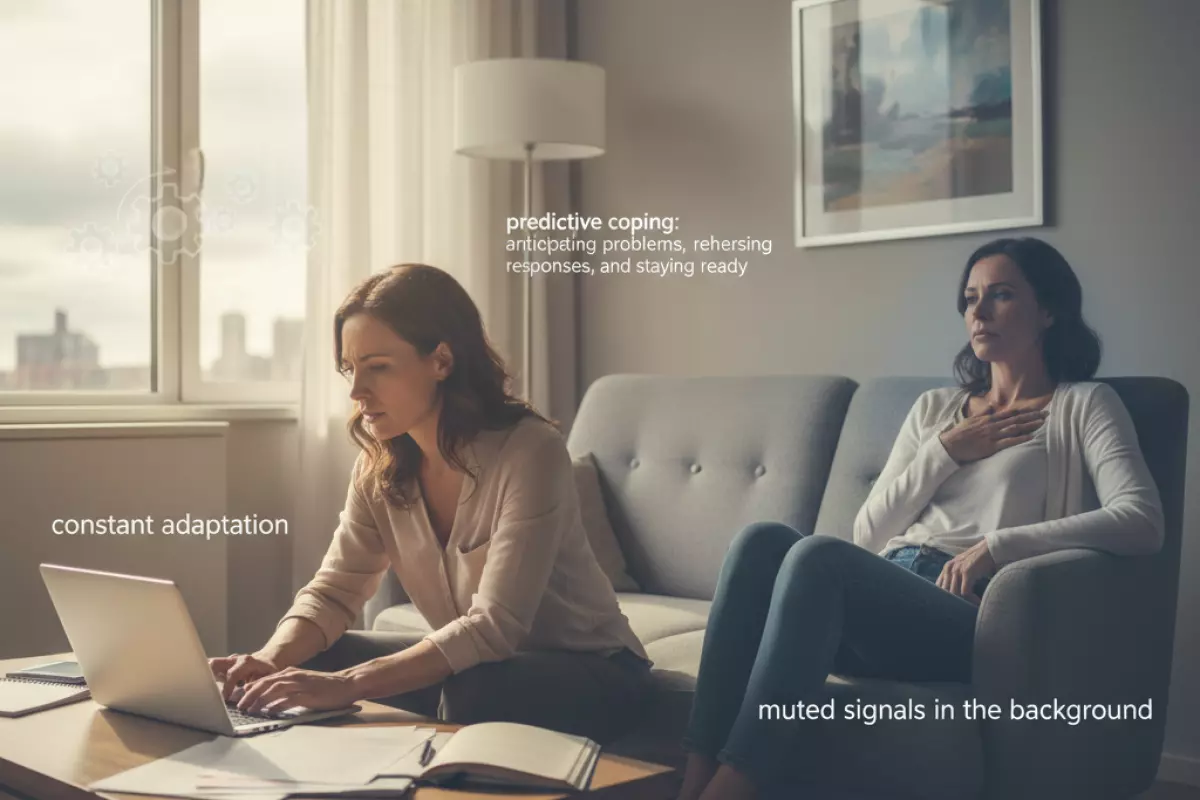
When life keeps demanding quick adjustments, the mind often shifts into a “manage and move on” mode. That can be useful in the moment, but over time it trains attention to focus on what needs fixing rather than what is being felt. Emotions still happen, yet they may register as muted signals in the background because mental energy is spent scanning for the next demand.
A big part of this narrowing comes from predictive coping: anticipating problems, rehearsing responses, and staying ready. If this becomes the default setting, feelings that don’t help with immediate functioning—like joy, curiosity, tenderness, or even ordinary sadness—get less room. The result is often a smaller emotional “palette,” where experiences feel flatter or more neutral than expected.
- Constant monitoring crowds out reflection. When attention is always on what could go wrong, there’s less capacity to notice subtle shifts in mood and meaning.
- Emotional signals get treated like distractions. Stress, irritation, or worry may be allowed because they feel “useful,” while softer emotions are pushed aside to stay efficient.
- Switching roles reduces authenticity. Adapting to different expectations at work, home, and socially can lead to performing the “right” response instead of sensing the true one.
- Micro-recoveries disappear. Small pauses that normally reset the nervous system—daydreaming, lingering enjoyment, quiet processing—are replaced by the next task.
- Repeated suppression becomes automatic. If feelings are routinely postponed (“later”), the brain learns not to surface them as strongly, which can look like emotional dullness.
- High baseline tension makes everything feel the same. When the body stays slightly activated, it can be harder to distinguish excitement from anxiety, or calm from emptiness.
| Everyday adaptation pattern | What it teaches the brain to prioritize | Common effect on emotional experience |
|---|---|---|
| Always being “on call” (messages, requests, interruptions) | Rapid response and availability | Less access to slower feelings like contentment or grief; more emotional blunting |
| Frequent context switching (work to family to errands) | Task completion over internal cues | Harder to name feelings; moods feel vague or “numb” |
| Walking on eggshells around conflict | Safety through self-editing | Reduced spontaneity; muted joy and muted anger alike |
| Optimizing everything (productivity, routines, self-improvement) | Control and efficiency | Pleasure feels less satisfying; achievements feel strangely empty |
Over time, this kind of constant adjustment can create a practical but limited emotional style: fewer peaks, fewer lows, and more “fine” or “whatever” days. It isn’t that feelings disappear; it’s that the system learns to keep them small so daily functioning stays possible under ongoing pressure.
The difference between endurance and shutdown
One common confusion is mixing up “pushing through” with going emotionally offline. Both can happen under long-term stress, but they look and feel different in daily life. Endurance is an active effort to keep functioning despite pressure. Shutdown is a protective drop in emotional responsiveness when the system is overloaded.
Endurance usually still includes a sense of purpose and some emotional range, even if it’s muted. A person may feel tired, worried, or irritable, but they can still connect, care, and react. Shutdown tends to narrow that range much further. Instead of feeling “too much,” someone may feel almost nothing, or they may notice a blank, distant quality that’s hard to shift.
| What you might notice | Endurance (staying engaged) | Shutdown (going numb) |
|---|---|---|
| Energy and effort | High effort to keep up; “I can do this, but it’s hard.” | Low drive; “I can’t access the energy to care or try.” |
| Emotional signals | Feelings are present (stress, frustration, sadness), even if controlled. | Feelings feel distant, flat, or delayed; reactions may seem absent. |
| Thinking style | Problem-solving stays online, though it may be rigid or hurried. | Foggy or detached thinking; decisions feel unreal or “not mine.” |
| Social behavior | Still shows up, responds, and tries to maintain relationships. | Withdraws, goes quiet, avoids messages, or “disappears” emotionally while present. |
| Body cues | Tension, restlessness, headaches, shallow breathing. | Heaviness, slowed movement, blank stare, numbness, or a sense of floating. |
| After the pressure eases | Relief is noticeable; emotions rebound with rest. | Relief may not register; numbness can linger even when things calm down. |
In everyday patterns, endurance often shows up as over-functioning: taking on tasks, staying busy, and relying on routines to keep control. Shutdown more often shows up as under-functioning: procrastination, missed calls, staring at a screen, or doing the minimum with little emotional engagement.
Both responses can be “adaptive” in the short term. Endurance helps a person meet demands when there’s no immediate alternative. Shutdown reduces emotional input when the mind and body interpret ongoing strain as too much to process. Over time, though, shutdown can blend into emotional numbness, where disconnection becomes the default rather than a temporary state.
- Endurance tends to signal strain with discomfort. The person knows they’re stressed and can usually name what’s wrong.
- Shutdown tends to signal strain with absence. The person may say “I’m fine” while feeling empty, distant, or indifferent.
- Endurance often responds to rest. Sleep, downtime, and support can restore feeling and motivation.
- Shutdown often needs reduced load plus reconnection. Lowering demands helps, but so does gently rebuilding emotional contact through safe interactions and manageable choices.
How pressure affects self-expression and needs
When life feels like a constant demand to perform, keep the peace, or “hold it together,” people often start editing themselves. The goal shifts from being understood to avoiding trouble, disappointment, or extra work. Over time, this can make everyday communication feel risky, so self-expression becomes smaller, safer, and more automatic.
Chronic emotional pressure also changes how needs are recognized. Instead of noticing hunger, rest, comfort, or connection as valid signals, the mind may treat them as distractions. A person can look “fine” on the outside while internally running on a narrow set of acceptable feelings and behaviors.
- Self-censorship becomes a habit. People may share fewer opinions, soften their tone, or avoid topics that could lead to conflict. This can show up as saying “It’s nothing” or “Whatever you want” even when something matters.
- Needs get postponed until they disappear. Rest, boundaries, and emotional support are delayed because there is always something more urgent. Eventually, it can become hard to tell what would actually help.
- Emotions are translated into tasks. Instead of “I feel overwhelmed,” the person focuses on fixing, organizing, or problem-solving. Doing replaces feeling because it seems more controllable.
- People-pleasing replaces honest preference. Choices are guided by what will keep others calm or satisfied, not by genuine interest. This can lead to a vague sense of living on autopilot.
- Boundaries feel “mean” or unsafe. Saying no may trigger guilt or fear of backlash, so limits are avoided. The short-term relief of compliance can reinforce the pattern.
- Physical signals become the main alarm system. When emotional cues are ignored, the body often carries the message through headaches, tightness, fatigue, stomach issues, or trouble sleeping.
| Pressure pattern | Common behavior shift | What gets lost |
|---|---|---|
| Fear of conflict or criticism | Avoiding difficult conversations; keeping responses neutral | Clear preferences, honest feedback, emotional closeness |
| High responsibility without recovery time | Staying “productive” even when exhausted | Rest, play, patience, stable mood |
| Unpredictable reactions from others | Scanning for cues; adjusting personality by situation | Consistency, spontaneity, sense of safety |
| Being valued mainly for results | Over-functioning; measuring worth by output | Self-worth not tied to performance; room for mistakes |
| Repeated dismissal of feelings | Minimizing emotions; “I’m fine” reflex | Accurate self-awareness; ability to ask for support |
As these patterns repeat, self-expression can feel less like sharing and more like managing reactions. Needs may still exist, but they get filtered through questions like “Is this allowed?” or “Will this cause problems?” That narrowing is one pathway by which emotional pressure can contribute to numbness: fewer feelings are acknowledged, fewer needs are voiced, and the inner world becomes quieter over time.
Why relief doesn’t always restore feelings immediately

When ongoing stress finally eases, the emotional system often stays in “protective mode” for a while. Numbness can be a learned short-term strategy: if feeling everything was overwhelming for months, the mind and body may keep the volume turned down even after the pressure drops.
Relief also tends to remove the immediate threat faster than it rebuilds the capacity to feel. Many people expect an instant return of warmth, joy, or motivation, but recovery is usually gradual because the nervous system needs repeated signals of safety before it shifts out of shutdown.
- The body lags behind the calendar. A stressful situation can end on a specific date, but stress hormones, muscle tension, sleep debt, and hypervigilance can take longer to settle. Until the body calms, emotions may still feel muted or distant.
- Emotional “re-entry” can be uncomfortable. Once there is space to feel again, buried sadness, anger, or grief may surface. To avoid that surge, people may stay detached without realizing it, choosing neutrality over a flood of feelings.
- Habits of suppression don’t switch off instantly. During chronic emotional pressure, many people practice pushing feelings aside to function at work, at home, or in caregiving roles. That pattern can become automatic, so even positive moments don’t fully register at first.
- Trust takes time to rebuild. If life has been unpredictable, the mind may keep scanning for the next problem. This “waiting for the other shoe to drop” mindset can block enjoyment and make calm feel unfamiliar.
- Identity can get stuck in survival mode. When routines revolve around coping, there may be a temporary emptiness after things improve: fewer urgent tasks, fewer distractions, and less adrenaline. That can be mistaken for depression or a lack of personality, when it is often a transition period.
- Connection may need rebuilding. Emotional numbness can reduce sharing, affection, and social energy. Even after stress lifts, relationships might still feel flat until communication, play, and closeness are practiced again.
| What relief changes quickly | What often changes slowly |
|---|---|
| Fewer immediate demands and crises | Baseline nervous system arousal and startle response |
| More free time and fewer urgent decisions | Ability to notice and name emotions in real time |
| Reduced conflict or external pressure | Comfort with calm, stillness, and “nothing to fix” moments |
| Practical stability (schedule, finances, workload) | Return of pleasure, motivation, and felt connection with others |
A slow return of feelings is usually a sign of adjustment, not failure. With consistent rest, predictable routines, and low-stakes positive experiences, emotional responsiveness often comes back in layers rather than all at once.
Reducing pressure sources without drastic changes
Lowering day-to-day strain often works best when it targets the specific situations that keep the nervous system on alert, rather than trying to overhaul life all at once. Chronic emotional pressure tends to build through repeated patterns: unclear expectations, constant availability, unfinished tasks, and environments where there is little recovery time.
A practical approach is to identify where pressure is coming from, then make small adjustments that reduce intensity or frequency. These changes are usually more sustainable because they fit typical routines and social expectations, and they create “breathing room” that helps feelings become easier to notice again.
| Common pressure source | What it looks like in everyday life | Small change that reduces the load |
|---|---|---|
| Unclear expectations | Vague requests, shifting priorities, guessing what others want | Ask for one concrete outcome and a deadline; summarize agreements in one sentence |
| Constant availability | Replying immediately, being “on call,” checking messages repeatedly | Set two or three check-in windows; use brief status updates instead of real-time back-and-forth |
| Overcommitment | Saying yes by default, stacking obligations with no buffer | Delay commitments (“Let me confirm by tomorrow”); cap weekly nonessential tasks |
| Unfinished task loops | Many open tabs, lingering chores, mental replay of what is not done | Create a short “closeout” list (3 items max); park the rest on a trusted list to revisit later |
| High-conflict interactions | Frequent criticism, defensiveness, repeated arguments with no resolution | Limit time in the hottest topics; move discussions to a set time and end with next steps |
| Low recovery time | Working through breaks, scrolling late, no transition between roles | Add short transitions (5–10 minutes) between tasks; protect one wind-down routine before sleep |
- Reduce intensity before reducing volume. If responsibilities cannot change, lowering emotional friction can still help. Examples include simplifying communication, using templates, or limiting how many decisions must be made in a day.
- Separate “urgent” from “important.” A common pressure pattern is treating every request as time-sensitive. Choosing one daily priority and one “must-respond” channel can prevent constant activation.
- Use boundaries that sound normal in conversation. Clear, brief phrases tend to create less pushback than long explanations. For example: “I can look at this after 3,” or “I can do A or B, not both.”
- Build predictable recovery points. Emotional numbness often follows long stretches with no downshift. Regular pauses, even short ones, teach the body that it is allowed to come out of defense mode.
These adjustments are not about avoiding responsibility; they are about lowering the ongoing pressure that keeps emotions muted. When strain becomes more manageable, people often notice a gradual return of signals like irritation, sadness, or relief, which can be useful information rather than something to suppress.
Relearning emotional responsiveness step by step
When emotional numbness has become a habit, the goal is usually not to force big feelings back on command. It is to rebuild sensitivity in small, repeatable ways so the nervous system learns that noticing emotion is safe, useful, and manageable.
A practical approach works best when it starts with awareness, then adds expression, and only later moves into deeper processing. Many people do better with short, frequent check-ins than with long sessions that feel intense or overwhelming.
-
Notice signals in the body first.
Blunted emotions often show up as physical cues before they become clear feelings: tight jaw, heavy chest, shallow breathing, stomach tension, restlessness, or fatigue. Naming body sensations (“pressure behind the eyes,” “clenched shoulders”) can be easier than naming emotions right away.
-
Use simple labels instead of perfect ones.
Try broad categories such as “pleasant,” “unpleasant,” or “neutral,” then refine later (irritated, disappointed, relieved). Overthinking the “correct” label can keep the mind in analysis and away from actual experience.
-
Track triggers and patterns without judging them.
Emotional shutdown often has predictable moments: after conflict, during busy workdays, when someone asks for vulnerability, or when there is no privacy. Identifying patterns helps separate “I do not feel anything” from “I tend to go blank in these situations.”
-
Practice micro-expression in low-stakes settings.
Small outward actions can reopen inner responsiveness: letting your face react to a movie, saying “that annoyed me” in a calm tone, or sharing one sentence about your day. The point is to build tolerance for expression, not to create drama.
-
Build a pause between feeling and reacting.
Chronic pressure trains people to move straight into problem-solving or compliance. A short pause (a breath, counting to five, unclenching hands) makes room to notice what is happening emotionally before deciding what to do.
-
Choose one safe person or channel for honesty.
For some, it is easier to start with journaling, voice notes, or private messages to themselves. For others, it is a trusted friend. Consistency matters more than intensity; repeated safe experiences reduce the need to shut down.
-
Set boundaries that reduce emotional overload.
If numbness is a protective response, lowering the load helps. This can look like limiting exposure to conflict, reducing multitasking, taking breaks from constant notifications, or saying no to extra responsibilities that keep the system in survival mode.
-
Reconnect with values and preferences.
When feelings are muted, decisions can become purely logical or automatic. Practicing preference (“I want tea, not coffee,” “I prefer quiet tonight”) strengthens the link between inner signals and daily choices, which supports emotional access over time.
-
Expect emotions to return unevenly.
It is common to feel irritation before sadness, or to have brief waves of feeling followed by flatness. Fluctuation does not mean failure; it often means the system is testing how much emotion it can allow without becoming overwhelmed.
| Step | What it looks like in daily life | Common obstacle | Helpful adjustment |
|---|---|---|---|
| Body check-in | Noticing tension, breathing changes, or fatigue during the day | “I do not feel anything” | Describe sensations instead of emotions |
| Basic labeling | Using simple words like “stressed,” “okay,” “off,” “relieved” | Getting stuck searching for the perfect label | Start broad, refine later |
| Pattern spotting | Realizing you go blank after criticism or during rushed mornings | Self-blame for shutting down | Treat it as a learned response with triggers |
| Small expression | Sharing one honest sentence or letting your face show a reaction | Fear of being “too much” | Keep it brief and low-stakes |
| Pause before action | Taking one breath before replying to a text or request | Automatic people-pleasing or fixing | Delay the response by a minute when possible |
| Boundary support | Reducing exposure to draining conversations or constant demands | Guilt about saying no | Use clear limits and repeat them calmly |
If numbness is persistent, linked to trauma, or accompanied by severe anxiety or depression, structured support can make the process steadier. In everyday terms, the aim is to restore emotional range while keeping life functioning, so feelings become informative signals again rather than threats to manage.
How to keep progress sustainable over time
Lasting change usually comes from reducing emotional load in small, repeatable ways rather than pushing harder. When someone has been under chronic emotional pressure, the nervous system often treats “more effort” as another demand, which can bring numbness back as a protective shutdown. The goal is to build routines that are realistic on ordinary days, not just on motivated days.
- Set a “minimum effective” baseline. Choose the smallest version of helpful habits you can do even when tired (for example: a 2-minute check-in, one message to a trusted person, or stepping outside briefly). Consistency teaches the brain that support is predictable, which lowers the need to go emotionally offline.
- Watch for the overcorrection cycle. A common pattern is: feel better, take on too much, then crash into detachment. Keeping progress steady often means leaving some capacity unused on purpose, especially after a good week.
- Use early signals instead of waiting for a shutdown. Emotional numbness rarely appears out of nowhere. Typical early signs include irritability, feeling “blank,” forgetting basic needs, scrolling for long stretches, or avoiding messages. Treat these as cues to reduce stimulation and simplify plans.
- Make boundaries specific and repeatable. Vague intentions (“I’ll say no more”) are harder to follow under stress. Clear rules are easier: no work messages after a set time, one social plan per weekend day, or a pause before agreeing to new responsibilities.
- Build recovery into the day, not just the weekend. Short resets prevent pressure from stacking. This can look like a quiet lunch, a short walk between tasks, a few minutes of stretching, or sitting without input before switching roles (work to home, caregiving to personal time).
- Keep emotional exposure gradual. If feelings have been muted for a long time, trying to “feel everything” at once can be overwhelming. Small steps like naming one emotion, noticing one body sensation, or journaling a few lines can be enough to increase tolerance without flooding.
- Choose support that matches your capacity. On low-energy days, lighter contact (a brief text, a check-in with a familiar person) may be more sustainable than intense conversations. The point is steady connection, not perfect processing.
| Common situation | What it often looks like | Sustainable adjustment |
|---|---|---|
| After a productive stretch | Taking on extra tasks, skipping rest, feeling “fine” until suddenly flat | Keep one buffer block daily; delay new commitments by 24 hours |
| High-conflict environments | Going quiet, people-pleasing, feeling detached during conversations | Limit exposure time; plan an exit line; schedule a decompression routine afterward |
| Caregiving or constant availability | Always “on,” difficulty noticing personal needs | Set predictable off-duty windows; rotate responsibilities when possible |
| Workload spikes | Skipping meals, working late, numbing out at night | Protect sleep and meals first; reduce nonessential decisions; use short breaks between tasks |
| Trying to reconnect emotionally | Sudden overwhelm, tears, or shutting down again | Use gradual steps: label one feeling, notice one body cue, stop while still regulated |
Progress tends to hold when the plan assumes setbacks. Instead of treating a numb day as failure, it helps to treat it as information: pressure may be rising, recovery may be too thin, or boundaries may need tightening. Returning to the baseline habits and reducing demands for a short period often restores momentum more reliably than trying to “push through.”