When One Partner Is More Emotionally Available

 This article explains what an emotional availability mismatch is, how it shows up day to day, and why partners may open up at different speeds. It also covers the effects on closeness and trust, the pursuit-withdrawal cycle, and how to talk, set boundaries, and rebalance.
- What an emotional availability mismatch means
- How emotional availability appears in everyday relationships
- Why one partner may offer more emotional access
- Different emotional pacing versus an ongoing mismatch
- How unequal availability affects closeness and trust
- The pursuit and withdrawal relationship cycle
- How to discuss emotional availability without blame
- Boundaries when emotional needs remain unmet
- Can emotional availability become more balanced?
- Frequently asked questions
When one partner is more emotionally open than the other, love can begin to feel uneven. You may care deeply for each other, yet still wait for warmth, clarity, or reassurance that seems easy for you but difficult for them. This difference is common and does not always mean the relationship is failing. It does, however, call for an honest look at your needs, habits, and the quiet ways you both try to feel safe, understood, and close.
What an emotional availability mismatch means
An emotional availability mismatch happens when two partners differ in how much emotional access, responsiveness, openness, or reassurance they naturally offer each other. One person may want to talk through feelings soon after something happens, seek frequent signs of closeness, and feel connected through vulnerability. The other may need more time, prefer practical problem-solving, or feel overwhelmed by repeated emotional conversations.
This does not automatically mean one partner loves more, cares more, or is “better” at relationships. Emotional availability is not simply a measure of affection. It includes comfort with feelings, habits learned over time, stress tolerance, communication style, trust, and the sense of safety each person feels in the relationship.
In everyday life, the mismatch often shows up as a recurring difference in emotional access. One partner may say, “I feel like I’m always reaching for you,” while the other says, “I feel like nothing I give is enough.” Both may feel misunderstood, even when neither is trying to hurt the other.
It can be useful to separate three related but different experiences:
- Emotional availability: the ability and willingness to be emotionally present, responsive, and engaged.
- Emotional expression: how openly someone shows feelings through words, facial expression, affection, or tone.
- Emotional need: the level of connection, reassurance, and responsiveness that helps someone feel secure.
A partner can be loving but not very expressive. Another can be expressive but inconsistent. Someone can want closeness but not know how to stay present when emotions intensify. These distinctions matter because they prevent the conversation from becoming a simple accusation: “You are unavailable,” or “You are too needy.”
When one partner consistently feels more attached, more emotionally invested, or more affected by distance, the experience may overlap with what many people describe as unequal attachment. That does not mean the relationship is doomed; it means the difference deserves honest attention.
Helpful distinction: Emotional availability is best understood as a pattern, not a single moment. Anyone can be distracted, tired, defensive, or quiet on a difficult day. A mismatch becomes important when one person repeatedly experiences the other as hard to reach, hard to read, or hard to rely on emotionally.
How emotional availability appears in everyday relationships
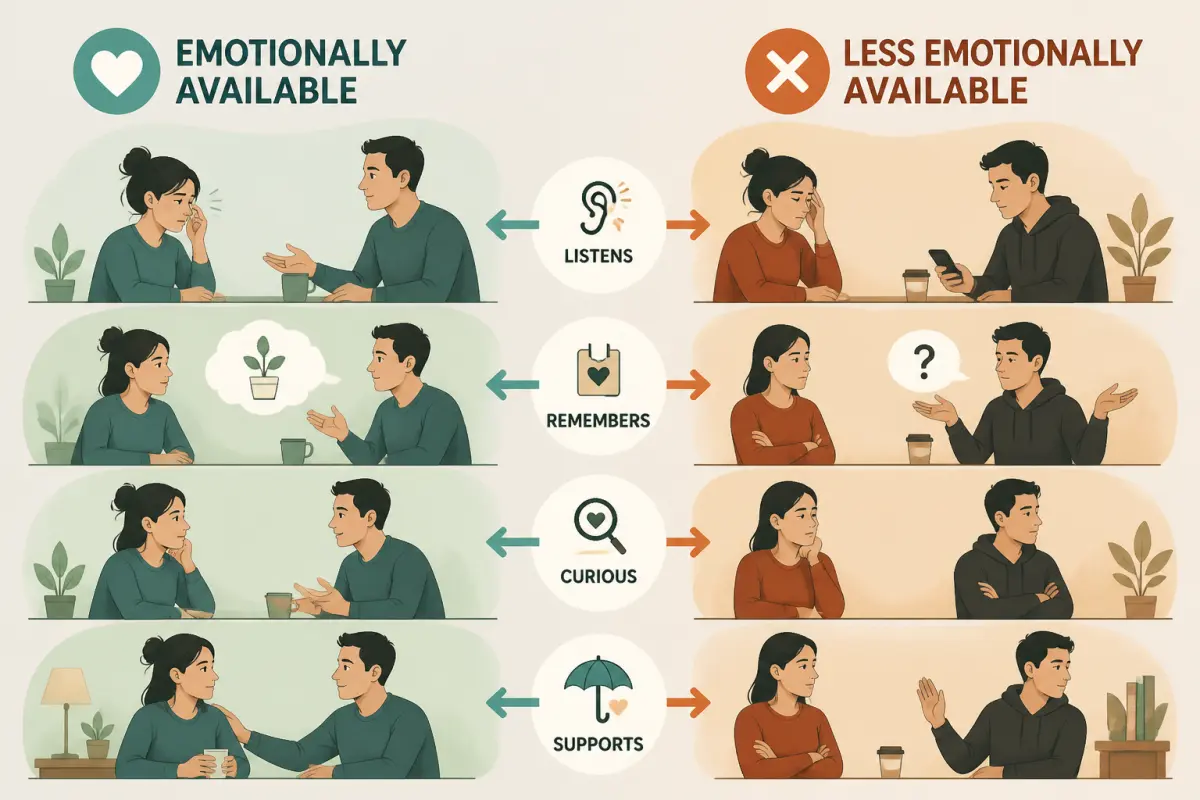
Emotional availability is often easier to recognize in ordinary moments than in dramatic conversations. It appears in how partners respond when one person is upset, how they repair after tension, how curious they are about each other’s inner world, and whether they make space for feelings without immediately shutting them down.
A more emotionally available partner may ask follow-up questions, remember what matters, notice a change in mood, or offer reassurance without being forced to. A less available partner may care deeply but respond with silence, impatience, jokes, distraction, quick advice, or a change of subject when emotional depth is requested.
The following table outlines common everyday signs. These are not labels for people; they are patterns that may appear in certain moments or become more fixed over time.
| Everyday situation | More emotionally available response | Less emotionally available response |
|---|---|---|
| One partner is visibly upset | Notices the change and asks what is happening without rushing the answer. | Acts as if nothing is happening or waits for the emotion to disappear. |
| A conflict has ended badly | Returns later to repair, clarify, or acknowledge the impact. | Moves on without discussing it and expects the other person to “drop it.” |
| One partner shares a fear or insecurity | Listens, validates the feeling, and responds with care even if they see it differently. | Debates the feeling, minimizes it, or becomes irritated by the need for reassurance. |
| Plans change unexpectedly | Communicates the change and considers how it may affect the other person. | Assumes the other person should adapt without emotional discussion. |
| The relationship feels distant | Can talk about the distance with curiosity and some willingness to reconnect. | Denies the distance, becomes defensive, or says the conversation is unnecessary. |
| Affection or closeness is requested | Responds with warmth or explains honestly when they need a pause. | Pulls away, becomes tense, or treats the request as pressure. |
| One partner needs comfort | Offers presence, touch, words, or practical support suited to the moment. | Offers solutions only, withdraws, or seems uncomfortable with emotional need. |
In many couples, the difference is not extreme. One person may simply be more fluent in emotional language. The other may show care through tasks, loyalty, problem-solving, or reliability. Problems arise when the available forms of care do not meet the other partner’s emotional needs, and neither person knows how to translate between them.
For example, one partner may think, “I fixed the problem, so why are we still talking about feelings?” The other may think, “You helped with the practical issue, but you never asked how it affected me.” Both are describing real forms of care, but only one is addressing the emotional layer.
Why one partner may offer more emotional access
People arrive in relationships with different emotional habits. Some learned early that feelings were welcome and could be discussed. Others learned to manage distress privately, to stay strong, to avoid burdening others, or to keep peace by not revealing too much. These patterns can become so familiar that they feel like personality rather than learned protection.
One partner may offer more emotional access because they are comfortable naming feelings, asking for closeness, and staying engaged during vulnerable moments. They may have had past relationships or family environments where emotional exchange was normal. They may also experience connection through conversation and reassurance more intensely than their partner does.
The less emotionally open partner may not be cold or uncaring. They may feel exposed when asked to talk about inner experiences. They may worry that emotional conversations will become criticism, demands, or conflict. Some people shut down because they do not know what to say; others become analytical because feelings feel too unstructured.
Stress also changes availability. A partner who is usually warm may become distant under work pressure, grief, financial strain, health worries, or family demands. Emotional bandwidth is not endless. However, temporary depletion differs from a long-standing unwillingness to engage.
Several common influences can shape how much access a person offers:
- Family norms: Some households encouraged emotional expression; others rewarded self-control and silence.
- Past hurt: A person who has felt rejected or shamed for vulnerability may become careful about revealing themselves.
- Conflict sensitivity: If emotional conversations quickly feel like danger, withdrawal may happen before the person can think clearly.
- Different love languages: One partner may show care through doing, while the other needs words and emotional presence.
- Personal temperament: Some people process internally and slowly; others process by speaking in real time.
- Relationship history: Repeated unresolved conflicts can make a person less willing to open up, even if they once did.
When a partner is avoiding closeness, it may be a protective response rather than a deliberate rejection. Still, protection can become painful for the other person when it blocks warmth, repair, and emotional contact.
Different emotional pacing versus an ongoing mismatch
Not every difference in emotional availability is a serious incompatibility. Some couples simply have different emotional pacing. One partner may need to talk immediately, while the other needs an hour, a walk, or a night of sleep before they can speak thoughtfully. If both people respect the difference, this can be managed well.
Different pacing becomes workable when the slower partner still returns to the conversation and the faster partner can tolerate a reasonable pause. The key is not identical timing; it is reliability. A pause feels safer when it comes with a clear promise: “I need some time to think, but I do want to talk tonight.”
An ongoing mismatch is different. In a persistent mismatch, the more emotionally available partner repeatedly reaches and the other repeatedly avoids, delays, minimizes, or gives only partial engagement. Over time, the issue is no longer about timing. It becomes about whether emotional connection is actually available.
It may help to ask the following questions:
- Does the less expressive partner come back after taking space?
- Can they acknowledge emotional impact, even if they disagree about details?
- Is there gradual improvement in responsiveness, or does every conversation reset to the beginning?
- Does the more expressive partner feel more secure over time, or increasingly anxious and lonely?
- Are both people making adjustments, or is only one person adapting?
Healthy difference allows room for personal space without using distance to avoid accountability. Space can be respectful, restorative, and necessary. But when space becomes a way to escape every emotional request, it stops functioning as self-regulation and begins to erode trust.
Practical test: A pause is usually healthy when it has a time frame, a purpose, and a return. “I need twenty minutes so I can calm down and speak respectfully” is very different from disappearing, refusing to say when the conversation will resume, and later acting as if the issue no longer exists.
How unequal availability affects closeness and trust
Unequal emotional availability affects more than communication. It shapes how safe each partner feels in the bond. When emotional responsiveness is inconsistent or hard to access, the more reaching partner may begin to monitor tone, delays, facial expressions, texting patterns, and small shifts in attention. This is not always “overreacting”; it may be the nervous system trying to predict whether connection is available.
The less available partner may experience the relationship differently. They may feel watched, evaluated, or pressured to perform emotional openness on demand. Instead of feeling invited, they may feel cornered. This can make them pull back further, which then confirms the other partner’s fear that they are alone in the relationship.
Over time, this pattern can affect closeness in several ways:
- Conversations become loaded. Simple check-ins start to feel like tests of love or commitment.
- Affection becomes uncertain. One partner may hesitate to reach out because rejection feels likely.
- Trust becomes conditional. The more available partner may trust practical reliability but not emotional presence.
- Resentment builds quietly. The partner who reaches may feel deprived; the partner who withdraws may feel chronically criticized.
- Repair becomes harder. Small hurts accumulate when they are not discussed and resolved.
Closeness depends on more than shared interests, attraction, or commitment. It also depends on the sense that important feelings can be brought into the relationship and met with some level of care. A couple does not need to process every emotion in detail, but both partners need to know that emotional reality is not unwelcome.
When unequal availability continues, the more emotionally open partner may begin to shrink their needs. They may stop bringing things up, not because they feel peaceful, but because they have learned that asking leads to disappointment. This kind of quiet adaptation can look like stability from the outside while intimacy is thinning inside the relationship.
The pursuit and withdrawal relationship cycle
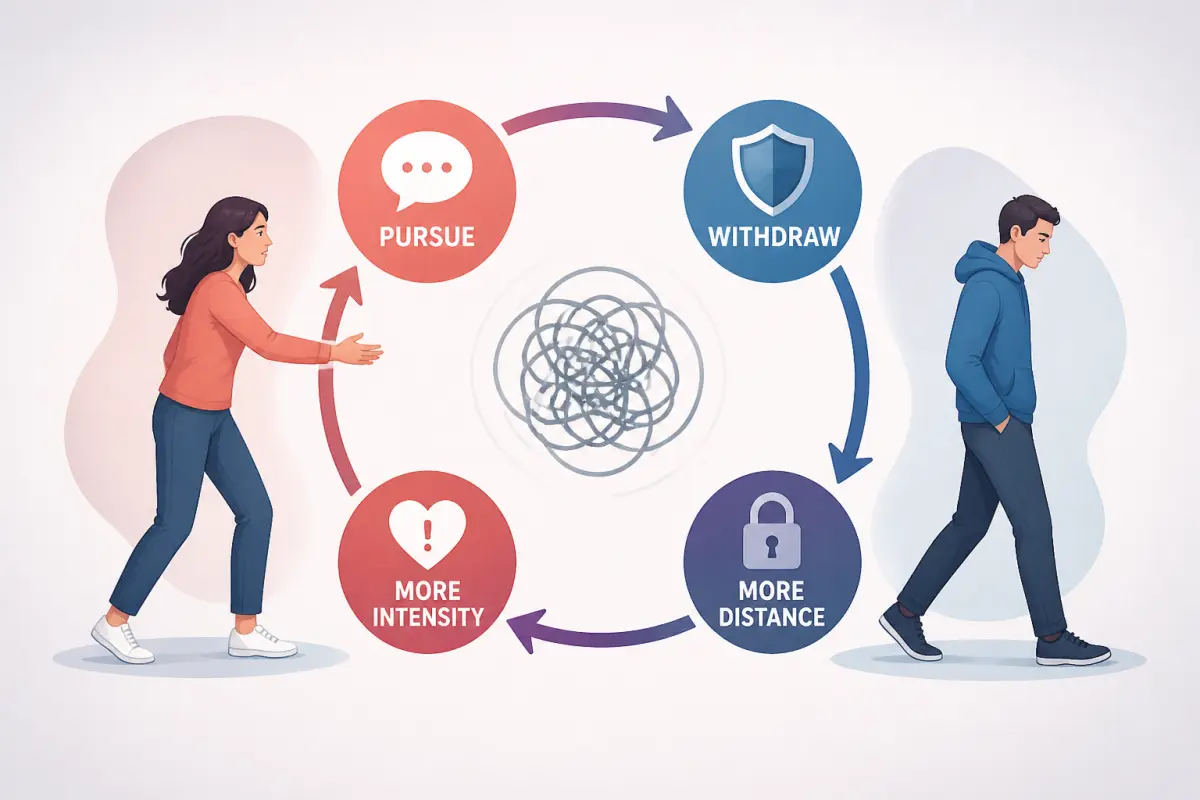
One of the most common patterns in an emotional availability mismatch is the pursuit and withdrawal cycle. One partner seeks contact, clarification, reassurance, or repair. The other feels pressured, inadequate, criticized, or overwhelmed, and pulls away. The pursuit then intensifies because distance feels alarming. The withdrawal then deepens because intensity feels unsafe.
This cycle can be painful because both partners may be trying to reduce distress. The pursuer is trying to restore connection. The withdrawer is trying to reduce emotional pressure. Unfortunately, each person’s coping strategy tends to activate the other person’s fear.
The cycle often looks like this:
- A moment of distance, conflict, or uncertainty occurs.
- One partner asks for emotional engagement or reassurance.
- The other partner feels flooded, criticized, or trapped.
- They become quiet, defensive, distracted, or physically leave.
- The first partner feels abandoned and pushes harder for a response.
- The second partner withdraws further or responds with irritation.
- Both partners end the interaction feeling unseen.
The issue is not that one person talks and the other is quiet. The issue is the rigid loop. If the couple cannot recognize the cycle, each partner may start blaming the other’s character: “You are too much,” or “You are emotionally unavailable.” These statements may contain pain, but they rarely create movement.
Understanding attachment patterns can help some couples make sense of why the same argument keeps returning in different forms. The goal is not to assign labels, but to notice the protective moves each partner makes under stress.
A more useful approach is to name the cycle as the shared problem. For example: “When I get scared, I ask more and more questions. When you feel pressured, you shut down. Then I panic, and you feel even more cornered. We need a different way to pause and return.”
Cycle shift: The first change is often not a perfect conversation. It is a small interruption: the pursuer softens the demand into a clear request, and the withdrawer offers a reliable return instead of disappearing. Even modest predictability can reduce the intensity of the loop.
How to discuss emotional availability without blame
Talking about emotional availability can easily sound like a character judgment. Words such as “unavailable,” “needy,” “cold,” or “clingy” tend to make people defend themselves rather than reflect. A more productive conversation focuses on specific moments, emotional impact, and concrete requests.
Instead of saying, “You never open up,” try naming the pattern more precisely: “When I ask how you are feeling and you say ‘fine’ but then stay distant all evening, I feel shut out. I would feel closer if you could tell me even one honest sentence about what is going on.”
Instead of saying, “You always need too much,” try: “When conversations become intense quickly, I feel overwhelmed and I struggle to respond well. I want to stay connected, but I need us to slow down and take turns.”
Good conversations about this topic usually include four elements:
- A specific example: “Last night after dinner, when we stopped talking...”
- The emotional effect: “I felt alone and unsure where we stood.”
- A non-accusatory interpretation: “I know you may have been tired, not trying to hurt me.”
- A clear request: “Could you tell me when you need quiet, and also let me know when we can reconnect?”
This is where clear communication becomes especially important. Clarity is not harshness. It means saying what is happening, what it means to you, and what would help, without forcing the other person to guess.
It is also important to choose timing carefully. A conversation about emotional availability usually goes better when neither person is already flooded, exhausted, intoxicated, rushing to work, or in the middle of another conflict. The aim is to create enough calm for honesty.
Useful opening phrases include:
- “I want to talk about a pattern between us, not blame you.”
- “I think we handle emotional moments differently, and I want to understand that better.”
- “I’m not asking you to become someone else. I’m asking whether we can find a way to meet each other more.”
- “Can we talk about what helps you stay present when emotions come up?”
- “I want to tell you what I need, and I also want to hear what feels difficult for you.”
If the conversation becomes circular, it may help to slow down and summarize each other before responding. For example: “What I hear you saying is that you feel pressured when I ask for reassurance repeatedly. Is that right?” This does not mean agreement; it means each person is trying to understand before defending.
Boundaries when emotional needs remain unmet
Compassion for a partner’s emotional limitations is valuable, but compassion does not mean abandoning your own needs. If emotional needs remain unmet despite repeated respectful conversations, boundaries become important. A boundary is not a punishment. It is a clear statement of what you can participate in while staying emotionally well.
A boundary might sound like:
- “I can give you space during conflict, but I cannot continue as if nothing happened afterward.”
- “I am willing to talk calmly, but I am not willing to beg for basic acknowledgment.”
- “I can accept that you process slowly, but I need us to return to difficult topics within a reasonable time.”
- “I respect your discomfort with vulnerability, but I need a relationship where emotional repair is possible.”
Boundaries should be connected to behavior you can control. You cannot force someone to become more emotionally present. You can decide how often you initiate, how long you wait for repair, whether you continue certain conversations, and what level of emotional distance is sustainable for you.
It is also useful to distinguish between an unmet preference and an unmet core need. A preference might be wanting more verbal affection than your partner naturally gives. A core need might be needing your partner to respond when you are distressed, repair after hurtful conflict, or be honest about feelings that affect the relationship.
If you repeatedly feel lonely in the relationship, it may be tempting to keep lowering the need so the relationship can continue. Sometimes adjustment is healthy. But when adjustment becomes self-erasure, the cost is high. You may become less expressive, less hopeful, or less recognizable to yourself.
If emotional unavailability is paired with intimidation, threats, humiliation, control, coercion, monitoring, financial restriction, or fear of your partner’s reaction, the issue is no longer only a difference in emotional style. Personal safety and appropriate support take priority. In such situations, it is important to seek help from trusted people or qualified services rather than trying to solve the pattern through better communication alone.
For many couples, boundaries clarify whether change is possible. If one partner responds to boundaries with reflection and effort, there may be room to rebuild. If they respond with contempt, repeated avoidance, or punishment, that gives important information about the relationship’s capacity for emotional safety.
Can emotional availability become more balanced?
Emotional availability can become more balanced when both partners recognize the pattern and are willing to practice different responses. Balance does not mean both people become identical. It means the relationship develops enough responsiveness, honesty, repair, and respect that neither person feels chronically deprived or overwhelmed.
The more emotionally expressive partner may need to practice slowing down, making requests more specific, and allowing space without assuming immediate rejection. This is not about suppressing needs; it is about communicating them in ways the other person can actually hear.
The less emotionally available partner may need to practice staying present longer, naming even simple feelings, returning after taking space, and offering reassurance before the other person has to plead for it. This is not about performing emotional intensity; it is about becoming more reachable.
Small changes can matter when they are consistent. Examples include:
- Checking in once a day without distractions.
- Saying, “I am upset, but I do not want to disconnect.”
- Agreeing on a repair conversation after arguments.
- Using brief but honest emotional language, such as “I feel embarrassed,” “I feel pressured,” or “I feel sad.”
- Offering reassurance without waiting for the other person to become distressed.
- Respecting a pause while also setting a clear time to return.
Balance becomes more likely when both partners can see the legitimacy of the other’s experience. The partner who wants closeness is not automatically demanding. The partner who needs time is not automatically uncaring. But both must take responsibility for how their coping style affects the relationship.
It may also help to involve a couples therapist, especially when the same conversations keep ending in shutdown, escalation, or despair. Professional support can help slow the cycle, translate emotional needs, and create safer ways to practice repair. This is not a sign of failure; it is often a practical step when goodwill alone has not been enough.
Sometimes, however, the answer is not more effort. If one person consistently refuses reflection, dismisses emotional needs, or offers temporary change only when the relationship is at risk, the more available partner may need to consider whether the relationship can provide the kind of closeness they need. Love can be real and still not be emotionally sufficient.
Frequently asked questions
Does being less emotionally available mean someone does not love their partner?
No. A person can love their partner and still struggle to show emotional presence in the way the relationship needs. Love, care, and availability are related, but they are not the same. The important question is whether the person is willing to understand the impact of their distance and make realistic changes.
Can the more emotionally available partner also contribute to the problem?
Yes. The more available partner may pursue, press for immediate answers, ask for reassurance repeatedly, or interpret every pause as rejection. These responses usually come from distress, not bad intentions, but they can still intensify the cycle. Both partners can have understandable reactions that also need adjustment.
How much emotional availability is reasonable to expect?
Reasonable expectations include basic responsiveness, willingness to repair after conflict, honesty about important feelings, and some capacity to offer comfort when a partner is distressed. It is not reasonable to expect constant attention, perfect reassurance, or unlimited emotional processing at any time. Healthy closeness includes both connection and space.
What if my partner says, “This is just how I am”?
That statement may be partly true, but it should not end the conversation. People do have temperaments and limits, yet relationships require adaptation. A more useful response is, “I understand this may not come naturally to you. I need to know whether you are willing to work on how it affects us.”
Is it fair to ask someone to become more emotionally open?
It is fair to ask for behaviors that support emotional safety, such as listening, returning after conflict, acknowledging feelings, and offering reassurance. It is not fair to demand a complete personality change or force vulnerability before someone is ready. The focus should be on mutual care, not emotional performance.
When should I stop trying to fix the mismatch?
It may be time to reconsider the effort when you have communicated clearly, made reasonable adjustments, respected your partner’s pace, and still experience persistent loneliness, dismissal, or lack of repair. A relationship requires two active participants. If only one person is carrying the emotional work, exhaustion is a meaningful signal.
Can a relationship survive with different levels of emotional availability?
Yes, if the difference is understood, respected, and actively managed. Many couples do not have identical emotional styles. The relationship is more likely to survive when the less available partner becomes more reliably responsive and the more expressive partner feels secure enough not to chase connection constantly.
What is the first practical step to take?
Start with one specific pattern rather than the whole relationship. Choose a calm moment and describe what happens, how it affects you, and what small change would help. For example: “When we argue and then do not talk about it, I feel distant for days. Could we agree to check in later the same evening or the next morning?”