How to Stay Close Without Losing Yourself

 It covers losing yourself in a relationship, why closeness blurs identity, and how compromise becomes ignoring your needs. It shows when it is too central. It covers keeping friendships, interests, expressing differences, sharing emotions, and healthy interdependence.
- What losing yourself in a relationship can look like
- Why closeness sometimes blurs personal identity
- Compromise versus abandoning your own needs
- Signs the relationship has become too central
- Keeping friendships, interests, and independent choices
- How to express differences without creating distance
- Sharing a life without carrying every emotion together
- Moving from dependence toward healthy interdependence
- A practical check-in for staying connected to yourself
- Frequently asked questions
Loving someone deeply while staying true to yourself is not always simple. Closeness is often built through small daily choices: answering when you are tired, changing plans, noticing moods, and making space. These gestures can be generous and healthy, but they can also become a quiet habit of self-abandonment. This article looks at how to build genuine intimacy while still respecting your needs, limits, preferences, and inner life.
What losing yourself in a relationship can look like
Losing yourself in a relationship usually does not happen in one dramatic moment. More often, it happens through a series of small adjustments that seem loving, reasonable, or easier than conflict. You say yes when you mean maybe. You stop mentioning preferences because your partner feels strongly. You postpone your own plans because the relationship seems to need you “just this once,” again and again.
At first, this can look like closeness. You may enjoy being needed, included, and emotionally important. But over time, the shape of your life may begin to narrow around the relationship until your own rhythms, opinions, friendships, and private thoughts feel less accessible.
Common everyday signs
- You automatically check how your partner will react before making ordinary decisions.
- You have difficulty answering simple questions such as “What do I want to do tonight?” without considering their preference first.
- You avoid sharing opinions that might disappoint, frustrate, or confuse your partner.
- Your friendships, hobbies, or routines have quietly faded, even though no one explicitly asked you to give them up.
- You feel guilty when you enjoy time alone or with other people.
- You find yourself managing your partner’s moods more carefully than your own needs.
- You feel anxious when there is distance, silence, or disagreement, even if nothing harmful has happened.
None of these patterns automatically means the relationship is “bad.” They may reflect old habits, fear of conflict, intense affection, or a learned tendency to keep peace by adapting. The important question is not whether you love your partner, but whether loving them still leaves room for you to remain present in your own life.
Psychologist’s note: A healthy relationship does not require you to be less visible. In fact, lasting closeness usually depends on two people being able to stay emotionally available while still having separate thoughts, preferences, limits, and sources of meaning.
Why closeness sometimes blurs personal identity
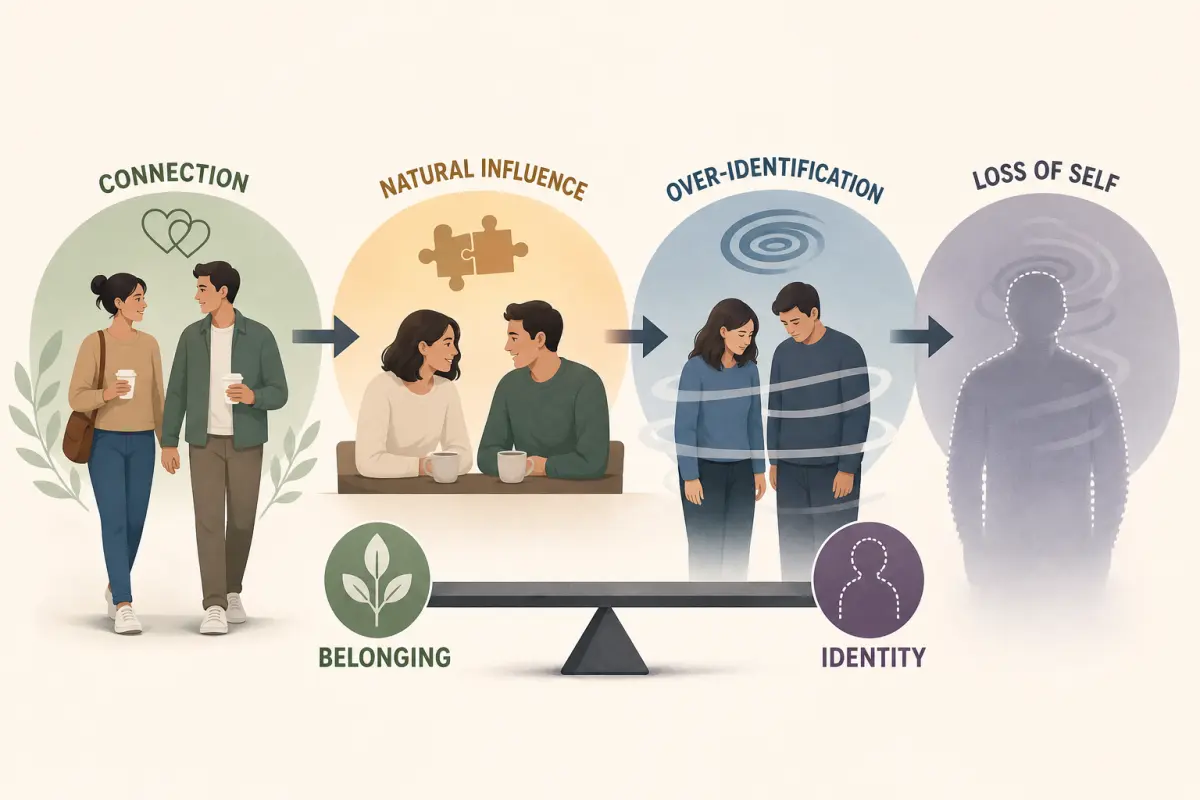
Human beings are wired for connection. It is natural to be influenced by the person you love. You may pick up each other’s phrases, habits, tastes, or ways of spending time. Shared routines can be comforting, and mutual influence is part of intimacy. The difficulty begins when influence quietly turns into self-erasure.
emotional closeness can feel especially powerful when a relationship provides comfort, security, validation, or a sense of belonging that has been missing elsewhere. If the bond becomes the main place where you feel valued, you may begin to protect it at the expense of your own honesty.
Why identity can blur in ordinary relationships
- The wish to avoid conflict: If disagreement feels threatening, you may over-adapt to keep the peace.
- The pleasure of being chosen: Feeling deeply important to someone can make it tempting to prioritize their world over your own.
- Old relational habits: If you learned to monitor others’ moods early in life, doing so in romance may feel automatic.
- Fear of abandonment: You may interpret separate needs as signs of rejection, even when they are normal.
- Intensity mistaken for security: Constant contact, constant reassurance, or constant agreement may feel like love, while actually reducing emotional steadiness.
This is also where emotional dependence can begin to develop. Dependence does not mean you care too much. It means your sense of stability, worth, or direction becomes overly tied to another person’s availability, approval, or mood.
Closeness becomes safer when it includes separateness. You can miss your partner without feeling abandoned. You can disagree without assuming the bond is broken. You can enjoy shared life without needing every feeling, choice, and preference to match.
Compromise versus abandoning your own needs
Compromise is part of every meaningful relationship. Two adults cannot build a life together without adjusting, negotiating, and sometimes choosing the relationship over immediate personal preference. But compromise is not the same as consistently abandoning yourself.
The difference often lies in reciprocity, freedom, and inner cost. A compromise may be inconvenient, but it still leaves you with dignity. Self-abandonment often produces resentment, fatigue, anxiety, or a growing sense that your life is no longer truly yours.
| Relationship situation | Healthy compromise | Self-abandonment |
|---|---|---|
| Choosing how to spend the weekend | You alternate between each person’s preferences and talk openly about energy, money, and timing. | You repeatedly cancel what matters to you because your partner’s plans always feel more urgent. |
| Handling disagreement | You listen, explain your view, and look for a solution that respects both people. | You stop expressing your view because disagreement feels too risky or exhausting. |
| Supporting your partner emotionally | You show care while recognizing that your partner is still responsible for their own reactions and choices. | You feel responsible for preventing, fixing, or absorbing every difficult emotion they have. |
| Making lifestyle changes | You adjust habits that genuinely support shared life while keeping important parts of your identity intact. | You reshape your values, appearance, friendships, or goals to avoid disapproval. |
| Responding to requests | You can say yes, no, or not now without fear of punishment or emotional withdrawal. | You say yes automatically, then feel depleted, resentful, or invisible. |
| Planning the future | Both people’s ambitions, fears, limits, and practical needs are included in the conversation. | One person’s timeline becomes the default, while the other quietly gives up important hopes. |
A useful test is to ask: “If I agree to this, am I choosing freely, or am I trying to prevent emotional consequences?” Loving generosity feels different from fear-based compliance. One expands connection; the other slowly reduces honesty.
Signs the relationship has become too central
A relationship can be deeply important without becoming the entire organizing principle of your life. The problem is not devotion. The problem is when your emotional, social, and practical world becomes so centered on one person that your own stability weakens.
Sometimes this happens when one partner is more invested, more anxious, or more available than the other. Patterns of unequal emotional investment can make one person work harder to secure closeness, often by over-giving, over-explaining, or over-monitoring the bond.
Warning signs to take seriously
- Your mood rises or falls almost entirely based on your partner’s tone, texts, or availability.
- You feel uncomfortable making plans that do not include them.
- You have stopped sharing certain feelings with friends because you think only your partner should matter.
- You measure your worth by how wanted, desired, or prioritized you feel in the relationship.
- You neglect sleep, work, health, finances, or family responsibilities because relationship concerns dominate your attention.
- You feel unable to enjoy good moments unless the relationship feels completely secure.
- You apologize for needs that are normal, such as rest, time alone, or contact with friends.
The relationship may also feel too central if ordinary distance feels unbearable. For example, a partner needing an evening alone may trigger panic, anger, or a sense of rejection. These reactions are understandable, but they are also signals that your emotional balance may need more than reassurance from one person.
If your partner pressures you to cut off friends, monitors your communication, punishes independence, threatens you for disagreeing, or makes you feel unsafe when you set limits, this is not simply “too much closeness.” Personal safety, trusted support, and appropriate professional or legal help take priority over relationship repair.
Keeping friendships, interests, and independent choices
Independence inside a relationship is not a rejection of closeness. It is one of the conditions that helps closeness stay alive. When both people continue to have friendships, interests, private reflection, and individual choices, the relationship has more oxygen.
healthy personal space is not emotional coldness. It is the room each person needs to think, restore, grow, and return to the relationship with genuine presence rather than obligation.
Ways to protect your own life without becoming distant
- Keep regular contact with friends. Do not wait until the relationship is strained to rebuild your support system.
- Continue at least one interest that is yours. It may be reading, sport, music, volunteering, study, walking, gardening, or creative work.
- Make some small decisions independently. Choose your clothes, schedule, meals, spending, or leisure without turning every preference into a joint negotiation.
- Preserve private thinking time. Journaling, quiet walks, or time without screens can help you hear your own mind again.
- Let your partner have separate experiences too. Mutual freedom reduces the pressure for one person to be everything.
If you feel guilty doing things without your partner, start gently rather than dramatically. A short coffee with a friend, a class once a week, or an hour alone on Sunday morning can be enough to remind your nervous system that separateness is not abandonment.
How to express differences without creating distance
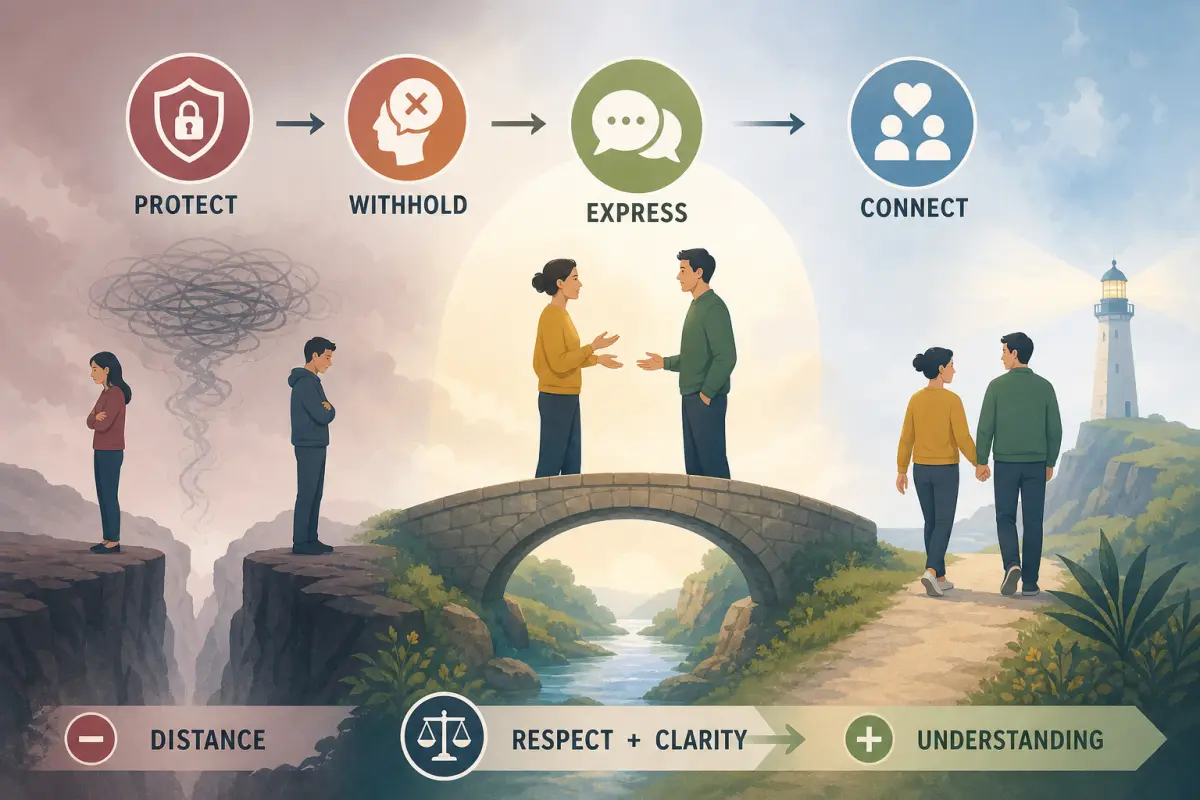
Many people lose themselves because they confuse difference with disconnection. They imagine that if they say, “I don’t see it that way,” the relationship will become colder, more fragile, or less loving. In reality, relationships that cannot tolerate difference often become tense and performative.
The goal is not to express every preference forcefully. It is to become honest in a way that is respectful, clear, and emotionally steady. clear relationship communication helps both people understand what is being asked, what is being felt, and what boundary or need is present.
Language that protects both honesty and connection
- “I want to understand your view, and I also have a different reaction.”
- “I’m not saying no to you. I’m saying this particular plan does not work for me.”
- “I need a little time to think before I agree.”
- “I care about this conversation, but I don’t want to continue it while we’re both escalated.”
- “Part of me wants to make you happy, but I also need to be honest about what I can realistically offer.”
Notice that these statements do not attack, diagnose, or accuse. They keep the focus on your experience, your limits, and your willingness to stay engaged. This matters because difference is easier to hear when it does not arrive as contempt.
When expressing difference feels frightening
If you are used to people reacting badly to your needs, even a mild disagreement may feel like a major risk. In that case, practice with lower-stakes topics first. Say what movie you prefer. Choose the restaurant once. Ask for a quieter evening. These small acts help rebuild the inner muscle of preference.
Afterward, observe what happens. Does your partner stay respectful, even if disappointed? Can they hear you without punishing you? Can you tolerate their temporary discomfort without immediately taking back your truth? These are important signs of whether the relationship can support two full people.
Sharing a life without carrying every emotion together
Emotional support is one of the great comforts of partnership. It is tender to be known, to be held in mind, and to have someone care when life is difficult. But sharing emotions is different from carrying every emotion together.
When boundaries are blurred, one person’s stress becomes both people’s emergency. One person’s sadness becomes the other person’s responsibility to fix. One person’s disappointment becomes a crisis that requires immediate repair. Over time, both partners may become less emotionally resilient because neither has enough room to process separately.
Supportive presence versus emotional over-carrying
- Supportive presence: “I’m here with you. I care. What would help right now?”
- Over-carrying: “I cannot relax until I make your feeling go away.”
- Supportive presence: “That sounds painful. I trust you to work through it, and I’ll support you.”
- Over-carrying: “Your distress means I have failed as a partner.”
- Supportive presence: “Let’s talk, and then I also need to sleep.”
- Over-carrying: “Your crisis cancels all my needs, every time.”
It is compassionate to care about your partner’s inner world. It is not sustainable to treat their emotional state as your assignment. Adults in healthy relationships help each other, but they do not hand over full responsibility for self-regulation, meaning, or identity.
A simple phrase can help: “I can be with you in this, but I cannot be this for you.” It communicates love without taking ownership of what belongs to the other person.
Moving from dependence toward healthy interdependence
Healthy interdependence sits between two extremes. On one side is rigid independence: “I need no one, and I will not let anyone affect me.” On the other side is dependence: “I cannot feel steady unless you are available, approving, and close.” Interdependence says, “We matter deeply to each other, and we remain responsible for ourselves.”
This shift is not about becoming less loving. It is about making love less fear-driven. Instead of clinging, testing, pleasing, or withdrawing, both people learn to ask for connection while also maintaining self-respect.
What healthy interdependence includes
- You can ask for reassurance without demanding constant proof of love.
- You can offer support without losing your own limits.
- You can make shared decisions without giving up your voice.
- You can tolerate temporary distance without assuming the relationship is ending.
- You can repair conflict without pretending nothing hurt.
- You can enjoy closeness without requiring sameness.
Moving toward interdependence often involves small repetitions rather than one dramatic transformation. You pause before agreeing. You name a preference. You let your partner have a mood without rushing to manage it. You reconnect with a friend. You let a disagreement exist long enough to be understood rather than immediately smoothed over.
Useful distinction: Dependence asks, “How do I keep you close enough so I feel okay?” Interdependence asks, “How do we stay connected while each of us remains emotionally responsible, honest, and alive in our own life?”
A practical check-in for staying connected to yourself
Self-connection is easier to maintain when you check in before resentment, confusion, or exhaustion builds up. The following questions are not a test of whether your relationship is perfect. They are a way to notice whether you are still living as a full person within it.
A weekly self-check-in
- What did I genuinely want this week? Did I notice my preferences, or did I skip over them?
- Where did I say yes? Was it generous, pressured, automatic, or afraid?
- Where did I say no? Did I allow myself to have a limit without over-explaining?
- Who did I connect with besides my partner? Did I nourish friendships, family ties, community, or professional support?
- What did I do that was just mine? Did I spend time with an interest, goal, practice, or quiet routine that belongs to me?
- Did I hide anything important to avoid discomfort? If so, what would a respectful version of honesty sound like?
- Did I take responsibility for emotions that were not mine to carry? What could support look like without over-functioning?
A simple reset practice
- Choose one area where you feel slightly disconnected from yourself.
- Name one small action that would restore a sense of personal agency.
- Tell your partner if the action affects shared plans, using calm and direct language.
- Take the action without turning it into a referendum on the whole relationship.
- Notice how you feel afterward: more anxious, relieved, guilty, grounded, or clear.
For example, you might decide to restart a weekly walk alone, call a friend after dinner, spend Saturday morning on your own project, or ask for time to think before agreeing to a family plan. These are modest choices, but they signal to your inner life: “I am still here.”
Practical reminder: If a small act of independence produces strong guilt, do not treat the guilt as proof that you are doing something wrong. Guilt can appear when you change an old pattern, especially if you are used to earning closeness by being endlessly agreeable.
Frequently asked questions
Can you be very close to someone without losing yourself?
Yes. Deep closeness and a stable sense of self can exist together. In fact, the most nourishing relationships often allow both people to be emotionally open and individually distinct. You can share a home, a future, affection, daily routines, and difficult feelings without giving up your preferences, friendships, values, or inner life.
Is wanting a lot of time with my partner unhealthy?
Not necessarily. Wanting time together is normal, especially in a loving or newer relationship. It becomes worth examining when togetherness is driven mainly by anxiety, when separate time feels intolerable, or when other important areas of life consistently disappear.
How do I know if I am compromising too much?
Look at the pattern rather than one decision. If both people adjust, both people’s needs matter, and you can speak freely, it is likely compromise. If you are repeatedly the one who gives in, hides discomfort, or fears the consequences of saying no, the pattern may be moving toward self-abandonment.
What if my partner feels hurt when I ask for space?
Your partner may feel disappointed or insecure, and that feeling deserves kindness. But their discomfort does not automatically mean your need is wrong. You can reassure them while still keeping the boundary: “I love spending time with you, and I also need an evening to myself so I can feel rested.”
Can independence make a relationship weaker?
Independence can feel threatening if a relationship has relied on constant availability for security. But healthy independence usually strengthens connection because it reduces pressure, resentment, and emotional over-reliance. The aim is not distance; it is a fuller, freer form of closeness.
What if I no longer know what I want?
Start small. Do not pressure yourself to answer major life questions immediately. Practice noticing simple preferences: what food sounds good, whether you want quiet or company, what music you like, what pace feels comfortable. Rebuilding self-trust often begins with ordinary choices.
When should I seek additional support?
Consider support from a qualified professional or trusted resource if you feel persistently anxious, controlled, isolated, unable to set limits, or unsure whether the relationship is safe. General relationship guidance can be helpful, but it is not a substitute for individualized care when distress, fear, or coercion is present.