Overthinking tone, wording, and pauses in communication

 This article explains why tone and pauses feel emotionally loaded, which cues people often overread, and how past experiences heighten sensitivity. It separates real signals from assumptions, shows how to reality-check in the moment, respond without escalating or shutting down, and build shared clarity on tone and pacing, plus common concerns.
- Why tone and pauses carry emotional weight
- Common cues people overinterpret in communication
- How past experiences shape tone sensitivity
- The difference between signal and assumption
- How to reality-check interpretation in the moment
- How to respond without escalating or withdrawing
- Building shared clarity around tone and pacing
- Common concerns around interpreting tone and pauses
Replaying conversations, scrutinizing your wording, and worrying that a pause sounded awkward is more common than you think. Many of us try to manage how we come across, especially in texts, meetings, or with people we care about. But constant self-editing can drain confidence and blur what you meant. This article explains why it happens and offers ways to speak with more ease and clarity.
Why tone and pauses carry emotional weight
People don’t just listen for words; they listen for cues that signal mood, intent, and safety. A slight change in pitch, a longer silence than usual, or a clipped response can feel meaningful because everyday conversation trains people to treat these signals as context. When the message is ambiguous, the brain leans more heavily on delivery to decide what’s “really” being said.
This happens partly because speech patterns are tied to emotion and attention. When someone is relaxed, they often speak more smoothly and pause naturally. When someone is stressed, distracted, or annoyed, their timing and tone can shift in noticeable ways. Listeners may interpret those shifts as directed at them, even when they reflect the speaker’s internal state or the situation.
- Tone carries attitude quickly. Warmth, impatience, sarcasm, and uncertainty can be conveyed in a single word depending on how it’s said. Because tone is processed fast, it can shape the emotional “headline” of the interaction before the content is fully understood.
- Pauses create room for interpretation. Silence can mean “thinking,” “hesitating,” “disapproving,” “multitasking,” or “not sure how to respond.” Without clear context, people fill the gap with the explanation that fits their expectations or worries.
- Timing signals priority. Quick replies often read as engagement; delayed replies can read as avoidance or low interest. In reality, timing is also influenced by workload, notifications, and energy levels, but the emotional impact can still land strongly.
- People use patterns, not single moments. One short answer may be nothing; a series of short answers can feel like a shift in closeness. Humans are pattern-detectors, so repeated changes in delivery stand out more than the literal wording.
- Ambiguity raises the stakes. Short texts, brief check-ins, or vague statements leave more unsaid. The less explicit information there is, the more weight gets placed on voice, pacing, and “what wasn’t said.”
Different settings also change how much these signals matter. In close relationships, small shifts in voice or silence can feel personal because the baseline is familiar. In work conversations, pauses may be interpreted as disagreement or judgment because people are tracking status, clarity, and risk.
| Cue | Common interpretation | Other everyday explanations |
|---|---|---|
| Short, flat “Okay.” | Upset, dismissive, or uninterested | Tired, trying to be efficient, distracted, unsure what else to add |
| Long pause before replying | Disapproval, doubt, or conflict | Thinking, reading carefully, switching tasks, poor connection |
| Fast speech with fewer pauses | Nervousness or impatience | Excitement, time pressure, habit, trying to get through details |
| Laughing after a serious point | Not taking it seriously or being sarcastic | Awkwardness, easing tension, social habit, uncertainty |
| Delayed text reply | Ignoring or losing interest | Busy schedule, notifications off, needed time to respond thoughtfully |
Because tone and silence are so open to interpretation, they often become the focus of overthinking. The same pause can be harmless in one context and loaded in another, and people typically default to the meaning that matches the relationship history, the current stress level, and how clear the words were in the first place.
Common cues people overinterpret in communication

People often try to “read between the lines” using small signals that feel meaningful in the moment. The problem is that many of these signals are ambiguous, shaped by habits, culture, context, and simple logistics (like being busy), so they can easily be misread as approval, annoyance, or rejection.
-
Response time
A slow reply is frequently taken as disinterest or anger, even though it can reflect meetings, commuting, time zones, notification overload, or someone wanting to answer carefully. A fast reply can be overread as urgency or emotional intensity when it may just mean the person saw the message immediately. -
Message length (short vs. long)
Brief answers like “Sure” or “OK” can be interpreted as cold or dismissive, but they may simply match the sender’s style or the situation. Long messages can be read as overexplaining, defensiveness, or hidden frustration, when they might just reflect thoroughness. -
Punctuation and formatting
A period at the end of a short text (“Thanks.”) is commonly perceived as stern, while multiple exclamation points can be read as forced enthusiasm. ALL CAPS can look like shouting, and ellipses (“…”) can feel ominous, even when used as a casual habit. -
Word choice that seems “off”
Small substitutions (“Noted” instead of “Got it,” “Fine” instead of “Sounds good”) can trigger assumptions about mood. In reality, people rotate phrases, mirror workplace language, or choose words quickly without intending a subtext. -
Emojis and the lack of them
No emoji can be interpreted as seriousness or irritation; an emoji can be read as flirting, sarcasm, or minimizing. Different age groups and social circles also assign different meanings to the same symbol, making certainty hard. -
Read receipts, typing indicators, and “seen” status
“Seen” without a reply often gets interpreted as avoidance, but it can mean the person opened the message at a bad time, got interrupted, or needs information before responding. Typing indicators can create false expectations about what’s coming next. -
Pauses and silence in live conversation
A pause can be mistaken for judgment, boredom, or disagreement. Many people pause to think, choose words carefully, manage nerves, or process what they heard. Silence can also be a turn-taking signal rather than a negative reaction. -
Tone of voice and “flatness”
A neutral tone may be read as annoyed or uninterested, especially on phone calls where facial cues are missing. Fatigue, stress, neurodiversity, or focusing on clarity can all reduce vocal expressiveness without changing intent. -
Facial expressions and micro-reactions
A raised eyebrow, a tight smile, or a blank face can be interpreted as criticism. But expressions often reflect concentration, confusion, lighting, or habitual resting face rather than a specific judgment about what was said. -
Body language shortcuts
Crossed arms, looking away, or checking a phone can be read as closed-off or rude. Sometimes it’s comfort, posture, sensory regulation, or multitasking due to a practical need (calendar checks, urgent messages, accessibility tools). -
Meeting and chat behaviors
Not speaking up in a group can be misread as disagreement or disengagement, when it may be deference, time constraints, or not wanting to interrupt. In group chats, reacting with a “thumbs up” can be interpreted as passive-aggressive, even though it’s often just a quick acknowledgment. -
Changes from someone’s “usual” pattern
When a person suddenly texts less, sounds more formal, or stops using nicknames, it’s easy to assume relational distance. Pattern shifts can also come from workload changes, family issues, health, or simply trying a different communication style.
| Cue people fixate on | Common interpretation | Other everyday explanations |
|---|---|---|
| Slow reply | “They’re upset” or “They don’t care” | Busy schedule, notifications off, time zone, waiting to respond thoughtfully |
| Short message (“Ok.”) | Dismissive or angry | Task-focused style, typing quickly, nothing more to add, low battery or on the move |
| Period / ellipses | Harsh, sarcastic, or ominous | Habit, autocorrect, trying to sound clear, mirroring workplace tone |
| “Seen” with no reply | Avoiding you | Interrupted, needs time, wants to check details, intends to reply later |
| Pause in conversation | Judging or disagreeing | Thinking, processing, choosing words, letting the other person continue |
| Neutral voice | Annoyed or bored | Fatigue, stress, concentration, naturally flat delivery, poor audio quality |
These cues feel “diagnostic” because they’re easy to notice and easy to compare to past interactions. But they rarely point to a single meaning on their own. When several signals cluster together across time and contexts, they may indicate something worth asking about; when it’s one isolated detail, it’s often just noise.
How past experiences shape tone sensitivity
People often become extra alert to wording, pauses, and “vibes” when earlier interactions taught them that small cues can have big consequences. If a past conversation ended in criticism, conflict, or withdrawal, the brain learns to scan for early warning signs the next time. That can make neutral messages feel loaded, and it can turn everyday delays—like a late reply—into something that seems meaningful.
This sensitivity is usually less about “reading minds” and more about pattern-matching. The mind compares a current text, email, or facial expression to previous moments that felt unsafe, embarrassing, or unpredictable. When there’s uncertainty, it tends to fill gaps with the most familiar explanation, especially if that explanation once helped avoid trouble.
- Unpredictable reactions in the past: If someone previously responded warmly one day and harshly the next, it can create a habit of monitoring tone closely to avoid being caught off guard.
- Criticism tied to “how you said it”: Repeated feedback like “watch your tone” can make people second-guess phrasing and delivery, even when they’re being neutral.
- Conflict where subtle cues mattered: In some families, workplaces, or friendships, a short answer or sigh signaled a bigger issue. That history can make brief messages feel like a red flag.
- Past social embarrassment: Being misunderstood, mocked, or excluded can increase vigilance about how words might land, leading to over-editing and replaying conversations.
- Experiences of being ignored: If silence previously meant rejection or punishment, a pause in replies can trigger worry and a search for hidden meaning.
- High-stakes environments: Roles where mistakes had outsized consequences (strict authority figures, tense teams, volatile relationships) can train people to interpret tiny shifts as urgent signals.
| Past experience pattern | What it can teach the brain to watch for | Common present-day communication habit |
|---|---|---|
| Mixed signals (warm then cold) | Micro-changes in enthusiasm, punctuation, speed of replies | Re-reading messages for “clues” and asking for reassurance |
| Frequent criticism or correction | Word choice, formality, “right” phrasing | Over-editing, drafting multiple versions, apologizing preemptively |
| Conflict escalation from small cues | Short answers, silence, facial expressions, pauses | Assuming a problem exists and trying to fix it immediately |
| Being ignored or stonewalled | Delays, read receipts, lack of emojis or sign-offs | Checking for responses repeatedly and interpreting gaps as rejection |
| Misunderstanding leading to embarrassment | Ambiguity, jokes, sarcasm, indirect language | Adding extra context, clarifying repeatedly, avoiding humor in text |
Because tone is partly inferred, the same message can feel different depending on what someone has learned to expect. A plain “OK.” might read as anger to a person who associates brevity with disapproval, while someone else reads it as efficient. In day-to-day life, this can show up as overthinking punctuation, interpreting pauses as judgment, or feeling compelled to “smooth out” messages so they can’t be misread.
These patterns are common in close relationships and workplace communication, where people want to avoid friction and maintain belonging. When the past included moments where safety depended on noticing subtle shifts, sensitivity to tone can become an automatic setting—helpful in some contexts, exhausting in others.
The difference between signal and assumption
In everyday conversations, it helps to separate what was actually observable from the story the mind builds around it. A signal is something you can point to in the message or behavior. An assumption is the meaning you attach to that signal, often based on past experiences, mood, or fear of being misunderstood.
This distinction matters because overthinking usually happens when assumptions start multiplying faster than the available evidence. A short reply, a delayed response, or a neutral facial expression can be real data, but the conclusion that it means rejection, anger, or disrespect may be an interpretation rather than a fact.
| What you notice | Signal (observable) | Assumption (interpretation) | A more grounded next step |
|---|---|---|---|
| They replied with “Ok.” | One-word response; no added detail | “They’re annoyed” or “They don’t care” | Ask a clarifying question or wait for more context before concluding tone |
| A long pause before answering | Several seconds of silence | “I said something wrong” or “They’re judging me” | Consider neutral reasons (thinking, multitasking); check in: “Want a moment to think?” |
| No response for a few hours | Message not answered yet | “They’re ignoring me on purpose” | Account for schedules; if needed, send one simple follow-up with a clear request |
| They used fewer emojis than usual | Change in typing style | “They’re upset with me” | Look for stronger cues (content, consistency over time); don’t treat style shifts as proof |
| They sounded flat on a call | Lower energy voice; fewer inflections | “They’re mad” or “They’re bored by me” | Consider fatigue or stress; ask about their day rather than interrogating the tone |
- Signals are specific and quotable. You can describe them without guessing motives: “They didn’t answer,” “They said ‘fine,’” “They paused.”
- Assumptions fill in missing information. They often show up as certainty about intent: “They meant…,” “They must think…,” “They’re doing this because…”
- Signals can be combined; assumptions tend to snowball. One neutral cue is manageable. A chain of interpretations can quickly feel like proof, even when it’s mostly inference.
- Signals invite questions; assumptions invite defensiveness. When someone reacts to an interpretation instead of the observable behavior, the conversation can drift into reassurance-seeking or conflict.
A practical way to keep the two separate is to mentally phrase your first thought as a hypothesis instead of a verdict: “One-word reply could mean they’re busy.” When the mind treats an interpretation as the only explanation, it tends to reread messages, overanalyze pauses, and rewrite what to say next.
When you’re unsure, prioritize the content and the pattern over a single moment. One clipped text or one awkward silence is weak evidence. Repeated behavior across situations is a stronger signal, and even then it still helps to confirm meaning with a calm, direct question.
How to reality-check interpretation in the moment
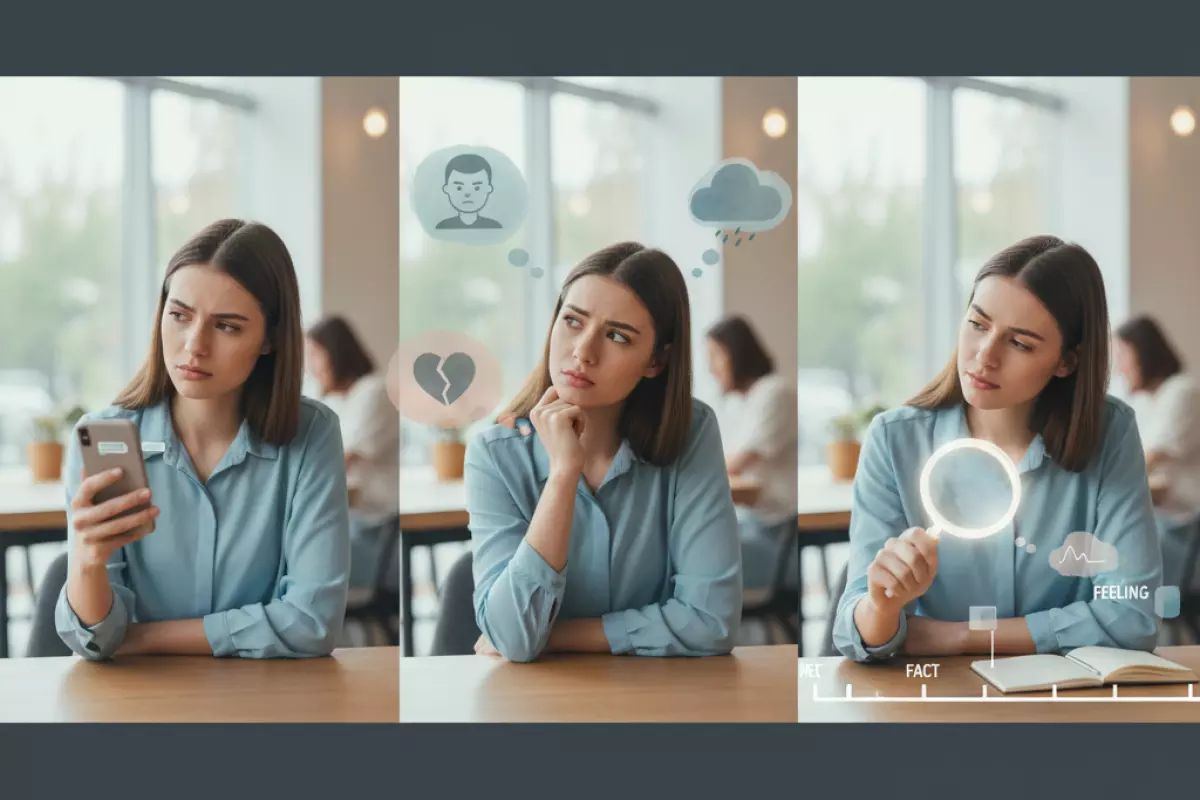
When you start reading into a pause, a short reply, or a “different” tone, the brain often fills in missing context with a story that feels true. A quick reality-check helps separate what you actually observed (words, timing, facts) from what you inferred (intent, emotion, meaning). The goal isn’t to shut down your intuition, but to slow the leap from “I noticed something” to “I know what it means.”
-
Label the data first.
State the observable details in plain terms: “They replied with ‘OK.’ There was a 3-hour gap. No emoji. No follow-up question.” This reduces the chance that assumptions sneak in as if they were facts.
-
Name your interpretation as a guess.
Convert certainty into a hypothesis: “I’m interpreting this as annoyance” or “My mind is telling me they’re pulling away.” This keeps the meaning flexible while you gather more information.
-
Check for common “tone traps.”
- Negativity bias: assuming the worst explanation is the most realistic.
- Mind reading: treating your inference about their feelings as confirmed.
- Personalization: assuming the shift is about you rather than their day, workload, or attention.
- Recency effect: letting one odd message outweigh a longer pattern of normal communication.
-
Compare this moment to the person’s baseline.
Ask: “Is this actually unusual for them?” Some people are naturally brief, respond in batches, or use minimal punctuation. If the behavior matches their typical style, it’s less likely to signal a problem.
-
Generate at least three neutral alternatives.
Before settling on a negative meaning, list other plausible explanations: they were in a meeting, distracted, trying to be efficient, unsure what to say, or assumed the topic was resolved. The point is not to pick the most comforting story, but to avoid treating one story as the only story.
-
Decide what you actually need: reassurance, clarity, or time.
If you need clarity, you can ask a simple, low-pressure question. If you mainly need reassurance, it may be better to wait and look for more data rather than pushing for an immediate read on their mood.
| Trigger in the moment | Quick reality-check question | Grounded next step |
|---|---|---|
| A long pause before they reply | “Do I know what they were doing during that time?” | Wait for the next message or check the broader pattern before concluding anything. |
| A short or one-word response | “Is brevity their normal style, or is this a clear change?” | Reply with one clarifying prompt: “Want me to expand, or does that cover it?” |
| No emojis or “warm” wording | “Am I using my own texting style as the standard?” | Assume neutrality unless there are other signals (content, pattern, context). |
| A message that sounds “cold” in your head | “If I read this in a neutral voice, what changes?” | Re-read once with a neutral tone, then respond to the content rather than the imagined mood. |
| A sudden change in punctuation (periods, caps) | “Is this consistent with how they write when busy or on mobile?” | Hold off on confrontation; ask for intent only if the content is also sharp or critical. |
| You feel an urge to send multiple follow-ups | “Am I trying to reduce uncertainty or solve a real problem?” | Pause, draft a single clear message, and set a time to revisit if there’s no response. |
If you still feel stuck after checking the facts and alternatives, use a direct but non-accusatory clarification. Keep it specific and tied to your needs, not their character: “I might be misreading this, but did you mean that neutrally?” or “Just checking, are we good?” This approach reduces the pressure on the other person to defend themselves while giving you cleaner information than guessing from wording alone.
How to respond without escalating or withdrawing
When you’re stuck analyzing someone’s tone, wording, or pauses, it’s easy to default to two extremes: pushing harder for clarity (which can come off as accusatory) or pulling back to avoid discomfort (which can look like coldness). A steadier approach aims for clear intent, limited assumptions, and a pace that matches the situation.
- Start with what you know, not what you’re guessing. Use observable facts: “I haven’t heard back since yesterday,” rather than “You’re ignoring me.” This reduces the chance of triggering defensiveness.
- Name your goal before your feelings. “I want to make sure we’re on the same page,” sets a collaborative frame and prevents the message from sounding like a verdict.
- Ask one clean question at a time. Overthinkers often bundle multiple worries into one text. A single question is easier to answer and less likely to escalate.
- Offer a neutral explanation for the pause. Silence can mean distraction, stress, or timing. A line like “Not sure if you’re busy or missed this” keeps the door open without assigning blame.
- Use “check” language instead of “challenge” language. “Can I check I understood you right?” lands softer than “What did you mean by that?” which can sound like cross-examination.
- Set a time boundary without pressure. “No rush—when you have a moment today” is different from repeated follow-ups that communicate urgency or suspicion.
- Match the channel to the complexity. If you’re reading a lot into short replies, suggest a quick call or in-person chat. Tone is easier to read when there’s voice and timing.
- Don’t punish uncertainty with distance. Withdrawing to “protect yourself” can unintentionally signal resentment. If you need space, state it plainly: “I’m going to step away for a bit and we can revisit later.”
| Common trigger | Escalating response | Withdrawing response | Balanced alternative |
|---|---|---|---|
| Short reply (“ok”, “sure”) | “Why are you being rude?” | Stop replying to “match energy” | “Got it. Are you good to talk more later, or is now busy?” |
| Long pause after a message | Multiple follow-ups (“??”, “hello?”) | Delete messages, decide they’re upset | “Not sure if you saw this—no rush. Let me know when you can.” |
| Ambiguous wording | Interrogate details to “prove” intent | Assume the worst, disengage | “When you said X, did you mean A or B?” |
| Change in tone (less warm than usual) | “What’s your problem with me?” | Act overly fine, but go distant | “You seem a bit off today—everything okay on your end?” |
If you notice your message getting longer as you edit, that’s often a sign you’re trying to manage every possible interpretation. A practical reset is to keep it to: one observation, one intention, one question. This structure communicates care without turning the conversation into a test.
Finally, allow for normal human variation. People type quickly, multitask, and miss cues. Responding as if every pause or phrasing choice is meaningful can create tension that wasn’t there. A calm, specific check-in gives the other person room to clarify while keeping you engaged without overcorrecting.
Building shared clarity around tone and pacing
Misreads often happen because people assume their default interpretation is shared: a short reply means annoyance, a delayed response means avoidance, a pause means disagreement. In everyday conversation, tone and timing carry extra meaning, but that meaning is not consistent across people, contexts, or channels. Creating a few shared reference points reduces the urge to analyze every word, comma, or silence.
Clarity usually comes from naming what each person tends to do under normal conditions. Some people write briefly to be efficient, others add warmth to prevent sounding cold. Some pause to think, others fill silence to show engagement. When those patterns are surfaced, a neutral behavior is less likely to be treated as a signal of conflict.
- Separate channel limits from intent. Text and chat strip out facial cues and softeners, so “Okay.” can look sharper than it sounds. Voice notes and calls add tone but can introduce pauses that feel heavier than they are.
- Agree on what “fast” and “slow” mean. One person may expect replies within minutes; another may batch messages and respond later. A simple expectation like “I usually reply after work” prevents guessing.
- Normalize thinking time. In meetings or serious talks, a few seconds of silence often means processing, not disapproval. Stating “I’m thinking” or “Give me a moment” can prevent spiraling interpretations.
- Use explicit markers for emotion and urgency. People commonly rely on punctuation, capitalization, or brevity to signal mood, but those cues vary. Clear phrases like “Not upset, just tired” or “This is time-sensitive” reduce ambiguity.
- Clarify what “direct” sounds like. Some communicate plainly and skip cushioning; others expect a greeting, a softener, and then the point. Aligning on a shared “direct but kind” style avoids reading bluntness as hostility.
- Set a repair habit for misreads. A quick check-in (“Did that come off harsh?” or “I read that as frustrated, is that right?”) keeps small tone gaps from turning into extended overthinking.
| Common situation | Typical assumption | Other likely explanation | Simple clarification to use |
|---|---|---|---|
| Short messages (“Sure.” “Ok.”) | They are annoyed or dismissive | They are busy, concise, or typing on mobile | “Quick reply because I’m in the middle of something, but yes.” |
| Long pause before answering | They disagree or are withholding | They are thinking, choosing words, or regulating emotion | “I’m taking a moment to think so I answer clearly.” |
| Delayed response (hours or a day) | They are ignoring the message | Notifications off, work constraints, message overload | “I saw this and will reply later tonight.” |
| No emojis or sign-offs | They are cold or upset | They prefer a neutral style or worry about looking unprofessional | “I’m neutral in tone here, not upset.” |
| Direct feedback without softening | They are angry or critical | They value efficiency and assume trust is already established | “I’m being direct to be clear, not to be harsh.” |
Shared norms work best when they are specific and lightweight: preferred response windows, how to flag urgency, and what pauses usually mean. The goal is not to script every interaction, but to reduce the “mystery gap” that invites people to over-interpret tone and pacing.
Common concerns around interpreting tone and pauses
People often treat silence, short replies, or a flat-sounding message as a signal that something is wrong. In everyday communication, though, tone and timing are shaped by context: multitasking, stress, cultural norms, personal habits, and the limits of text-based cues. A pause can mean “I’m thinking,” “I’m busy,” or “I don’t know what to say yet,” not necessarily “I’m upset.”
- “They took a while to respond, so they must be mad.” Response time is usually more about availability than emotion. Many people answer when they have a moment to focus, not the instant they see a message.
- “That message was short, so they’re annoyed.” Brevity can be a practical style, a sign the person is in a hurry, or an attempt to be clear. Some communicators default to minimal wording even when they feel positive.
- “No emoji or exclamation point means coldness.” Punctuation habits vary widely. Some people avoid extra marks at work, some find them distracting, and some worry they look unprofessional or overly emotional.
- “They said ‘Okay.’ with a period, so it’s passive-aggressive.” In text, periods can read as final or stern, but many writers use them automatically. The same “Okay.” can be neutral, efficient, or simply consistent with someone’s writing style.
- “A sigh or long pause in person means disapproval.” Pauses can be processing time, fatigue, or a moment to choose words carefully. A sigh can signal stress or physical tiredness, not necessarily judgment.
- “They didn’t mirror my energy, so they don’t care.” Not everyone matches enthusiasm in the same way. Some show care through actions, follow-through, or problem-solving rather than expressive tone.
- “If they cared, they’d respond the ‘right’ way.” Expectations about the “correct” tone are often unspoken. When two people have different norms, mismatches can look like disrespect even when intentions are fine.
| Signal that gets overread | Common neutral explanations | When it may be worth checking in |
|---|---|---|
| Delayed reply | In a meeting, driving, low battery, mentally overloaded, saw it but couldn’t answer thoughtfully | Pattern shifts suddenly, delay follows a tense exchange, or the topic requires a time-sensitive decision |
| One-word or very brief response | Busy, prefers concise texting, thinks the question was answered, saving a longer reply for later | Repeatedly shuts down conversation, ignores direct questions, or avoids necessary coordination |
| “Flat” tone in text | Work mode, translation differences, neurodiversity-related communication style, aiming for clarity | Message includes criticism, blame, or dismissive wording alongside the flatness |
| Long pause before speaking | Thinking, choosing words carefully, anxiety, processing complex info, not wanting to interrupt | Pauses occur only around certain topics or people, or are paired with visible discomfort or withdrawal |
| Less warmth than usual (fewer jokes, fewer emojis) | Tired, distracted, stressed, different setting (work vs. friends), conserving energy | Change persists across contexts, coincides with conflict, or includes reduced engagement overall |
Another frequent worry is assuming there is one “correct” interpretation of tone. In reality, the same wording can land differently depending on the reader’s mood, the relationship, and what happened earlier that day. Text especially invites mind-reading because it removes facial expression, pacing, and immediate repair attempts like “I didn’t mean it that way.”
When uncertainty shows up, the most reliable cue is usually consistency over time rather than a single pause or oddly phrased sentence. A one-off delay or awkward wording is common; a sustained pattern of avoidance, hostility, or disregard is more informative. If the meaning matters, a simple clarification question often reduces guesswork more than re-reading the message for hidden tone.