How Attachment Shapes Repair After Conflict

 This article explains what conflict repair involves and why partners reconnect at different speeds. It covers urgency, distance, apologies that miss safety, repair attempts that restart fights, and how couples can reopen hard talks and create a shared repair process.
- What repair after conflict actually involves
- Why people return to connection at different speeds
- The urge to repair everything immediately
- Why some partners need distance before reconnecting
- When apologies fail to restore emotional safety
- Repair attempts that accidentally restart the argument
- How to reopen a difficult conversation constructively
- Creating a shared repair process as a couple
- Signs that conflict repair is becoming more secure
- Frequently asked questions
Our early bonding patterns often shape how we try to reconnect after an argument, even when we do not notice it. Some people reach quickly for reassurance, while others need space, shut down, or worry about making things worse. These reactions are not failures; they are learned ways of protecting closeness. When we understand them, everyday disagreements can feel less threatening, making it easier for couples, friends, and families to return to one another with patience.
What repair after conflict actually involves
Repair after conflict is not simply “making up” or saying “I’m sorry.” It is the process of helping the relationship feel safe enough again for both people to return to contact, cooperation, and emotional openness. In everyday life, repair may be as small as softening your tone after snapping, or as significant as revisiting a painful argument with honesty and care.
Attachment shapes this process because conflict often touches the question beneath the argument: Are we still okay? Are you still with me? Can I trust what happens next? Different people ask these questions in different ways. Some ask through urgency, repeated explanations, and a need for reassurance. Others ask through silence, withdrawal, or a wish to avoid further emotional intensity.
Healthy repair usually includes several parts:
- Calming the nervous system: Both people need enough emotional steadiness to listen and respond rather than defend or attack.
- Recognizing impact: Repair requires understanding how the conflict affected the other person, not only explaining your own intention.
- Taking responsibility: This may mean apologizing, clarifying, correcting a behavior, or acknowledging a pattern.
- Restoring connection: The couple finds a way back into warmth, ordinary conversation, touch, humor, cooperation, or mutual care.
- Learning from the rupture: A useful repair often leaves both people with a clearer sense of what to do differently next time.
Repair does not mean pretending the disagreement was harmless. It also does not require immediate emotional closeness. Sometimes a relationship becomes more secure not because conflict disappears, but because both people gradually learn that conflict can be survived, understood, and repaired without punishment or abandonment.
Psychologist’s note: A useful way to think about repair is this: the goal is not to prove who was right, but to restore enough trust that the issue can be handled without either person feeling emotionally alone. When couples focus only on the facts of the argument, they often miss the relational injury underneath.
Why people return to connection at different speeds
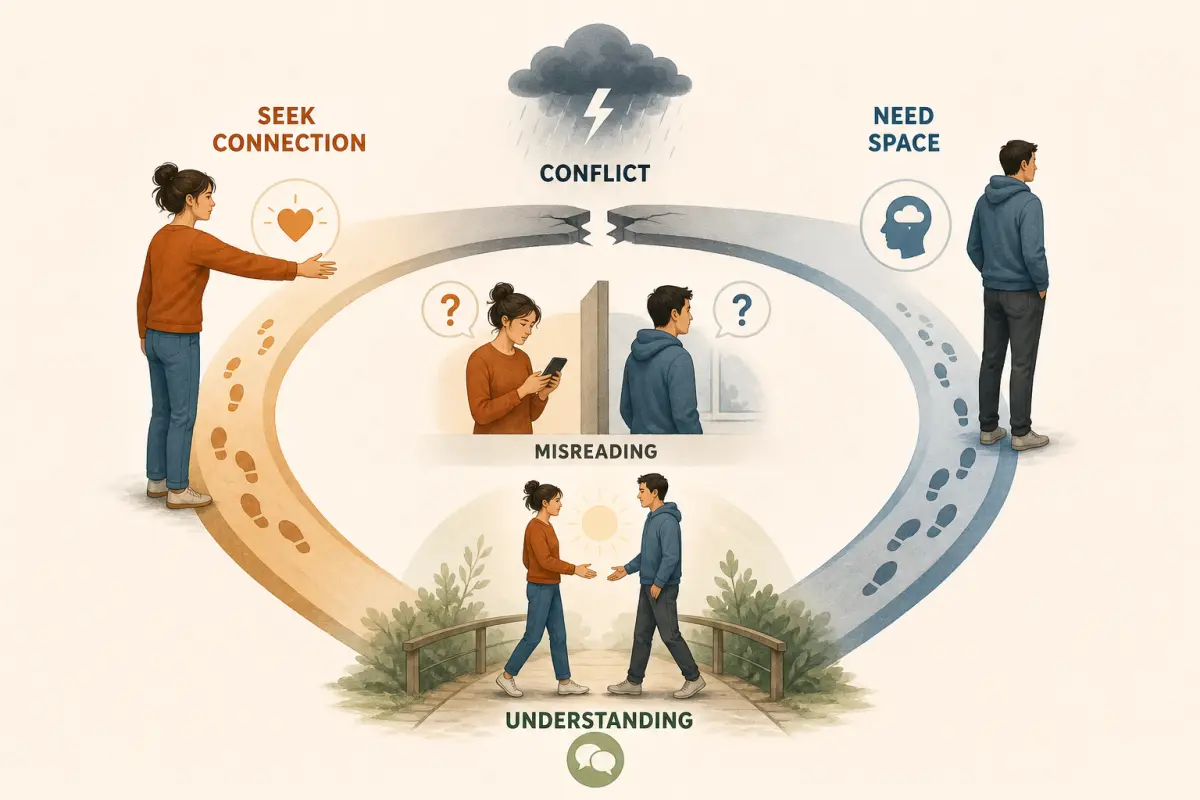
After a disagreement, partners often assume that the other person’s timing has the same meaning it would have for them. If one person wants to talk immediately, they may see distance as indifference. If one person needs quiet, they may experience repeated attempts to reconnect as pressure. Much of this misunderstanding comes from different ways of regulating closeness after stress.
Attachment does not create a fixed personality type, and it should not be used as a label to reduce someone to a category. Still, many people recognize familiar patterns in how they respond when connection feels threatened. These patterns may show up as reaching, retreating, freezing, explaining, apologizing quickly, becoming analytical, or acting as if nothing happened.
Some partners return to connection quickly because separation feels emotionally risky. They may want reassurance before they can think clearly. Others return more slowly because closeness during tension feels overwhelming. They may need space before they can speak kindly. Neither speed is automatically more mature. The important question is whether the speed includes respect for both people’s emotional reality.
| Post-conflict tendency | What it may feel like inside | How it may look to a partner | What helps repair |
|---|---|---|---|
| Wanting to talk immediately | “I cannot settle until I know we are okay.” | Demanding, intense, unable to let things breathe | Agreeing on a specific time to return to the conversation, rather than insisting on resolution now |
| Needing distance before talking | “I need quiet so I do not say something worse.” | Cold, dismissive, uninterested | Offering reassurance that space is temporary and the relationship still matters |
| Explaining repeatedly | “If you understand my intention, you will stop being hurt.” | Defensive, unwilling to acknowledge impact | Pausing the explanation and naming the other person’s experience first |
| Apologizing quickly | “Please let this be over; I cannot stand the disconnection.” | Insincere, rushed, conflict-avoidant | Following the apology with curiosity about what actually needs repair |
| Becoming very logical | “If we stay rational, this will not get out of control.” | Detached, superior, emotionally unavailable | Combining facts with emotional acknowledgment |
| Acting normal too soon | “If we move on, maybe we can feel okay again.” | Avoidant, minimizing, unwilling to revisit pain | Checking whether the other person also feels ready to resume normal contact |
It can be helpful to understand your own conflict response patterns because the way you try to restore connection may be shaped by what you learned to expect during emotional tension. Awareness does not excuse hurtful behavior, but it can make behavior easier to change.
The urge to repair everything immediately
For some people, the period after conflict feels almost physically uncomfortable. A partner’s quiet tone, delayed reply, or lack of eye contact can feel like a signal that the relationship is in danger. The mind may start scanning: Are they leaving? Are they angry? Did I ruin everything? How do I fix this now?
This urgency often leads to repair attempts that are understandable but not always effective. A person may apologize repeatedly, ask for reassurance many times, continue the conversation after the other person has asked for a pause, or try to solve every layer of the problem in one sitting. The intention is usually closeness. The impact may be pressure.
The urge to repair immediately can be softened without ignoring it. The goal is not to shame the need for reassurance, but to make it more workable.
What immediate repair seekers can practice
- Name the need without making it a demand: “I’m feeling anxious and I want to know we’ll come back to this. Can we choose a time?”
- Separate reassurance from resolution: You may need to hear “I still care about us” before either of you is ready to solve the issue.
- Notice protest behavior: Repeated texting, following a partner from room to room, or escalating the emotional volume may create more distance.
- Use a temporary self-soothing plan: Take a walk, breathe slowly, write down what you want to say, or contact a supportive friend without turning the partner into the villain.
- Ask for a bridge: A bridge is a small statement of continuity, such as “I need an hour, but I’m not leaving the conversation.”
When someone feels anxious after conflict, the body may treat uncertainty as danger. This is why simple reassurance can be powerful. It does not solve the entire issue, but it can reduce the panic that makes a thoughtful conversation harder.
Why some partners need distance before reconnecting
Some people cannot reconnect well while their body is still flooded with anger, shame, fear, or mental noise. They may need time alone before their words become careful again. This distance can be protective rather than rejecting. It may be an attempt to prevent escalation, regain perspective, or avoid saying something they will regret.
However, distance becomes confusing when it has no explanation, no time frame, and no signal of continued care. A partner who is left in silence may not experience the distance as self-regulation. They may experience it as abandonment, punishment, or emotional disappearance.
The difference between healthy space and hurtful withdrawal is often communication.
Helpful distance sounds like this
- “I am too activated to talk respectfully right now. I need thirty minutes.”
- “I care about you, and I am not ignoring this. I will come back after dinner.”
- “I want to understand you, but I need to calm down first.”
- “Please do not follow me from room to room. I am taking space so I can return more constructively.”
Hurtful distance often looks like this
- Leaving without saying whether the conversation will continue
- Using silence to make the other person feel anxious or guilty
- Refusing to acknowledge the conflict later
- Returning only when the other person acts as if nothing happened
Partners who need space can support repair by making their absence predictable. Partners who fear distance can support repair by respecting a clearly stated pause. Both skills matter. One person learns not to disappear; the other learns not to pursue past the point where conversation is still useful.
Practical distinction: A pause is not the same as avoidance. A pause includes a return plan, a basic reassurance, and an intention to continue. Avoidance leaves the issue suspended indefinitely and often requires the other person to choose between chasing, suppressing their feelings, or living with uncertainty.
After conflict, people may also experience changes in energy, appetite, focus, irritability, or emotional sensitivity. Understanding common post-conflict mood changes can help partners avoid misreading every shift as a statement about the relationship.
When apologies fail to restore emotional safety
An apology can be sincere and still not be enough. This is frustrating for the person apologizing and often lonely for the person receiving the apology. The gap usually appears when the apology addresses the visible behavior but not the emotional meaning of what happened.
For example, “I’m sorry I raised my voice” may be true, but the other person may also need to hear, “I understand that when I raised my voice, you felt intimidated and alone in the conversation.” The first sentence names the action. The second recognizes the impact.
Apologies tend to fail when they contain hidden defenses. These may include:
- “I’m sorry, but you were also being difficult.”
- “I already apologized; why are you still upset?”
- “I’m sorry you feel that way.”
- “I didn’t mean it like that, so you shouldn’t take it that way.”
- “Fine, I’m sorry. Can we move on now?”
These statements may be attempts to end discomfort, but they often leave the injured partner feeling unseen. Emotional safety is restored less by the word “sorry” and more by the experience of being understood, taken seriously, and protected from a repeat of the same harm.
Elements of an apology that supports repair
- Specific behavior: “I interrupted you and dismissed your point.”
- Impact: “I can see how that made you feel unimportant.”
- Ownership: “That was mine to manage, even though I was frustrated.”
- Curiosity: “Is there another part I have not understood yet?”
- Change: “Next time I will ask for a pause instead of talking over you.”
There is also a difference between forgiveness and repair. Forgiveness is an internal process that cannot be forced. Repair is a relational process that requires trustworthy behavior over time. A partner may accept an apology and still need time before their body and emotions catch up.
If conflict includes intimidation, threats, coercive control, physical aggression, sexual pressure, destruction of property, stalking, or fear for personal safety, ordinary repair conversations are not the priority. In those situations, safety, support, and appropriate professional or community resources matter more than improving communication. No one is obligated to repair a relationship in conditions where they are being harmed or controlled.
Repair attempts that accidentally restart the argument
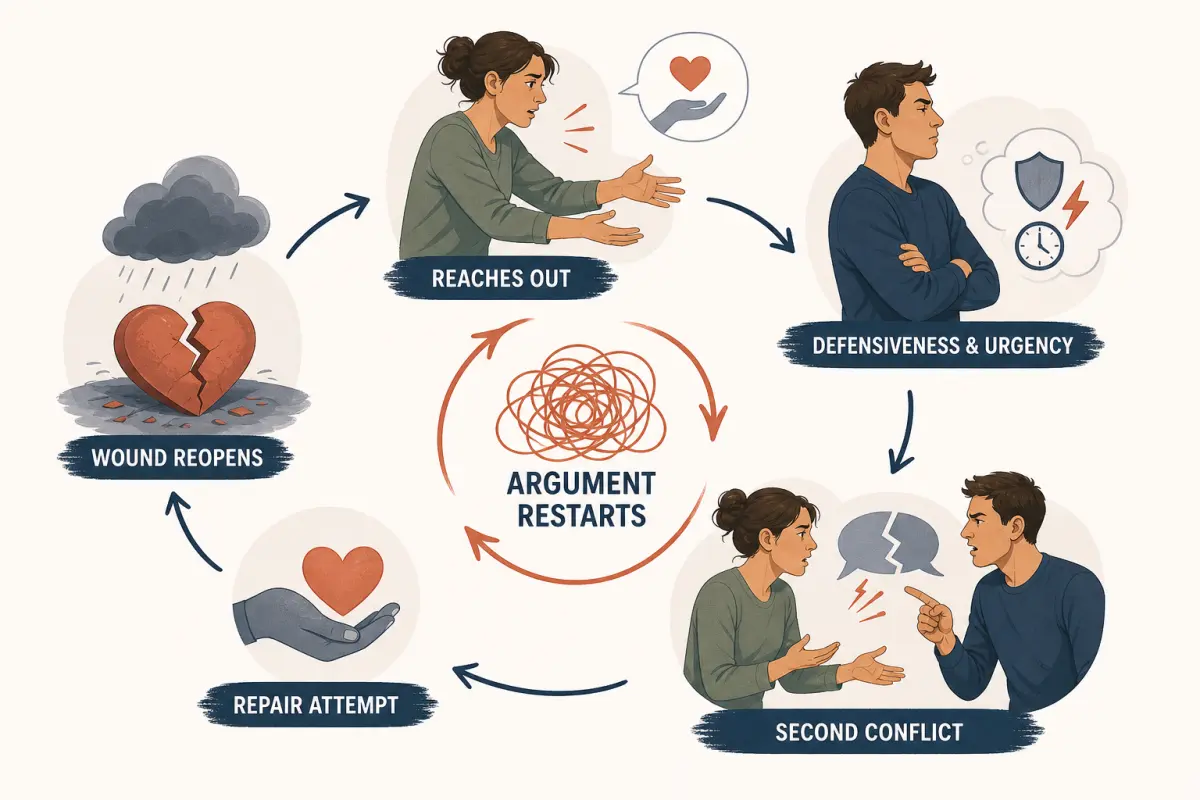
Many couples do try to repair, but the repair attempt reopens the wound. This often happens when one person reaches for connection while still carrying defensiveness, urgency, sarcasm, or a need to be declared innocent. The result is a second conflict about the first conflict.
Common repair attempts that backfire include:
- Explaining too soon: “That’s not what I meant” may be true, but if it comes before acknowledgment, it can sound like correction rather than care.
- Using affection to skip the issue: A hug, joke, or affectionate gesture may feel dismissive if the other person still needs words.
- Over-apologizing: Repeated apologies can shift attention from the injured person’s experience to the apologizer’s distress.
- Demanding reassurance: “Tell me we’re okay” may feel impossible if the other person is still hurt.
- Reopening with accusation: “Are you finally ready to talk?” can restart the power struggle immediately.
- Collecting evidence: Returning with a list of past examples may overwhelm the conversation before repair begins.
A useful repair attempt usually has a soft entry point. It does not require the other person to instantly agree, forgive, or comfort. It simply opens a door.
Instead of restarting the argument, try a repair bridge
- “I have been thinking about what happened, and I want to understand your side better.”
- “I can see I came in defensively earlier. Can I try again?”
- “I do want to explain my intention, but first I want to acknowledge the impact.”
- “I care about us more than winning this point.”
- “Would now be a good time to revisit this, or should we choose a time later today?”
These statements work because they reduce threat. They signal that the conversation is not simply another attempt to win. They also give the other person some choice, which is essential when conflict has made someone feel cornered or unheard.
How to reopen a difficult conversation constructively
Reopening a hard conversation requires more than courage. It requires timing, tone, and a structure that helps both people stay oriented. Without structure, couples often fall back into the same loop: one pursues, one withdraws; one explains, one protests; one minimizes, one intensifies.
Good repair conversations usually begin with a narrow focus. Instead of trying to resolve the entire relationship history, choose the specific moment or pattern that needs attention. A focused conversation is more likely to end with clarity rather than exhaustion.
A simple structure for reopening
- Ask for consent: “Is this a good time to talk about what happened last night?”
- State your intention: “I want us to understand each other, not start the argument again.”
- Begin with ownership: “I can see that my tone made things worse.”
- Describe rather than accuse: “When the conversation shifted to money, I felt scared and became defensive.”
- Invite the other person’s experience: “What was that moment like for you?”
- Reflect before responding: “So you felt I had already made up my mind. Is that right?”
- Identify one next step: “Next time, let’s pause before either of us raises our voice.”
Using clear relationship communication is especially important after conflict because emotional ambiguity often gets filled with fear, assumptions, or old protective habits.
Conversation tool: Try separating three layers: what happened, what it meant to each person, and what should change next time. Couples often argue because they are speaking from different layers. One person is debating facts while the other is describing emotional impact. Naming the layer can prevent unnecessary confusion.
Questions that help the conversation stay constructive
- “What did you most need from me in that moment?”
- “What did I misunderstand?”
- “Which part felt the most hurtful?”
- “What would help you feel safer if this topic comes up again?”
- “Is there something I am asking from you that feels difficult or unfair?”
Constructive reopening does not guarantee immediate agreement. Its purpose is to create a conversation where disagreement does not require emotional injury.
Creating a shared repair process as a couple
Couples often rely on instinct after conflict. One partner reaches out; the other retreats. One wants to talk; the other wants normality. One apologizes; the other still feels unsettled. Without a shared process, each person may interpret the other’s coping style as a lack of love.
A shared repair process gives the relationship a predictable pathway back to connection. It does not need to be formal or complicated. It simply answers: What do we do after we hurt each other, misunderstand each other, or get emotionally overwhelmed?
What a shared repair plan can include
| Repair agreement | Why it helps | Example wording |
|---|---|---|
| Permission to pause | Prevents conversations from continuing when one or both people are too activated to be respectful | “Either of us can ask for a pause, but we must say when we will return.” |
| A return time | Reduces anxiety for the person who fears being left with unresolved tension | “Let’s take forty minutes and talk again at 7:30.” |
| A reassurance phrase | Protects connection while allowing space | “I am upset, but I am still here and I want us to work through it.” |
| No problem-solving while flooded | Recognizes that intense emotional states often reduce listening and increase defensiveness | “If either of us is yelling, shutting down, or panicking, we slow down first.” |
| One topic at a time | Keeps repair from turning into a review of every unresolved issue | “Tonight we are only talking about what happened during the phone call.” |
| Impact before intention | Helps the hurt partner feel seen before explanations begin | “I will listen to how it affected you before I explain what I meant.” |
| A closing ritual | Signals that the relationship is returning to safety, even if the issue is not perfectly solved | “When we finish, we check whether we need space, affection, or ordinary time together.” |
These agreements are most useful when created during a calm period, not in the middle of a fight. When both partners are regulated, they can speak more generously about what they need and what they find difficult.
It may also help to talk about long-term attachment patterns as recurring relational habits rather than permanent traits. This keeps the conversation focused on changeable behavior instead of blame.
Questions for building your own repair process
- How do each of us usually act when we feel hurt or threatened?
- What kind of pause feels respectful rather than abandoning?
- What kind of reassurance feels comforting rather than forced?
- What words or behaviors make conflict worse for each of us?
- How do we want to signal that we are ready to reconnect?
- What should we do if one of us is ready to talk and the other is not?
A shared repair process does not remove emotional discomfort, but it reduces uncertainty. Over time, predictability itself can become soothing.
Signs that conflict repair is becoming more secure
Secure repair is not measured by never arguing. It is measured by what happens during and after disagreement. A couple may still have tense conversations, misunderstandings, and emotional reactions, yet the overall pattern becomes less frightening and less damaging.
One of the clearest signs of progress is that both partners begin to trust the return. They may not enjoy conflict, but they no longer experience every rupture as a possible ending. The relationship develops a felt sense of continuity: We can be upset and still come back.
Signs of more secure repair
- Pauses are respected: Space is used to calm down, not to punish or disappear.
- Reassurance becomes easier: Partners can say “I still care” even while disagreeing.
- Apologies become more specific: They name behavior, impact, and intended change.
- Defensiveness softens sooner: Each person can notice when they are protecting themselves instead of listening.
- Arguments become less global: A disagreement about one issue does not become a verdict on the whole relationship.
- Repair attempts are recognized: A softened tone, a sincere question, or a request to try again is noticed and accepted more often.
- Both people can influence the process: Repair is not controlled by only the louder, more anxious, or more avoidant partner.
- Trust grows through follow-through: Promises made during repair begin to show up in later behavior.
More secure repair also changes the emotional memory of the relationship. Instead of accumulating evidence that conflict is dangerous, partners begin accumulating evidence that conflict can lead to understanding. This is closely connected to building relationship trust, because trust grows not only through affection but also through repeated experiences of being handled with care after tension.
Frequently asked questions
Can attachment style explain why my partner refuses to talk after conflict?
Attachment patterns may help explain why someone seeks distance when emotions run high, but they do not automatically justify refusal to communicate. A respectful pause includes some reassurance and a plan to return. Repeatedly shutting down every difficult topic without repair can leave the other partner carrying unresolved hurt.
Is it unhealthy to want reassurance after an argument?
No. Wanting reassurance is a normal human response when connection feels uncertain. The important part is how reassurance is requested. “Can you tell me we are still going to work through this?” is different from demanding immediate comfort from someone who is also upset and overwhelmed.
How long should a pause after conflict last?
There is no universal rule. A useful pause is long enough for both people to become more regulated, but not so vague that it creates unnecessary anxiety. For many everyday conflicts, naming a return time within the same day can be helpful. Bigger or more painful issues may need several conversations, but avoidance should not be disguised as “needing time.”
What if one partner always apologizes first?
If one person always initiates repair, the relationship can become imbalanced. The frequent apologizer may become resentful or overly responsible, while the other partner may miss chances to develop accountability. It can help to discuss repair when calm and ask, “How can we both take responsibility for coming back together?”
Why do I feel worse after my partner apologizes?
You may feel worse if the apology seems rushed, defensive, vague, or focused on ending the conversation rather than understanding you. Sometimes an apology also brings up the full impact of what happened. Feeling unsettled does not necessarily mean you are rejecting repair; it may mean your emotions need more acknowledgment and time.
Can affection repair conflict without talking?
Sometimes affection helps, especially after minor tension where both people already understand what happened. But affection alone can feel dismissive when the hurt is deeper or the pattern is repeated. Many couples need both: some form of emotional acknowledgment and some form of warm reconnection.
What if every repair conversation turns into another fight?
This usually means the repair process needs more structure. Try slowing down, choosing one topic, beginning with ownership, and taking pauses before either person becomes overwhelmed. If conversations repeatedly become hostile, frightening, or impossible to manage, outside support may be important.
Does secure repair mean we resolve everything before going to sleep?
Not necessarily. Some couples benefit from resolving small issues before bed, while others become more reactive when tired. Secure repair means you do not use sleep, silence, or distance to avoid accountability. A simple phrase such as “I love you, I’m still upset, and I want to talk tomorrow” can preserve connection without forcing a late-night resolution.